What Is an AI SRE? A Guide for Enterprise Teams
How AI SREs work, how much autonomy to give them for each use case, and the guardrails enterprises need.

What is an AI SRE?
An AI SRE is an AI agent that does the operational work of site reliability engineering: it triages alerts, investigates incidents, names the root cause with evidence, and fixes problems within guardrails your team sets.
It’s an agent, not a copilot. A copilot answers when an engineer asks. An AI SRE starts when the alert fires, decides what to investigate, and hands on-call a root cause instead of a question.
Every AI SRE promises faster firefighting. For an enterprise, the harder question is how much the agent may do on its own, and what stops it when it’s wrong.
Why do teams need an AI SRE now?
AI is writing more of the change, and causing more of the breakage. DORA’s 2026 research links AI adoption to rising delivery instability. Our State of Reliability 2026 found incidents disclosed by AI model and application companies rose from 1.7% of the total in 2023 to 10.7% in 2026.
Downtime is expensive and root cause is elusive. Unplanned downtime costs the Global 2000 $600 billion a year, and only 38% of technology executives consistently find the root cause (Splunk, 2026).
Headcount doesn’t scale with services. Alerts grow with every cluster and region. The on-call rotation doesn’t.
What does an AI SRE do?
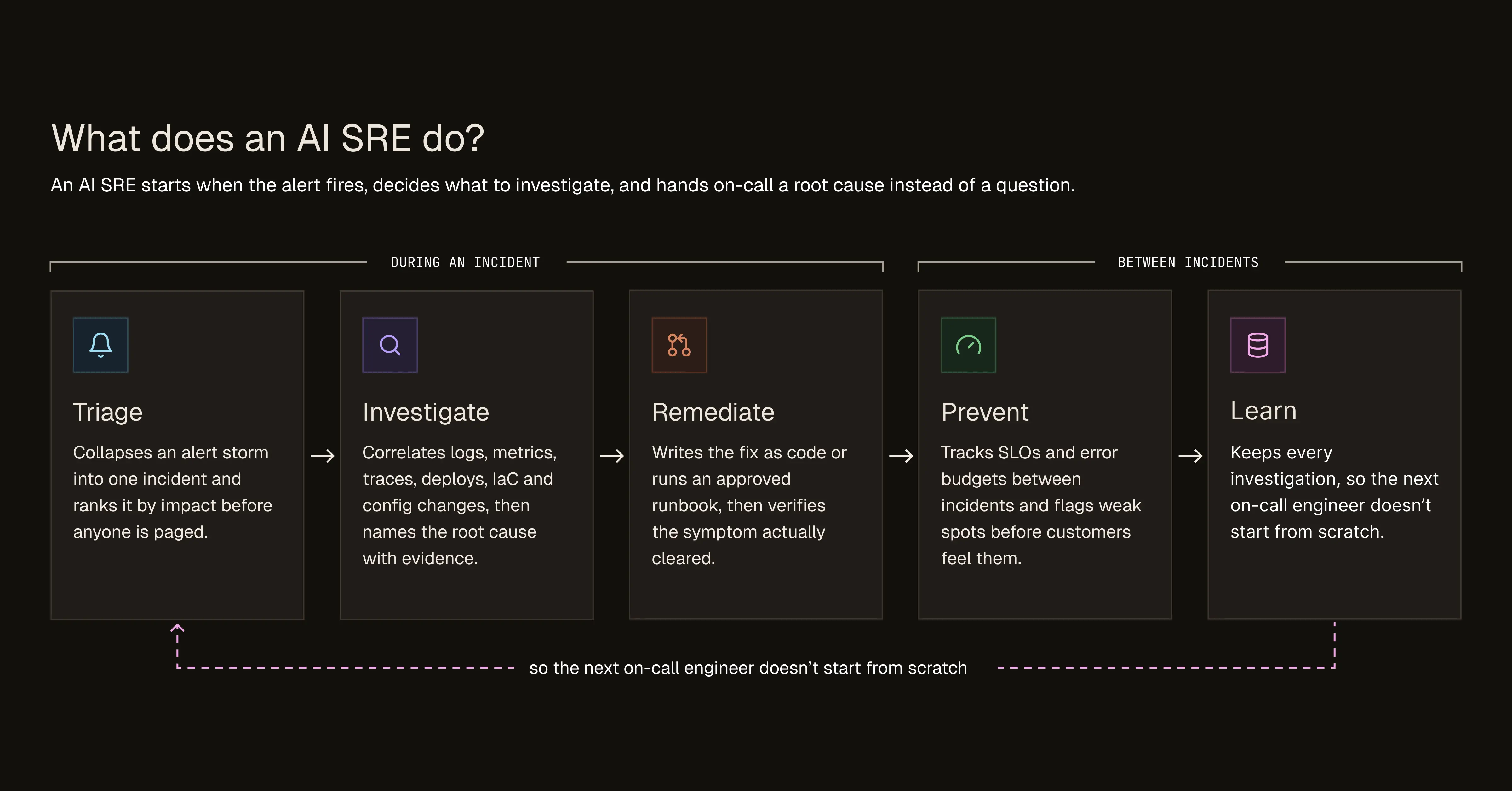
- Triage. Collapses an alert storm into one incident and ranks it by impact before anyone is paged.
- Investigate. Correlates logs, metrics, traces, deploys, IaC and config changes, then names the root cause with evidence.
- Remediate. Writes the fix as code or runs an approved runbook, then verifies the symptom actually cleared.
- Prevent. Tracks SLOs and error budgets between incidents and flags weak spots before customers feel them.
- Learn. Keeps every investigation, so the next on-call engineer doesn’t start from scratch.
Autonomy is the real question
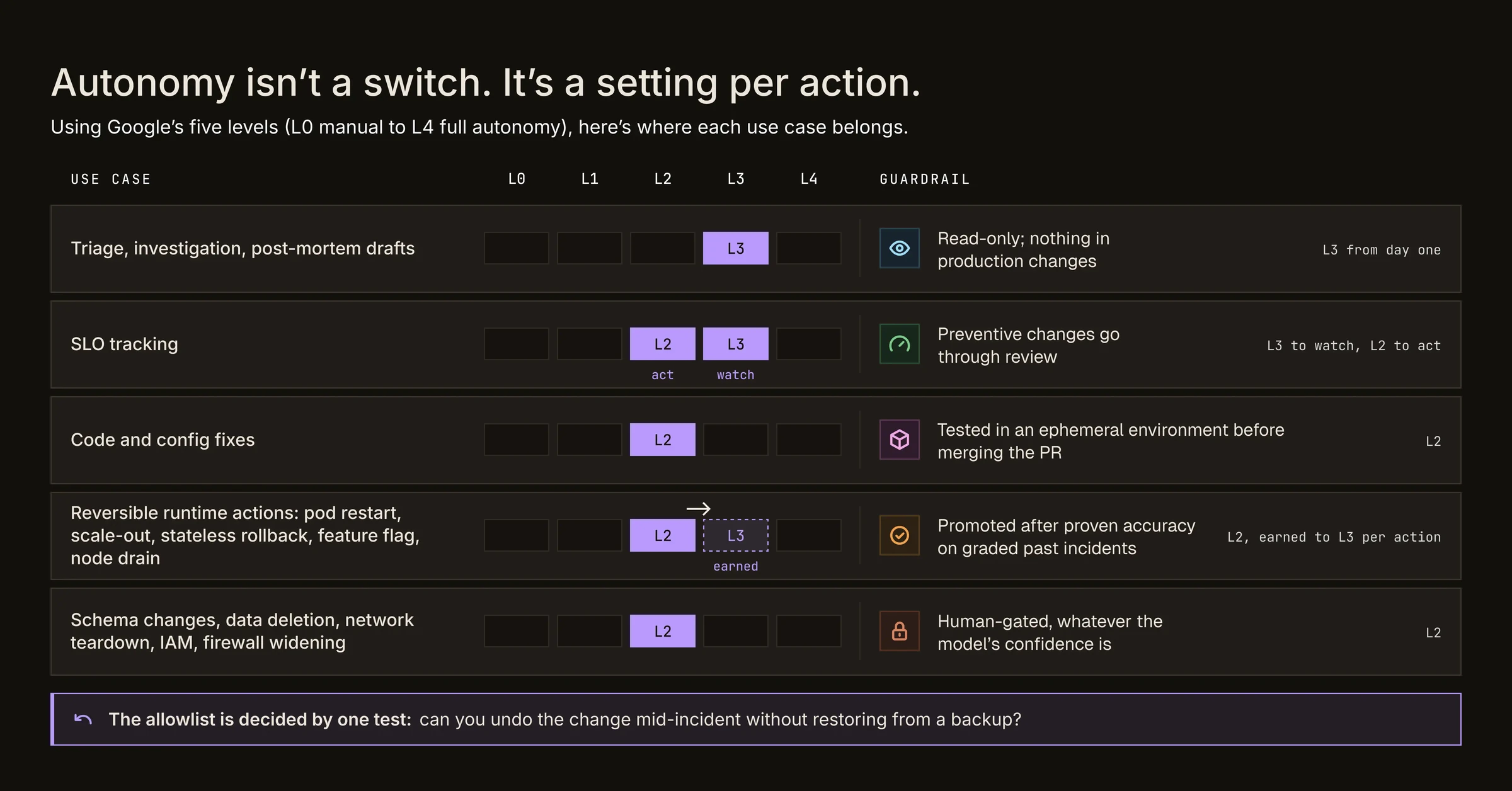
Autonomy isn’t a switch. It’s a setting per action. Reading logs is harmless; dropping a table is not. Using Google’s five levels (L0 manual to L4 full autonomy), here’s where each use case belongs:
- Triage, investigation, post-mortem drafts: L3 from day one. Read-only; nothing in production changes.
- SLO tracking: L3 to watch, L2 to act. Preventive changes go through review.
- Code and config fixes: L2. Tested in an ephemeral environment; a human merges the PR.
- Reversible runtime actions (pod restart, scale-out, stateless rollback, feature flag, node drain): L2, earned to L3 per action. Promoted only after proven accuracy on graded past incidents.
- Schema changes, data deletion, network teardown, IAM, firewall widening: Always L2. Human-gated, whatever the model’s confidence.
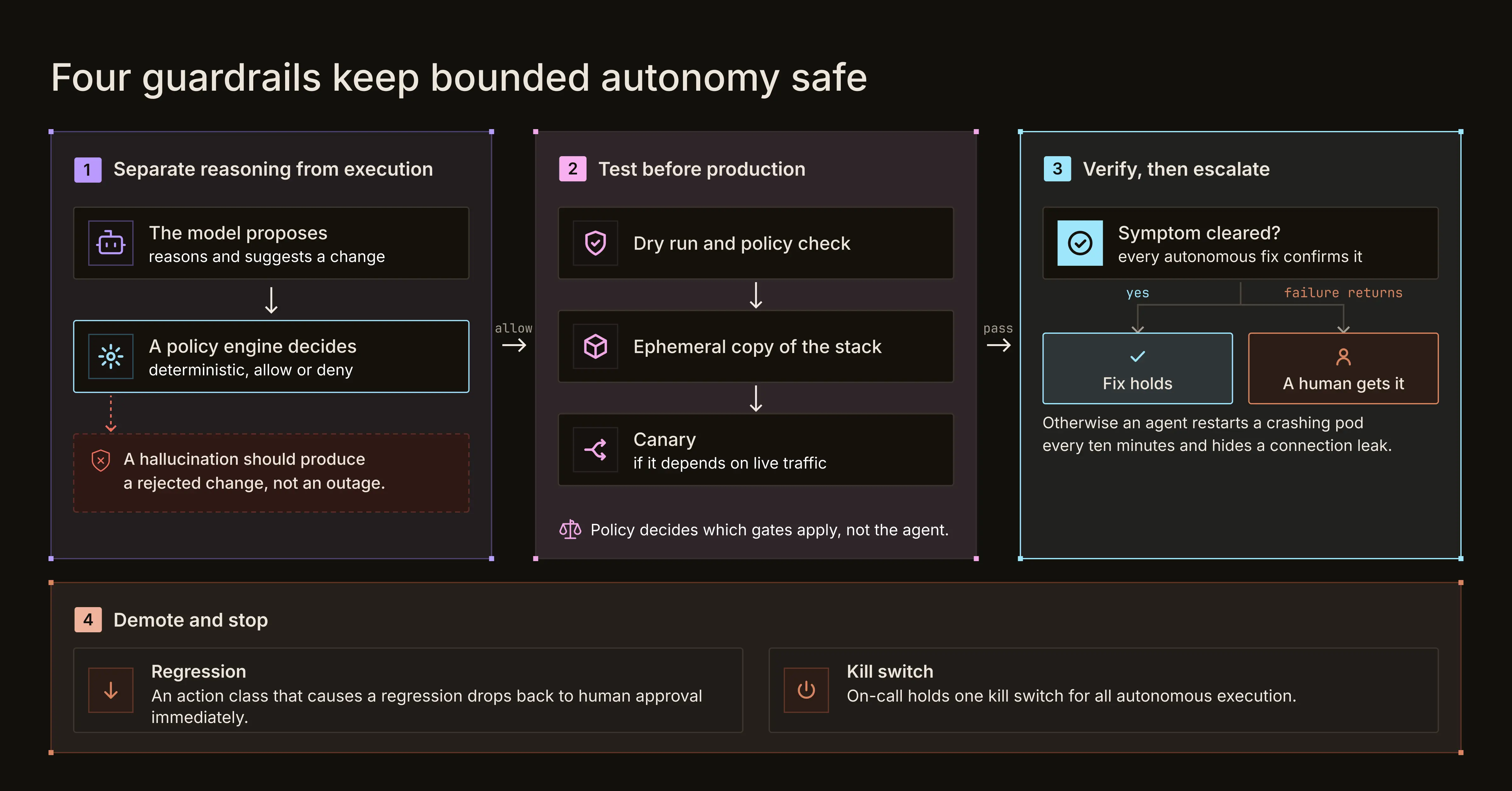
The allowlist is decided by one test: can you undo the change mid-incident without restoring from a backup? Then four guardrails keep bounded autonomy safe:
- Separate reasoning from execution. The model proposes; a deterministic policy engine decides. A hallucination should produce a rejected change, not an outage.
- Test before production. A fix clears a dry run and policy check, then an ephemeral copy of the stack, then a canary if it depends on live traffic. Policy decides which gates apply, not the agent.
- Verify, then escalate. Every autonomous fix confirms the symptom cleared. If the failure returns, a human gets it. Otherwise an agent restarts a crashing pod every ten minutes and hides a connection leak.
- Demote and stop. An action class that causes a regression drops back to human approval immediately, and on-call holds one kill switch for all autonomous execution.
Aiden for SRE: the AI SRE for the enterprise
Aiden for SRE is built on those guardrails. Policies set what Aiden may do alone and what needs approval, per action type. Every step is logged and replayable. Remote Runners keep your data inside your own network. Beyond the guardrails, four things set it apart.
Prevention, not just firefighting. You set SLOs and Aiden manages to them. Between incidents it tracks error budgets so you fix weak spots before they become outages.
Accuracy from the Aiden World Model. Aiden sees a live context graph of services, dependencies, deploys, config changes, drift and past incidents. It weighs likely causes side by side and names the root cause with evidence and a confidence score.
Fixes tested before they ship. Aiden writes the fix as code and tests it in an ephemeral environment, spun up by StackGen’s Shipyard engine. Aiden for DevOps then verifies the deployment against live system state.
Speed and cost that scale. Scoped context from the World Model and our purpose-built agent harness mean fewer, faster model calls. That keeps latency low and makes it affordable to run Aiden on every incident.
Aiden works with Grafana, Datadog, Dynatrace, PagerDuty, ServiceNow, Slack, Microsoft Teams and more, and it follows incidents across AWS, Azure, Google Cloud, Oracle Cloud and on-premises systems.
In production: Aiden cut root-cause time on StackGen’s own on-call rotation by 80%, to under two minutes. greytHR cut its average time to resolve incidents by 50%.
Learn how Aiden for SRE is shaping AI SRE-driven operations at Corcentric.
“At OneTrust, our engineering organization has rapidly become AI-native. We already see AI agents accelerate the time it takes for ideas to become customer value. Today, StackGen delivers real value for us by automating observability and incident response. Looking ahead, we are increasingly automating the rest of the operations life cycle – building what we think of as an operations factory run with autonomous agents. As a leader in AI governance, we see this shift not just at OneTrust but across the market, and we know success will depend on strong guardrails, accountability, and trust. That’s why StackGen’s vision of combining automation with governance is so compelling.” — DV Lamba, Chief Product and Technology Officer, OneTrust
Aiden for SRE is available in Microsoft Marketplace and AWS Marketplace.
How to evaluate an AI SRE
Replay five resolved incidents from last quarter and ask:
- Is autonomy set per action, with a kill switch? “Human in the loop” on everything won’t scale. Autonomy on everything won’t pass your change board.
- Who decides a change is safe: the model or a policy engine? If it’s the model, walk away.
- Are fixes tested before production? Ask to see the dry run, the ephemeral environment and the canary.
- Does it see change, or only alerts? Deploys, IaC state and drift are where most root causes live.
- Does it prevent incidents, or only respond? Ask how it uses your SLOs between incidents.
- What does it cost at your alert volume, inside your network? Price it at thousands of alerts a day, with data residency on.
See it on your own incidents
Any AI SRE can make firefighting faster. The enterprise test is whether you can trust it to act, and prove why. Aiden for SRE gives you SLO-driven prevention, tested fixes and autonomy you widen one action at a time.
Book a demo and watch Aiden investigate your incidents.