

Share This:
TL;DR
- Enterprise AI SRE starts with deployment architecture. Multi-cloud, flexible deployment, and built-in governance are non-negotiable.
- Aiden for SRE works with your existing tools to accelerate investigations and preserve operational knowledge. The goal is a consistent operational experience across your entire production environment.
Introduction
Enterprise infrastructure has evolved over the years of technology choices, acquisitions, regulatory requirements, and cloud adoption. Most organizations today operate across multiple cloud providers, Kubernetes platforms, and observability systems rather than a single environment.
The challenge is that most enterprises do not operate in a single cloud. They run their workloads across AWS, Azure, GCP, OCI, and other clouds. They operate Kubernetes clusters across multiple cloud providers. They have different observability platforms, security and governance controls, identity providers, and operational workflows.
In such setups, the problem is not how well an AI agent understands one cloud; it is whether the solution that is deployed can operate consistently across the operational environment into which it is deployed.
When considering an AI SRE platform, the conversation should start with the deployment architecture.
- Can this platform run in our environment?
- Can it integrate with the systems we already use?
- Can it operate within our security and governance boundaries?
- Can it fit into existing operational workflows rather than replacing them?
Those questions determine whether the platform is even in scope for the organization before evaluating the AI capabilities themselves.
What to Look for in an Enterprise AI SRE Platform
1. Multi-cloud coverage
One of the first capabilities teams evaluate in AI SRE software is multi-cloud support. An agent built primarily for one cloud and later extended support to others behaves differently from one designed as cloud agnostic from the first place.
Aiden for SRE is cloud-agnostic, with AWS, Azure, and GCP all available as GA integrations and governed consistently.
An agent architected around one cloud, with others added later, often introduces differences in integrations, permissions, operational workflows, and investigation capabilities. A platform designed for multi-cloud from the beginning provides a consistent operational experience regardless of where workloads are running.
For enterprises managing infra across multiple providers, consistency matters more than depth in a single environment.
An application running on Kubernetes may depend on AWS networking, Azure Active Directory for authentication, Prometheus for metrics, Grafana for dashboards, and a ServiceNow workflow for change management.
The investigation should remain consistent even when the underlying infrastructure does not. That consistency becomes increasingly valuable as enterprise environments continue to grow.
2. Deployment Flexibility
For many enterprises, especially those operating in regulated industries, deployment architecture is a non-negotiable requirement.
Different organizations have different deployment requirements. Some are comfortable using a fully managed SaaS platform. Others require the platform to operate entirely inside their own cloud.
Highly regulated industries can require complete deployment isolation.
Aiden for SRE supports three deployment models:
- Fully Managed Cloud
- Private SaaS
- Self-hosted
Regardless of the deployment model, organizations retain control over where operational data resides, which AI models are used, and how governance policies are enforced.
With Private SaaS, Aiden runs inside your own cloud environment, whether that's EKS, AKS, GKE, or another Kubernetes platform, while StackGen manages the deployment remotely. Production data, networking boundaries, and operational control remain within your own environment.
This allows organizations to decide where operational data is processed and which AI models are used based on their own security and compliance requirements.
Organizations can also bring their own enterprise-approved LLMs or internal AI endpoints instead of relying on vendor-managed models. This allows security and AI governance teams to standardize on approved models while keeping operational workflows unchanged.
For organizations operating in very regulated or isolated environments, Aiden also supports limited-egress and air-gapped deployment models where connectivity can be restricted to only approved internal services and AI endpoints. This allows enterprises to meet strict security and compliance requirements without changing operational workflows
The deployment model should adapt to enterprise requirements rather than forcing enterprises to adapt to the platform.
3. Governance by default
One of the main concerns enterprises have around AI operations is autonomous access to production systems.
Most organizations are still not comfortable allowing an AI agent to perform production changes without visibility, approvals, and clearly defined operational boundaries.
Aiden for SRE is designed with governance as the default operational model.
As an example, Kubernetes integration is deployed with read-only permissions by default. The Remote Runner receives cluster-wide visibility using only get, list, and watch permissions.
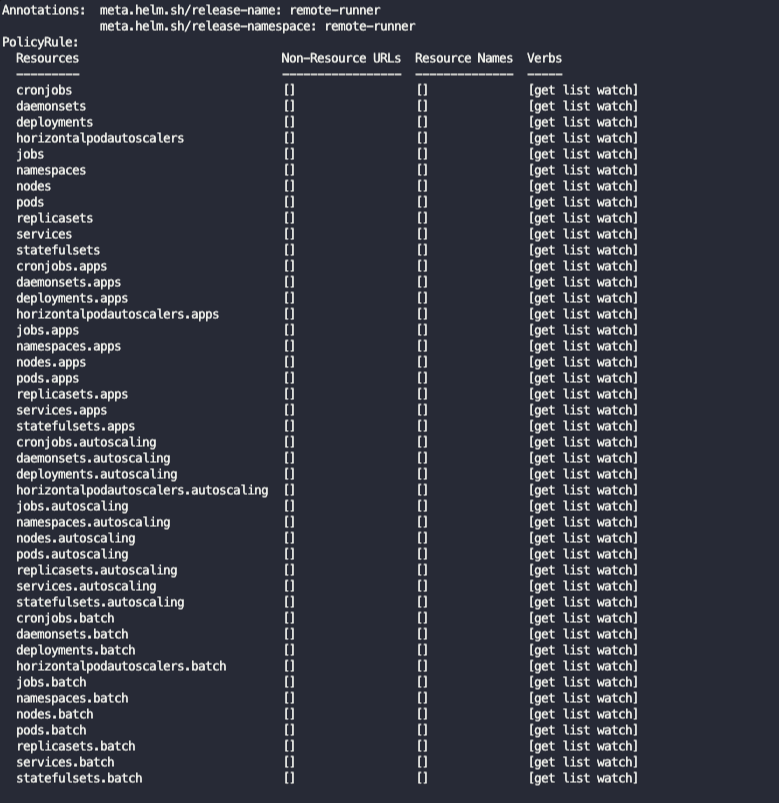
This allows Aiden to investigate Deployments, Pods, Services, Nodes, Events, Jobs, and other Kubernetes resources without modifying production workloads.
Operations such as deleting Pods, scaling Deployments, updating ConfigMaps or modifying Secrets require explicit write permissions to be granted by an administrator.
Beyond infrastructure permissions, organizations can have human approvals set up throughout an operational workflow. Human-in-the-loop (HITL) approval gates can be inserted at investigation, remediation, or notification stages, allowing enterprises to decide which actions can execute autonomously and which require an operator's approval. This enables organizations to progressively adopt automation while keeping production-risk actions under human control.
Meaning, the platform starts with least privilege and expands only through intentional configuration.
Automation can also be configured based on operational risk. Low-risk actions can execute automatically, medium-risk actions can notify operators, while production-impacting actions can require explicit approval. This allows different environments, such as development, staging, and production, to operate with different governance policies.
The same philosophy applies across cloud integrations.
Access is granted based on the operational capability required rather than broad administrative permissions. Organizations can onboard production environments for investigation immediately while gradually enabling automation where it makes operational sense.
Governance extends beyond infrastructure permissions. Most enterprises already operate with:
- RBAC policies
- Approval workflows
- Enterprise identity providers such as Azure AD or Okta
- Audit requirements
- ITSM platforms such as ServiceNow
An AI SRE platform should operate within those existing governance controls rather than introducing a parallel operational model. That allows teams to adopt AI into existing production processes without changing how governance already works.
4. Observability that brings signals together
Enterprises often pay for multiple observability platforms while still finding a way to correlate signals during incidents.
- Metrics live in one tool
- Logs live in another
- Traces live somewhere
Infrastructure teams may use Prometheus and Grafana. Application teams may use Datadog or New Relic. Cloud teams rely on CloudWatch, Azure Monitor, or Google Cloud Operations.
During an incident, engineers spend as much time navigating between these tools as they do investigating the issue itself.
For AI-powered incident response, bringing metrics, logs, traces, alerts, and cloud telemetry into a single investigation is more valuable than replacing the observability tools you already use. Aiden integrates with your existing observability stack rather than requiring a complete replacement.
This allows Aiden to correlate metrics, logs, traces, alerts, and cloud telemetry into a single investigation workflow.
For example, consider an application reporting increased API latency. Instead of only identifying that latency has increased, Aiden can correlate:
- Prometheus metrics showing elevated CPU usage.
- Kubernetes Events indicating recent Pod restarts.
- Loki or CloudWatch logs showing repeated connection timeouts.
- Jaeger traces identifying the downstream dependency.
- Deployment history showing a recent production rollout.
Rather than asking engineers to switch between dashboards manually, the investigation combines those signals into a single context.
The result is not another observability platform. The result is faster investigations using the observability platforms enterprises already own.
5. Time to first value
One of the biggest challenges with AI operations platforms is the amount of manual configuration required before teams see meaningful results.
Aiden reduces that effort through an automated discovery process during onboarding.
Instead of spending weeks configuring AI automation, teams can begin from the operational knowledge that already exists inside their environment.
For example, during onboarding, Aiden can discover:
- Kubernetes clusters
- Cloud accounts
- Existing dashboards
- Cloud resources
Based on that discovery, Aiden automatically generates operational Tasks and builds a knowledge base.
Newly generated Tasks remain disabled by default. Teams can review them, modify them if required, and explicitly enable them before execution.
This allows organizations to begin investigations immediately while still maintaining governance over operational automation.
Rather than spending weeks configuring an AI platform, teams can begin from the operational knowledge that already exists inside their environment.
6. RCA audit trail
In AI incident management, every investigation should improve the next one. Yet valuable operational knowledge is often lost once an incident is resolved.
When another engineer investigates the same issue six months later, they often begin from scratch.
Postmortems require teams to manually reconstruct what happened, and Audit teams request historical investigations. Operational knowledge slowly disappears into Slack threads, documents, and ticketing systems.
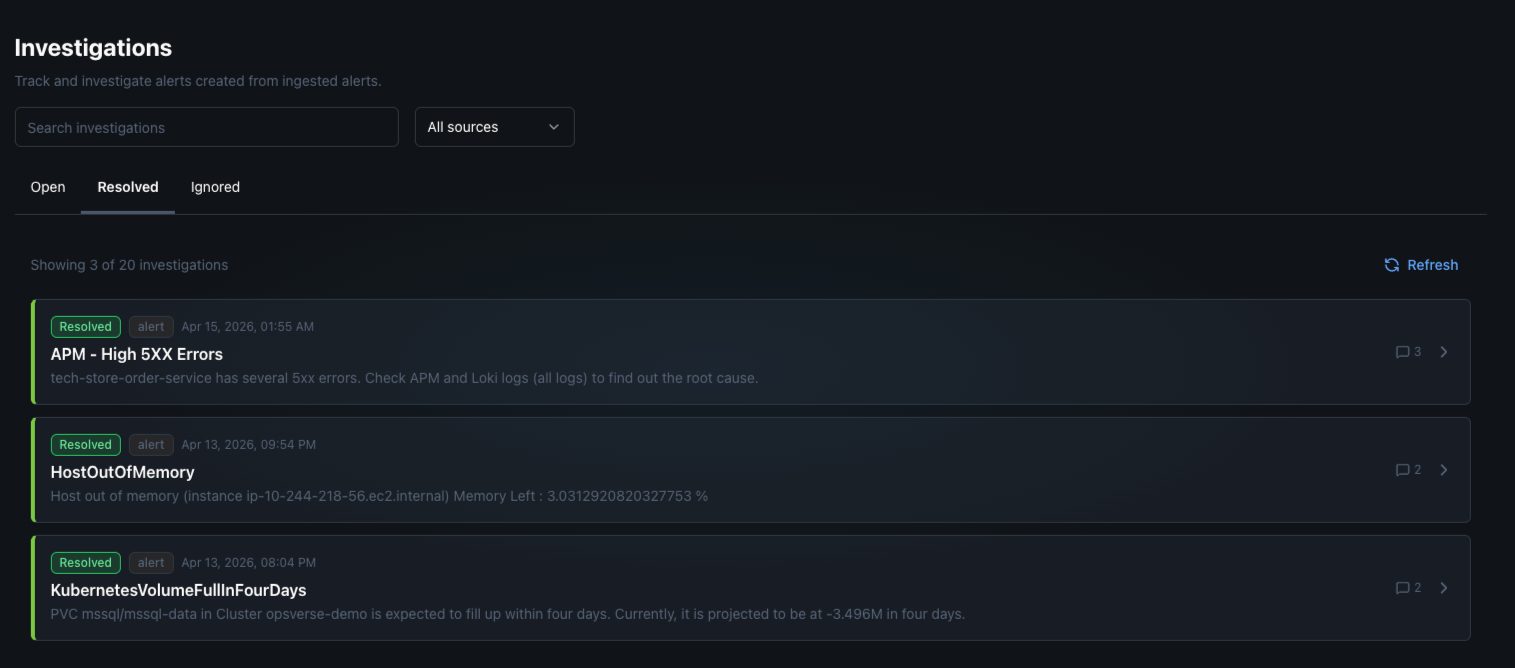
Aiden automatically stores investigation history as structured operational knowledge. Investigations become searchable and reusable.
For example, if a production database connection issue occurs again several months later, engineers can retrieve the previous investigation, understand which remediation steps were successful, and continue the investigation without repeating the same work.
This allows operational knowledge to improve over time rather than being recreated after every incident.
The investigation itself becomes part of the operational audit trail. Every investigation maintains a history, evidence collected, reasoning steps, tool executions, and remediation actions. Teams can revisit investigations step-by-step, export records for compliance reviews, and reconstruct incident timelines without relying on Slack/Email conversations or manually assembled postmortems.
 7. Kubernetes depth
Kubernetes is no longer simply another platform. For many enterprises, it has become the primary runtime environment.
An AI agent that looks at Kubernetes as just another integration often produces shallow investigations because it relies primarily on monitoring signals rather than the live state of the cluster.
Aiden connects directly to Kubernetes clusters through a Remote Runner.
This enables Kubernetes incident response by allowing engineers to investigate the live state of production clusters alongside observability signals.
For example:
Show me all production Pods that have restarted more than five times in the last hour and are still receiving traffic.
The investigation does not stop at listing Pods.
Aiden can continue investigating:
- Why are these Pods restarting?
- Did a deployment happen recently?
- Are the replacements healthy?
- Are there correlated Kubernetes Events?
- Are application logs reporting failures?
- Is the issue isolated to one cluster or occurring across multiple regions?
The answer comes from the live Kubernetes environment combined with observability signals rather than from a single monitoring dashboard.
This allows investigations to move beyond symptom detection into operational reasoning.
8. Proactive prevention
One of the long-term goals of AI SRE is to move beyond faster incident response and toward incident prevention.
Aiden includes scheduled monitoring Tasks that continuously evaluate systems and identify potential risks before they become customer-facing incidents.
Tasks such as Monitor Services for Anomalies can run proactively and surface emerging issues early.
The goal is not simply faster incident response; the goal is fewer incidents to respond to.
How to Evaluate an Enterprise AI SRE Platform
It's easy to evaluate an AI SRE platform through a demo. It's much harder to determine whether it fits the way your organization already operates.
The questions that matter usually come after deployment:
- Can it operate across multiple clouds?
- Can it satisfy governance requirements?
- Can it run inside our environment?
- Can it provide a complete audit trail?
- Can it work consistently across Kubernetes, cloud services, and observability platforms?
- Can it reuse our existing runbooks and operational knowledge?
Most enterprises have years of operational knowledge captured in runbooks, troubleshooting guides, and incident response procedures. Replacing those processes isn't practical.
With Aiden for SRE, existing runbooks can be translated into Skills and a Knowledge Base using natural language. Each workflow step can then be executed by the appropriate agent or integration, allowing teams to preserve established operational processes instead of rebuilding them.
Aiden takes an enterprise approach by delivering a consistent operational experience across AWS, Azure, GCP, Kubernetes, and the surrounding tooling that platform and SRE teams rely on every day.
For organizations operating in a multi-cloud environment, that consistency matters. The goal isn't to add another tool for another cloud. It's to establish a reliability layer that works the same way wherever your workloads run.
Book a demo or try Aiden Community Edition to see it in your own environment.