

Share This:
Introduction
If your team is re-evaluating IaC tooling right now, you're probably not doing it because you woke up one morning and felt curious. You're doing it because something broke, a renewal invoice arrived 40% higher than last year, a SOC 2 audit flagged infrastructure drift you couldn't explain, or your platform team became the bottleneck that every product squad routes tickets through.
Terraform, Pulumi, and AWS CDK all solve the same core problem: defining and provisioning cloud infrastructure as code, but they fit different teams, pressures, and cloud strategies in very different ways. Picking the wrong one doesn't just slow you down; it creates technical debt that shows up exactly when you can least afford it: during audits, scaling events, and contract renewals.
In this guide, we break down the real tradeoffs across cost, governance, developer experience, and operational fit. We also show where Aiden for Infrastructure sits on top of whichever tool you choose — turning IaC from a bottleneck into a self-service capability.
Why Teams Re-Evaluate IaC (The Real Triggers)
Understanding why teams switch IaC tools matters as much as understanding the tools themselves. Based on 105 documented adoption decisions, four triggers drive the vast majority of re-evaluations:
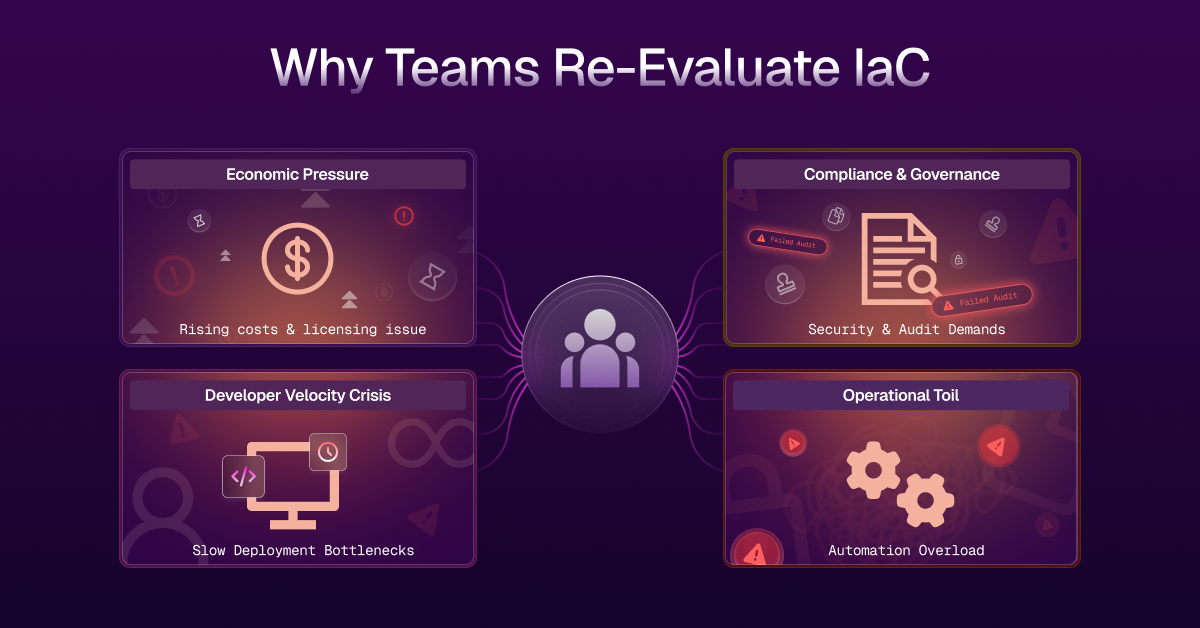
Economic Pressure (17% of decisions, 78% high urgency) — Licensing changes, per-workspace pricing, and concurrency limits are forcing teams off commercial IaC platforms faster than many anticipated. Teams report paying for workspaces that run once a month, and renewal quotes that have no relationship to actual usage growth. When the cost of your IaC platform starts to outpace its value, re-evaluation stops being a quarterly discussion and becomes an immediate one.
Compliance & Governance (14% of decisions, 87% high urgency) — This is the single highest-urgency trigger in the IaC segment. Audit deadlines don't move. Teams that failed a SOC 2 or ISO 27001 review because they couldn't prove who approved an infrastructure change six months ago or because drift existed between what was in code and what was actually deployed don't get a slow remediation window. Security teams are now mandating policy-as-code with full audit trails, and "we use Terraform" is no longer a sufficient answer.
Developer Velocity Crisis (18% of decisions) — The platform team became a bottleneck instead of an enabler. Developers wait 3–5 days for infrastructure changes because everything routes through a ticket queue or a pull request into a repo that only the platform team understands. New engineers take weeks to make their first infrastructure change.
Operational Toil (20% of decisions) — State file locking conflicts blocking deployments. Six wrapper scripts around Terraform that nobody remembers writing. An entire sprint is burned every quarter on provider version bumps and module upgrades. The automation that was supposed to reduce toil has become its own source of it.
Keep your trigger in mind as you read; it's the most important input to your tool decision.
Quick Comparison
| Dimension | Terraform | Pulumi | AWS CDK |
| Language | HCL (declarative DSL) | TypeScript, Python, Go, C#, Java | TypeScript, Python, Java, C# |
| Cloud scope | Multi-cloud, 100+ providers | Multi-cloud + SaaS, 80+ providers | AWS-only (via CloudFormation) |
| Execution model | Plan & Apply with state backend | Preview & Up via Pulumi engine | Synthesize to CloudFormation |
| Governance story | Strong (Sentinel, OPA, audit logs) | Strong (built-in policy-as-code) | Relies on AWS-native controls |
| Cost model | OSS free; Terraform Cloud/Enterprise paid | OSS free; Pulumi Cloud paid | Free (CloudFormation costs apply) |
| Best fit | Platform teams, multi-cloud, compliance-heavy | Developer-heavy app teams | AWS-first orgs, serverless/containers |
Terraform: The Multi-Cloud Standard
Terraform is built around HCL, a declarative DSL designed to describe infrastructure state. You write .tf files, run terraform plan to preview changes, then terraform apply to enact them against cloud APIs.
Where Terraform excels:
- Platform-agnostic: AWS, Azure, GCP, Kubernetes, on-prem, and 100+ providers with one consistent workflow
- Mature ecosystem: Vast module registry, strong community conventions, and the broadest hiring-market familiarity of any IaC tool
- Drift detection: The plan/apply model with state tracking surfaces drift between intended and actual infrastructure, critical for compliance environments where drift is a time bomb
- Governance-ready: Strong integrations with Sentinel and OPA for policy-as-code. When your security team mandates policy enforcement, and an auditor wants to know who approved an infrastructure change six months ago, Terraform's enterprise tooling has a credible, documented answer
Terraform is the default choice for platform and SRE teams managing shared infrastructure across multiple clouds. If your organization runs AWS in one region, Azure in another, and GCP for data workloads, Terraform gives you a single, standardized IaC toolchain with one governance model to maintain.
Where Terraform struggles:
Complex logic loops, dynamic compositions, and advanced abstractions become verbose in HCL. As teams scale, state file locking conflicts become a persistent operational pain: multiple engineers working across the same workspace hit race conditions and blocked deployments with uncomfortable regularity. Large monolithic state files require careful layout and modularization that teams often defer until it's already a problem.
For teams running Terraform Cloud, the economics deserve an honest look. Per-workspace pricing and concurrency limits made sense at a small scale; at an enterprise scale, you may be paying for workspaces that run once a month and queuing serializes deployments that should run in parallel. The BSL licensing change accelerated this scrutiny for many teams, and for some, it's the reason they're reading this article.
Choose Terraform when:
- You're multi-cloud today or expect to be within two years
- Compliance and governance are a near-term pressure auditors need policy-as-code with provable, timestamped change history
- A platform or SRE team owns shared infrastructure and needs a standard that its hires already know
- You're evaluating a move off Terraform Cloud and want to stay on HCL while reducing platform costs
Pulumi: Developer-First Universal IaC
Pulumi takes a fundamentally different approach: you define infrastructure using real programming languages: TypeScript, Python, Go, C#, Java, and get full language features, including loops, conditionals, functions, and unit tests. No DSL, no context-switching.
Where Pulumi excels:
- Language-native: Use your team's existing skills, IDEs, linters, and test frameworks, developers write infrastructure in the same language they write applications
- Reusable abstractions: Build higher-level components that behave like normal libraries, making it far easier to enforce standards across teams without a central review bottleneck for every PR
- Multi-cloud + SaaS: Works across 80+ providers, and can interoperate with AWS CDK constructs useful if you're evaluating between CDK and Pulumi
- Built-in policy and secrets: Integrated encryption for secrets across state, logs, and CLI outputs, plus policy-as-code capabilities that can replace external tools like Sentinel for many compliance requirements
For developer-heavy teams, Pulumi dramatically reduces IaC onboarding friction. A new engineer who already knows TypeScript can be writing production infrastructure within hours rather than spending weeks learning HCL conventions. Infrastructure tests run in the same CI pipeline as application tests, which means compliance gates get enforced automatically rather than requiring a platform engineer to hand-hold every change.
Where Pulumi struggles:
It's younger than Terraform, so conservative enterprises sometimes view it as less battle-tested at extreme scale. The Pulumi Service is central to many workflows, though self-hosting is possible. For ops-heavy teams with deep Terraform expertise, the transition from declarative HCL to imperative code requires genuine investment, not just a tool swap.
Choose Pulumi when:
- Your team is primarily developers using TypeScript, Python, Go, or Java, and context-switching to HCL is a real velocity cost
- You want infrastructure tests to run in the same CI pipeline as application tests
- Compliance requirements need policy-as-code, and you'd rather enforce it in code than through an external tool
- You need multi-cloud flexibility with a developer experience comparable to CDK
AWS CDK: Deep AWS Integration
AWS CDK lets you define AWS infrastructure using general-purpose languages, then synthesizes that code into CloudFormation templates. It's tightly integrated with AWS services and offers rich construct libraries that encode best practices out of the box.
Where CDK excels:
- AWS-native: First-class support and day-one alignment with new AWS service features
- High-level patterns: Rich L2/L3 construct libraries for VPCs, ECS, EKS, Lambda, and serverless apps, opinionated scaffolding that encodes a large surface area of AWS best practices for free
- CloudFormation safety: Inherits CloudFormation's drift detection and rollback capabilities
- Developer speed on AWS: Teams building serverless or containerized workloads on AWS can provision complex stacks with dramatically less boilerplate compared to raw Terraform or CloudFormation
Where CDK struggles:
You inherit CloudFormation's constraints: AWS-only by design, stack resource limits that complicate large deployments, and a change model that can restrict certain refactors. CDK's governance story depends on what you build around it; there's no built-in equivalent of Sentinel or Pulumi policy-as-code. For regulated environments, you're assembling governance from AWS Organizations, Config, Service Control Policies, and CloudFormation itself.
Introducing CDK alongside an existing Terraform setup fragments your governance model across two tools, creates two sets of modules to maintain, and splits your on-call knowledge. For organizations where platform standardization is already a challenge, this fragmentation has a real operational cost.
Choose CDK when:
- You're firmly AWS-only and have no near-term plans to change that
- Your developers build primarily serverless or containerized apps using TypeScript or Python
- You want AWS's prescriptive construct libraries to encode best practices rather than writing boilerplate from scratch
- You're modernizing away from raw CloudFormation templates and want a better authoring experience without leaving the AWS ecosystem
Head-to-Head: The Dimensions That Matter
Cost and Licensing
This dimension has become increasingly decisive. Terraform's OSS core is free; Terraform Cloud and Enterprise carry per-workspace and per-user pricing that scales uncomfortably with team growth. Pulumi's OSS core is also free; Pulumi Cloud pricing is generally more predictable at scale, with a model that doesn't penalize workspace proliferation. AWS CDK is effectively free, as a tool, you pay for CloudFormation API calls and the underlying AWS resources, not the IaC layer itself.
If the current IaC cost is a pressure point, model the total cost of ownership honestly: OSS Terraform with self-managed state in S3, Pulumi Open Source with Pulumi Cloud, and CDK (if AWS-only) all look very different from Terraform Enterprise at renewal time.
Compliance and Governance
With 87% high-urgency classification, compliance pressure is the fastest-moving reason teams make IaC decisions. The key requirement isn't which tool you're using, it's whether you can demonstrate policy enforcement and produce a timestamped, auditable change history when the auditor asks.
Terraform with Sentinel/OPA has the most mature enterprise governance story with the most established third-party validation. Pulumi's policy-as-code capabilities are tightly integrated and reduce external tooling dependencies. CDK relies on assembling AWS-native controls, which is powerful for AWS-only shops but requires more intentional architecture.
One frequently underestimated compliance risk: drift between what's in code and what's actually deployed. All three tools surface drift in different ways, but how consistently your team detects and remediates them and whether those events are logged and auditable is what an auditor actually cares about.
Developer Experience and Velocity
Developers waiting days for infrastructure because everything routes through a ticket queue is a pattern all three tools can break, but they break it differently.
Pulumi and CDK enable developer self-service most naturally for developer-heavy teams because they use languages engineers already know. Terraform enables it too, but the HCL learning curve extends the time before developers can contribute independently. For platform teams trying to shift from "we do everything" to "we build the golden paths," Pulumi's abstraction model makes it easier to package those paths as reusable, testable libraries.
Operational Toil at Scale
As platforms grow, the operational properties of each tool compound:
- Terraform: State file management becomes a discipline of its own. Workspace sprawl, locking conflicts, and provider version management are the most common toil sources at scale. Well-organized Terraform is powerful; poorly organized Terraform becomes a web of wrapper scripts and undocumented conventions that takes a sprint to untangle.
- Pulumi: Real language abstractions make DRY, reusable components easier to build, reducing toil over time. But the upfront investment to build those abstractions well is real.
- CDK: CloudFormation's deployment model means stack operations can be slow, and change set management adds overhead at scale. Stack resource limits require decomposition planning before you hit them.
Decision Framework
Start with your trigger — not the feature matrix:
Cost pressure (renewal, pricing change, BSL): Model OSS Terraform + self-managed state vs. Pulumi Open Source + Pulumi Cloud before your next renewal conversation. The tool capability difference matters less than the total cost of ownership.
Compliance/audit pressure: Both Terraform with Sentinel/OPA and Pulumi with policy-as-code are defensible in an audit. The decision comes down to whether your team is developer-heavy (Pulumi integrates more naturally) or ops-heavy (Terraform has more organizational familiarity). What matters most is demonstrating policy enforcement and change provenance, not the specific tool.
Developer velocity: Is your team AWS-only? → CDK. Multi-cloud with developer-heavy team? → Pulumi. Mixed ops and dev team needing a recognized standard? → Terraform.
Operational toil: Identify the specific source. State locking and workspace sprawl? Terraform, Pulumi, and CDK each solve this differently. Manual authoring bottlenecks on the platform team? That's a problem all three tools share — and one Aiden for Infrastructure eliminates regardless of which tool you're on.
Then apply these filters:
- AWS-only now and for the foreseeable future? → CDK (or Terraform if the ops team is entrenched)
- Multi-cloud or likely to be within 2 years? → Terraform (ops-heavy) or Pulumi (developer-heavy)
- Compliance/governance is the primary driver? → Terraform (most mature enterprise story) or Pulumi (tighter integration, less external tooling)
- Developer velocity and self-service are the primary driver? → Pulumi (multi-cloud) or CDK (AWS-only)
Where StackGen Fits In
Here's what all three tools have in common: someone still has to write the code.
Whether your team uses Terraform HCL, Pulumi TypeScript, or CDK constructs, that authoring step is where velocity breaks down, and toil accumulates. Senior engineers spend their time reviewing pull requests instead of building platform capabilities. Junior engineers write modules that drift from standards, and that drift becomes a compliance problem six months later. New hires spend weeks learning IaC conventions before making their first contribution. And every time a standard changes, a new security policy or a new compliance requirement, every existing module needs to be updated manually.
Aiden for Infrastructure is built to solve this, regardless of which tool you're on.
If you're a Terraform team, Aiden generates policy-compliant HCL from plain-language intent, enforcing your module standards and governance rules automatically. Infrastructure requests that used to route through the platform team become self-service, with guardrails enforced at generation time rather than after the fact.
If you're a Pulumi or CDK team, Aiden works natively with your language stack, generating TypeScript or Python infrastructure code that passes your existing tests and meets your compliance requirements before it ever reaches review.
Platform teams using StackGen alongside their existing Terraform workflows have seen up to 70% reduction in infrastructure provisioning time. More importantly, compliance and governance checks that used to require a senior engineer to hand-hold every change become automatically built into the generation step itself, not bolted on at the end.
The right IaC tool is still your foundation. Aiden makes it dramatically faster — and dramatically more consistent to build on it.
Explore the platform overview or see how Aiden for DevOps extends these capabilities across your broader automation stack.
Conclusion
If your team is evaluating IaC tooling, start with your trigger — not the tool feature matrix.
Cost pressures, compliance deadlines, developer velocity issues, and operational overhead all point to different tools and remediation paths. The good news: all three tools are strong choices for the right context, and none of them requires you to throw away what you've already built.
- Terraform — multi-cloud, compliance-driven, ops-heavy teams; the most mature governance story; the easiest to hire against
- Pulumi — developer-heavy teams wanting real-language IaC with built-in policy-as-code; best for multi-cloud with fast-moving dev teams
- AWS CDK — AWS-only teams building serverless or containerized workloads; fastest onramp for developers already writing TypeScript or Python
Whichever path you choose, the authoring bottleneck doesn't disappear when you pick a tool. That's the problem StackGen solves — on top of whichever toolchain you're already running.
Ready to cut infrastructure provisioning time by 70% while enforcing compliance at the generation step? Book a demo or explore Aiden for Infrastructure to see it in action with your existing IaC stack.