Let Developers Provision Infrastructure Straight From Their IDE
Use Stackgen's MCP server to take action across the infrastructure lifecycle, right where your engineers live in AI IDE tools like Claude Code, Github Copilot, AWS Kiro and more

What is the StackGen MCP Server and how does it work?
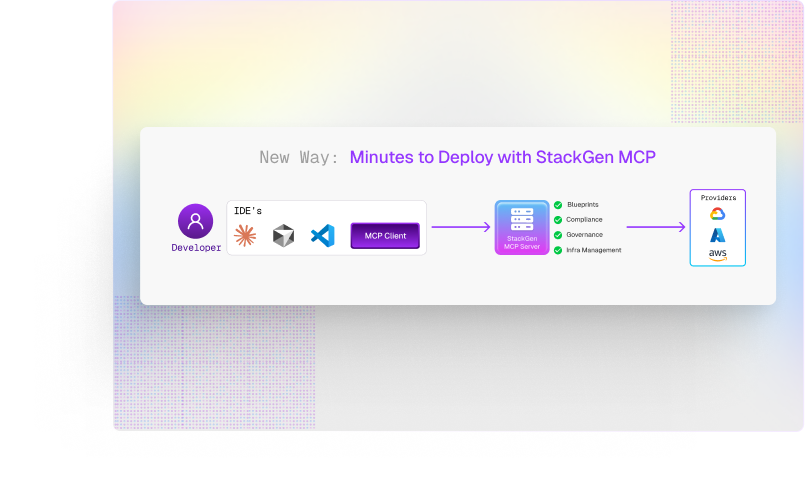
The StackGen MCP Server is a Model Context Protocol server that connects AI assistants like Claude, Cursor, and VS Code to StackGen's infrastructure deployment platform. It enables developers to deploy, manage, and monitor cloud infrastructure using natural language directly from their preferred development environment. The MCP server acts as a bridge between your AI assistant and StackGen's infrastructure lifecycle management capabilities, allowing you to create AppStacks, provision resources, detect drift, and manage multi-cloud deployments without leaving your IDE.
Which AI assistants and IDEs are supported?
StackGen MCP Server currently supports:
Claude Desktop/Claude Code - Fully supported with native integration (easiest setup)
Cursor - Supported via MCP extension (medium difficulty)
Gemini CLI - Fully supported with native integration
Windsurf - Supported via Cascade
VS Code - Coming soon via extension
Each platform offers the same comprehensive set of infrastructure management tools, with setup difficulty varying based on the platform's native MCP support.
How long does it take to set up the MCP server?
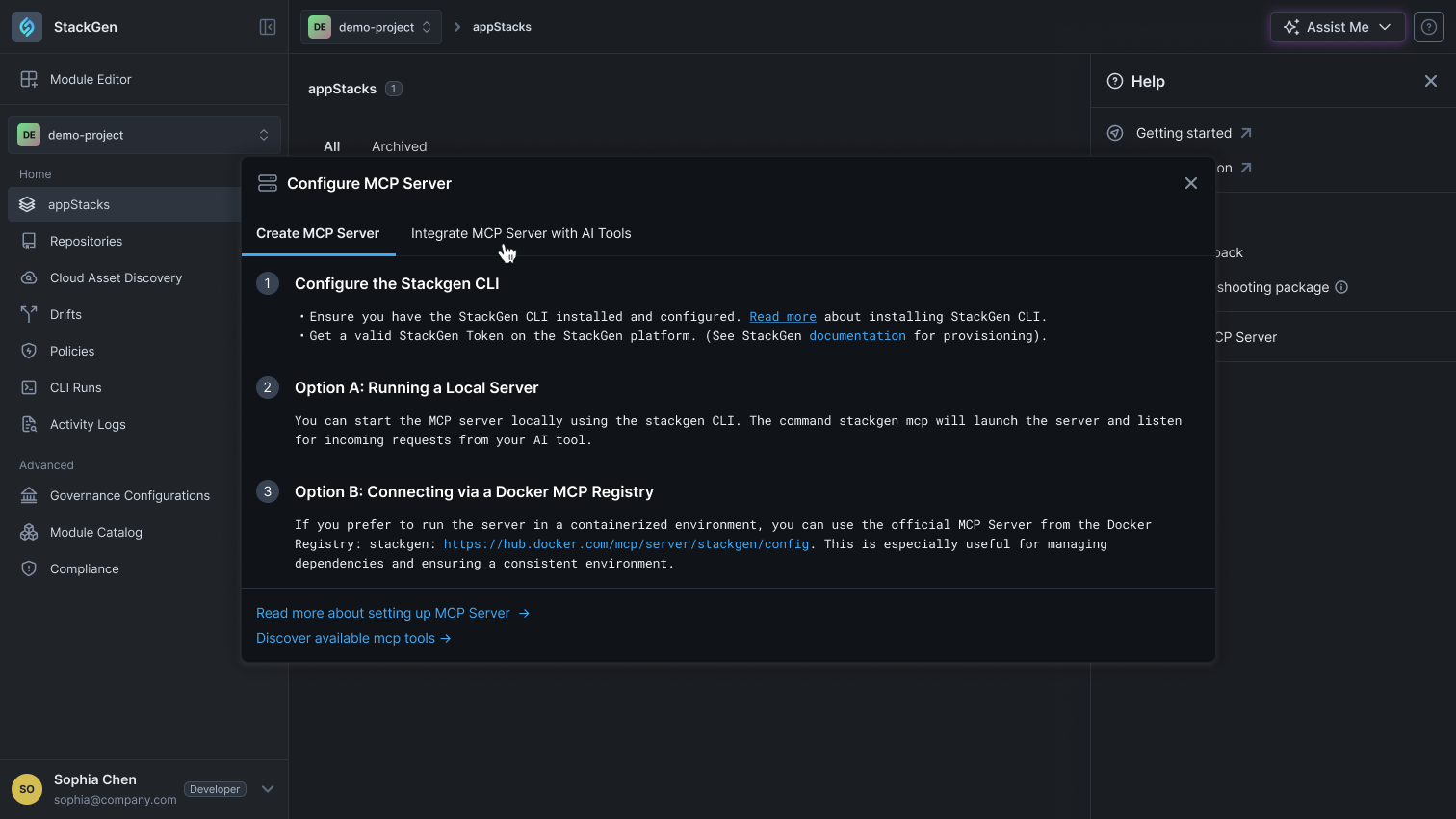
Setup typically takes 5-10 minutes and involves three simple steps:
Install StackGen and cloud2code CLIs (via Homebrew or direct download)
Generate a Personal Access Token from your StackGen account settings
Configure your AI assistant with the MCP server using either the CLI command or settings file
For Claude Code, it's as simple as running one command: claude mcp add stackgen with your authentication token. The server automatically detects CLI locations and handles configuration.
What can I do with the StackGen MCP Server?
The MCP server provides 25+ tools for comprehensive infrastructure management:
Create and manage AppStacks - Define infrastructure blueprints using architecture diagrams or natural language
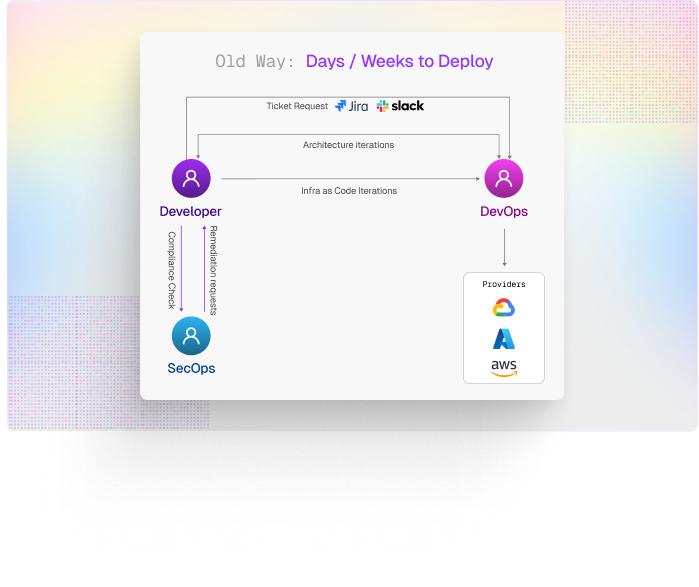
Deploy multi-cloud infrastructure - Provision resources across AWS, Azure, and GCP
Import existing resources - Convert running cloud resources into managed IaC with Cloud2Code
Detect and manage drift - Identify configuration differences between deployed and desired state
Apply governance policies - Enforce security, compliance, and resource restrictions
Sync with version control - Integrate with GitHub for CI/CD workflows
All operations are executed through conversational prompts like "Deploy my Python application to AWS ECS" or "Check if my production AppStack has any drift."
Is the StackGen MCP Server secure for enterprise use?
Yes, the MCP server is built with enterprise security in mind:
Encrypted token storage - PAT tokens are stored using keychain (macOS/Linux) or encrypted file storage
No credential logging - Tokens are never exposed in logs or error messages
Command sanitization - All CLI commands are validated to prevent injection attacks
TLS encryption - All external communications use secure protocols
Process isolation - Each command runs in isolation with timeout protection
Governance enforcement - Supports IAM restrictions, security rules, and resource policies
The server enables platform engineering teams to provide developers with AI-native infrastructure access while maintaining centralized governance and security controls.