

Share This:
Fully autonomous infrastructure isn't science fiction anymore. It's the point where AI agents, observability, and infrastructure-as-code finally converge into a self-driving platform for software delivery and operations. The breakthrough? A real-time knowledge graph that fuses signals from application code, infrastructure, and production behavior—enabling AI agents to reason over them and act safely without waiting for humans to click buttons.
This post explores what it takes to move from today's automation—which still assumes a human is watching—to systems that truly drive themselves within defined guardrails.
From Cruise Control to Self-Driving Infrastructure
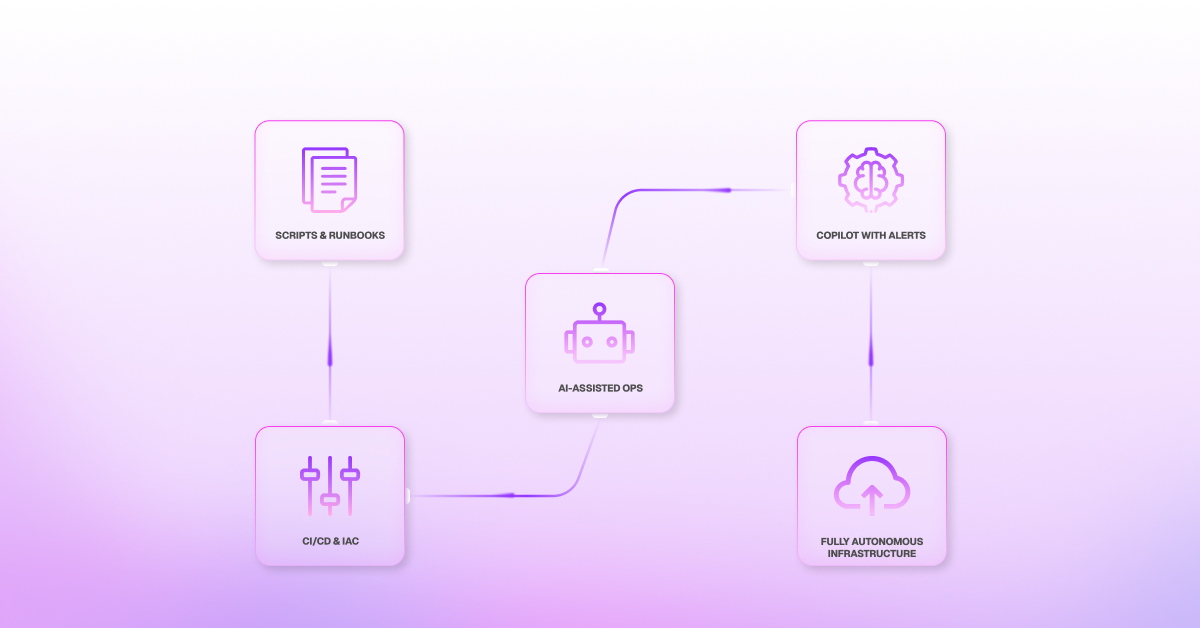
For decades, teams have automated infrastructure. But most automation has looked more like cruise control than self-driving. CI/CD pipelines, infrastructure-as-code, and configuration management gave us speed—yet they still assumed a human was approving changes, watching dashboards, and chasing incidents late at night.
Autonomous infrastructure raises the bar for underlying AI in three critical ways:
- Continuous observation. The system ingests logs, metrics, traces, user behavior, cost data, and risk posture in real time—not just when someone opens a dashboard.
- Contextual understanding. It knows what the business is trying to achieve, which policies must never be violated, and what "good" looks like for each service.
- Safe, bounded action. It builds, governs, heals, and optimizes systems without waiting for a ticket to be filed—but within explicit guardrails defined by humans.
Think of the progression in cars: ABS, then cruise control, then lane keeping, and finally Full Self-Driving. Infrastructure is walking a similar path—from scripts and runbooks to pipelines and now to AI agents that drive operations decisions at machine speed.
The Three Sources of Truth
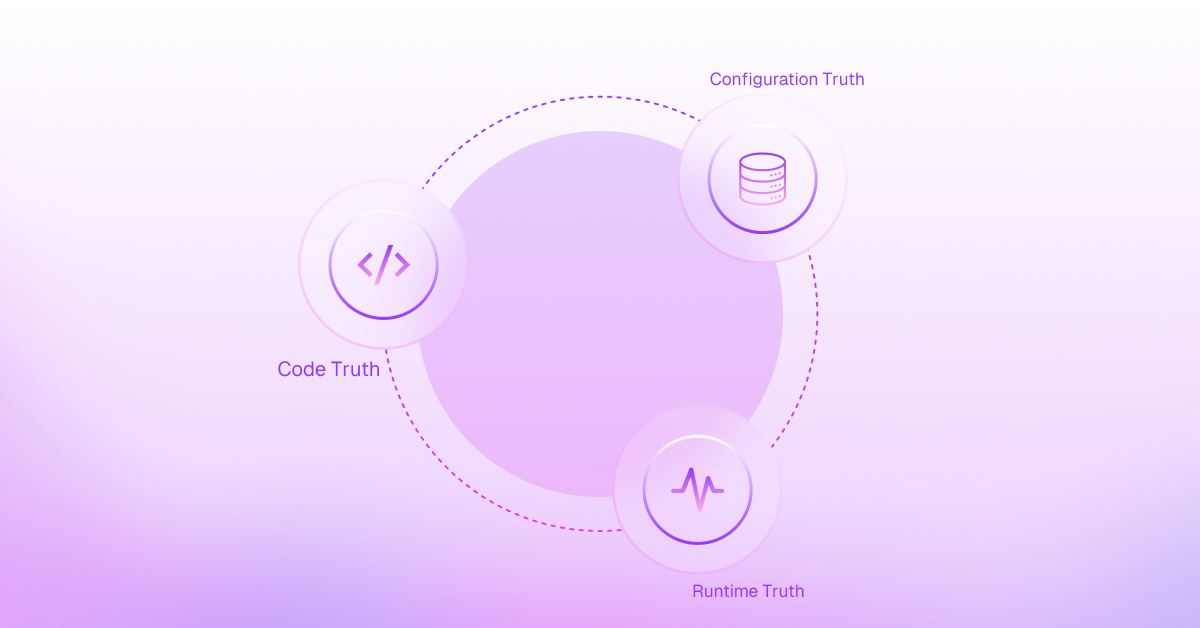
Most enterprises live in a fractured reality where three independent "truths" about their estate evolve at their own pace:
Code truth. Application code and infrastructure-as-code describe what we believe is running. Git history, CI/CD logs, and deployment artifacts form a time-stamped narrative of developer intent.
Configuration truth. CMDBs, inventory tools, cloud control planes, and ticketing systems capture what we think is provisioned and how it's wired together. In practice, this data is often stale, incomplete, and riddled with drift.
Runtime truth. Observability systems report what is actually happening: traffic spikes, error bursts, tail latencies, saturation, and cost anomalies. User behavior signals—funnel drop-offs, feature adoption, failures masked by retries—tell us how the system is experienced, not just how it's configured.
Traditional SRE and DevOps tooling can query each plane, but rarely correlate them in real time. When an incident hits, humans are forced into manual context stitching: tracing a symptom from logs, to metrics, to a deployment, to a Terraform plan, to a misconfigured policy or forgotten feature flag.
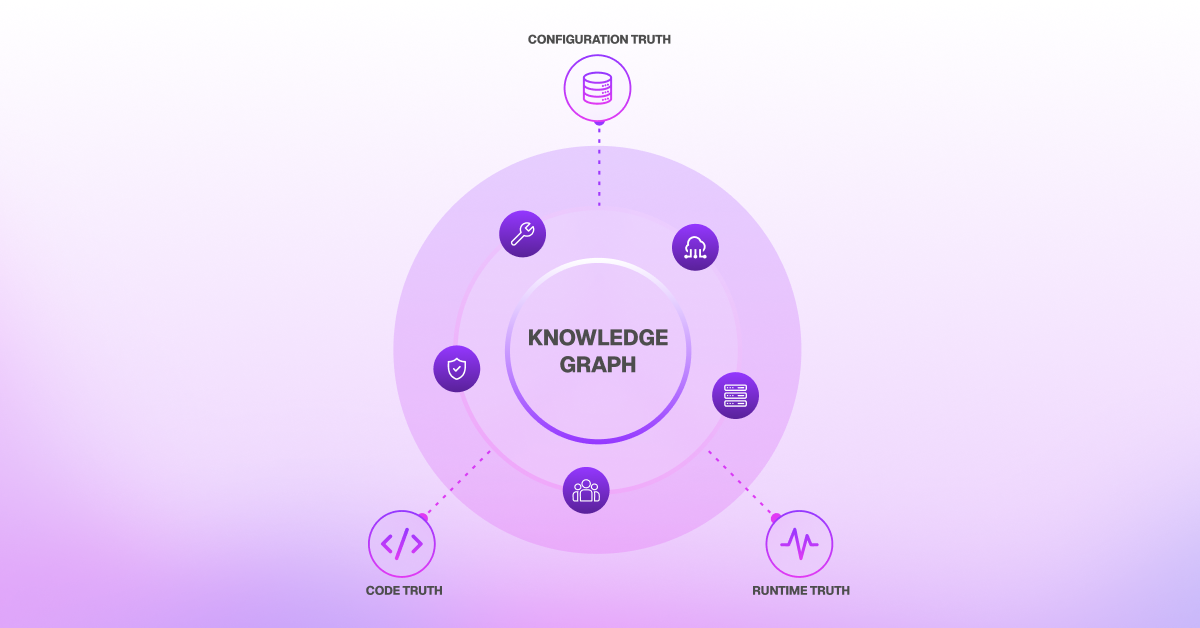
The Holy Grail is a single, continuously updated Knowledge Graph that spans all three sources of truth and encodes the relationships between them.
The Real-Time Knowledge Graph
A real-time operational Knowledge Graph isn't a diagram on a wiki—it's a living system that ingests high-dimensional data and keeps it consistent as the world changes.
At minimum, the graph encodes:
Entities: Services, APIs, data stores, queues, clusters, regions, users, and policies.
Relationships: Dependencies, blast-radius paths, ownership, deployment pipelines, and risk boundaries.
Events: Deploys, rollbacks, config changes, policy decisions, and incident annotations.
High-cardinality telemetry—labels on traces, dimensions on metrics, attributes on logs—is the raw material from which this graph is continuously refined. AI agents operate over this graph to discover non-obvious correlations: failure patterns that only appear under certain load shapes, cost anomalies tied to specific feature flags, or regressions that only affect a subset of tenants.
Without such a graph, AI in operations degenerates into clever log search or expensive anomaly detection that still pushes tickets to humans. With it, AI agents can reason over chains of causality—"this deploy changed this resource, on which this service depends, which now shows elevated error rates for premium customers in one region"—and choose actions that are both effective and safe.
Why AI SRE Agents Alone Aren't Enough
Early experimentation with "AI SRE agents" has focused on narrow tasks: triaging alerts, drafting runbooks, or suggesting queries to debug incidents. These agents are useful assistants, but they're bounded by the narrow context they see—usually just logs or metrics from a single domain.
To cross the threshold from helpful copilot to truly autonomous operator, agents must:
See all three sources of truth at once, not just observability data.
Understand policies, risk appetite, guardrails, and safety nets as first-class inputs—not afterthoughts.
Learn from outcomes and refine their own behavior through regenerative feedback loops.
An isolated "incident bot" cannot know that a rollback conflicts with a regulatory cutoff for a financial batch, or that a cheaper instance type violates latency SLOs for a platinum tier. That reasoning emerges only when incident data, deployment history, business policies, and user impact share a common semantic fabric in the knowledge graph.
In this world, human SREs increasingly move up the stack: defining SLOs, guardrails, and evaluation criteria that shape agent behavior—instead of hand-crafting runbooks for each failure mode. The SRE function becomes the architect and ethicist of autonomous infrastructure, not its primary operator.
The Detect-Respond-Learn Loop
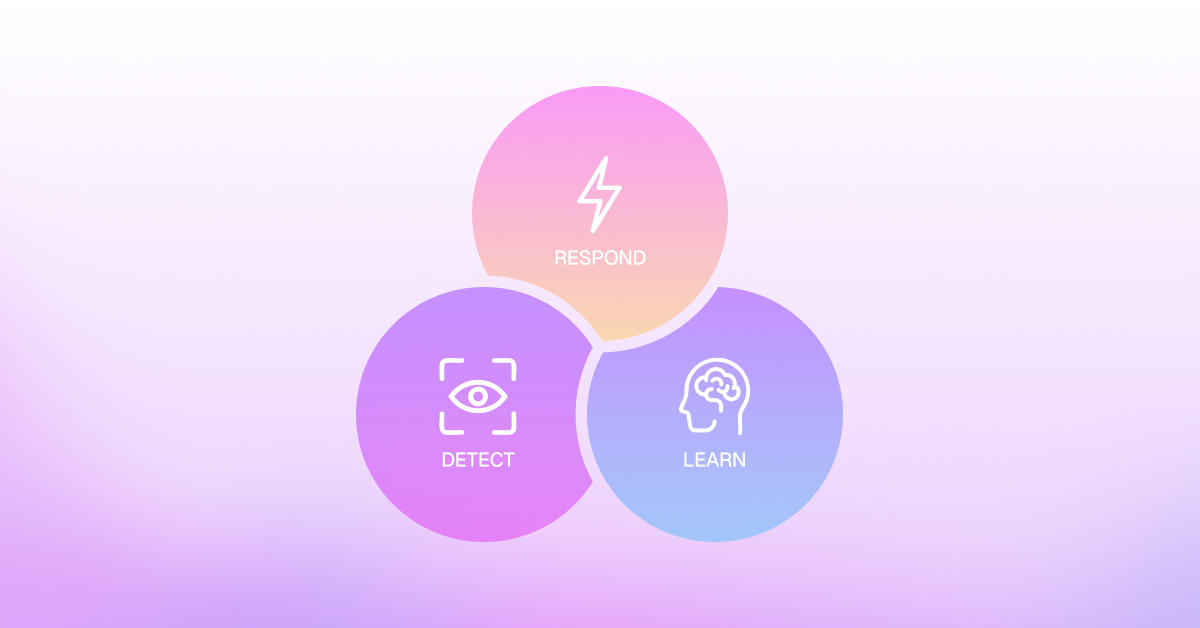
The operational loop in autonomous infrastructure consists of three interlocking stages:
Detect
Agents continuously monitor high-dimensional telemetry for anomalies, pattern shifts, and signals that matter to defined SLOs. Rather than firing raw alerts at humans, they enrich events with graph context: affected services, dependencies, recent changes, and probable root causes. This transforms alert fatigue into actionable intelligence.
Respond
For known, well-understood situations—validated through a rich knowledge base of incidents providing thorough system history—agents take direct action: traffic shifting, safe rollbacks, feature flag flips, or targeted scaling. For low-confidence or first-of-a-kind (FOAK) scenarios, agents prepare recommended actions and route them to humans with clear rationale and options.
Learn
Every incident, mitigation, and post-incident review feeds a regenerative learning loop that augments the knowledge base and updates the knowledge graph. Evals—structured tests of agent behavior across representative scenarios—ensure that as the system learns, it does so safely and within risk boundaries.
Over time, the catalog of "known knowns" grows. The ratio of FOAK incidents shrinks, and the surface area where humans need to be in the loop narrows to truly novel or high-risk situations. Incidents that once required hours of war-room time get resolved in seconds by agents that have seen this pattern before—because they learned it from the last outage.
Human in the Loop, by Design
"Fully autonomous" should never mean "no humans anywhere." It should mean that humans define intent, guardrails, safety nets, and trust models—while agents execute within those constraints.
What should such a system look like?
Policy-driven agency. Every action an agent can take—create, change, or destroy resources; alter traffic; change access—is gated by explicit, codified policy.
Risk-tiered autonomy. Low-risk domains (stateless services, non-prod environments, A/B experiments) allow higher degrees of autonomy, while high-risk areas (safety-critical systems, health data, compliance boundaries) keep humans firmly in the loop.
Transparent reasoning. Agents must show their work: why they think an issue is happening, what options they considered, and why they chose one remediation over others.
This is where eval-driven development (EDD) for agents becomes essential. Instead of retrofitting tests after the fact, teams define evals upfront: scenarios that encode "what good looks like," including safety expectations and acceptable trade-offs among cost, latency, and risk.
When the world changes—new services, new regulations, new attack patterns—those evals evolve first, and agents are updated only when they continue to pass the updated eval suites. Autonomy becomes an earned capability, expanding over time as the system proves it can behave safely.
The Road to the Holy Grail
Several forces are converging to make fully autonomous infrastructure achievable in large enterprises—not just greenfield startups:
AI-native agents and protocols. Standardized agent protocols like MCP (Model Context Protocol) and tool ecosystems make it easier to plug AI agents into existing platforms—from application delivery pipelines to observability to ITSM. Enterprises can start small (automating change risk scoring or incident triage) while building toward a cohesive agentic fabric over time.
Maturing observability and IaC. Years of investment in high-cardinality telemetry and infrastructure-as-code mean the raw data for the knowledge graph already exists—it just needs to be correlated and activated. As more infrastructure intent is surfaced (via policies, SLOs, and contracts), agents have richer semantic inputs to reason over.
Regulatory clarity on AI. Frameworks like the NIST AI Risk Management Framework and sector-specific guidance for financial services and insurance are giving teams a blueprint for safe, responsible autonomy. The conversation has shifted from "can we do this?" to "how do we do this safely and measurably?"
The Convergence Point
The Holy Grail isn't a single product—it's an architectural pattern where a real-time knowledge graph, fed by three sources of truth, becomes the substrate on which AI agents operate.
When these patterns are in place, infrastructure stops being a constraint and starts behaving like a self-driving system: always observing, always learning, and always aligning its actions with the intent, guardrails, and safety nets defined by the humans it serves.
The quest isn't over. But for organizations willing to invest in the knowledge graph, define clear guardrails, and let AI agents earn autonomy incrementally, the destination is finally in sight.
Ready to Start Your Journey?
StackGen's Aiden for SRE brings AI-native incident management and autonomous remediation to your operations, building the knowledge graph your teams need for faster, safer incident resolution. Learn how Aiden for SRE works or request a demo to see it in action.