

Share This:
This is part 3 of 5 in a series adapted from our white paper, The Autonomous Operations Factory: the operating model that completes the AI software factory. Download the full white paper for the complete argument, figures and sources.
The Autonomous Operations Factory is a governed operating model in which specialized agents share operational context, work toward the objectives you set, and coordinate work across build, operate, observe and remediate, at an autonomy level you control, using your existing tools as the system of execution.
Part 1 argued that operations is a queue, and that fragmentation sets its cycle time. Part 2 showed why adding point agents to each stage does not fix that. This post defines what does: what an operations factory is, where it sits in the market, and the four components it cannot do without.
What is an Autonomous Operations Factory?
It is an operating model rather than a product. A factory is typically assembled from several elements rather than bought whole, and a smaller operations footprint may need only one of them. Two properties set it apart.
- It is governed. Autonomy without policy is not a factory. Autonomy is set at one of five levels, and you choose which.
- It works toward objectives you set. The agents are not only bounded by what they may not do. They are pointed at what the organization is trying to achieve, and the factory holds that objective between runs.
Where does it sit in the operations tooling market?
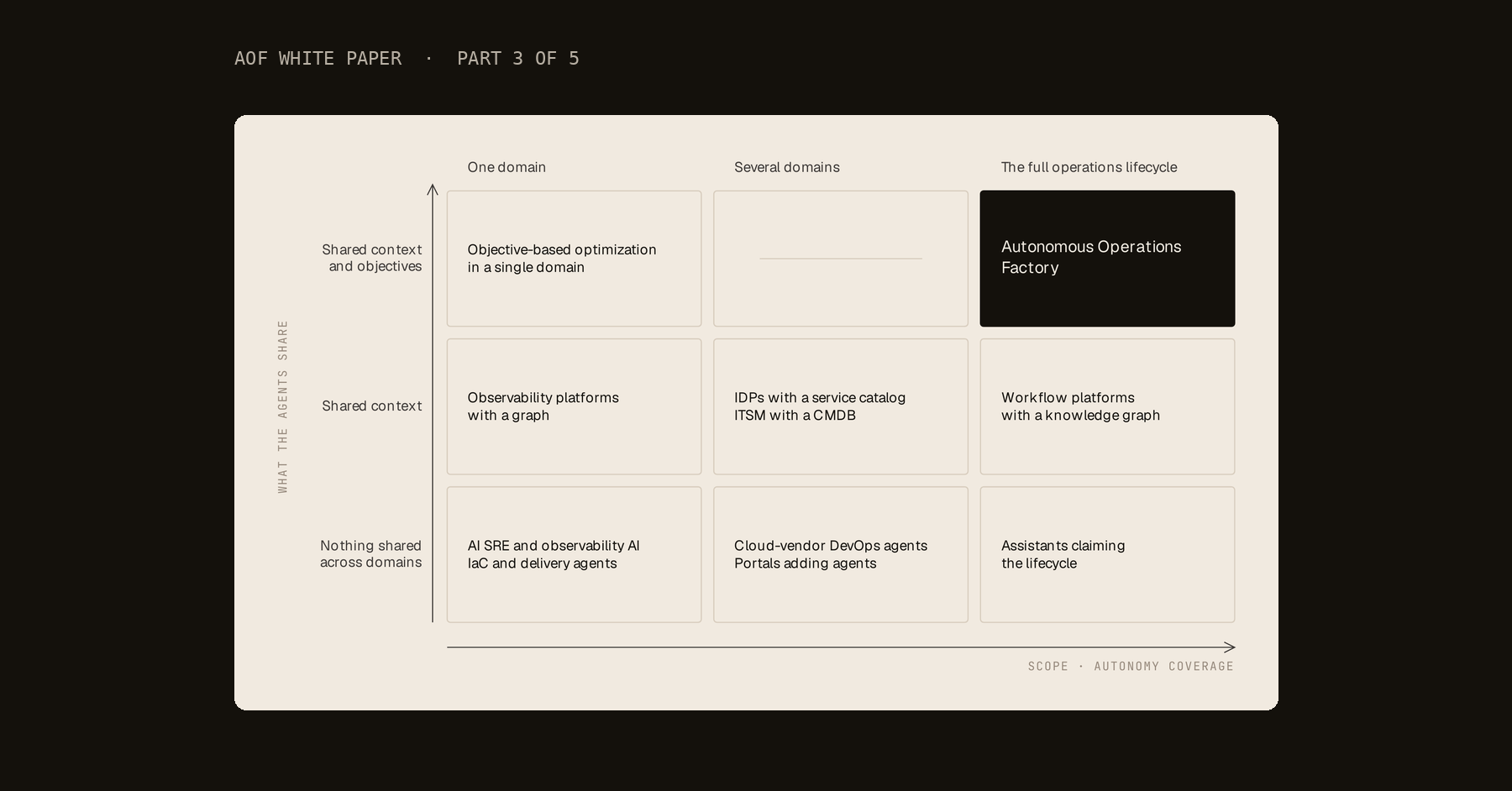
The market for operations tooling is organized by stage: infrastructure platforms for build, delivery platforms for operate, observability platforms for observe, and incident and SRE tooling for remediate. Each of those four is now growing an agent layer, and each agent inherits the boundary of the category it was built in.
An operations factory is not a fifth category alongside them. It is what makes the four work as one: shared context underneath, one objective across them, and one governance record over the top. Your existing platforms stay the system of execution.
This is also what separates it from AIOps. AIOps correlates signals across domains to tell a person what happened. An operations factory coordinates action across domains, so the work is cleared rather than reported.
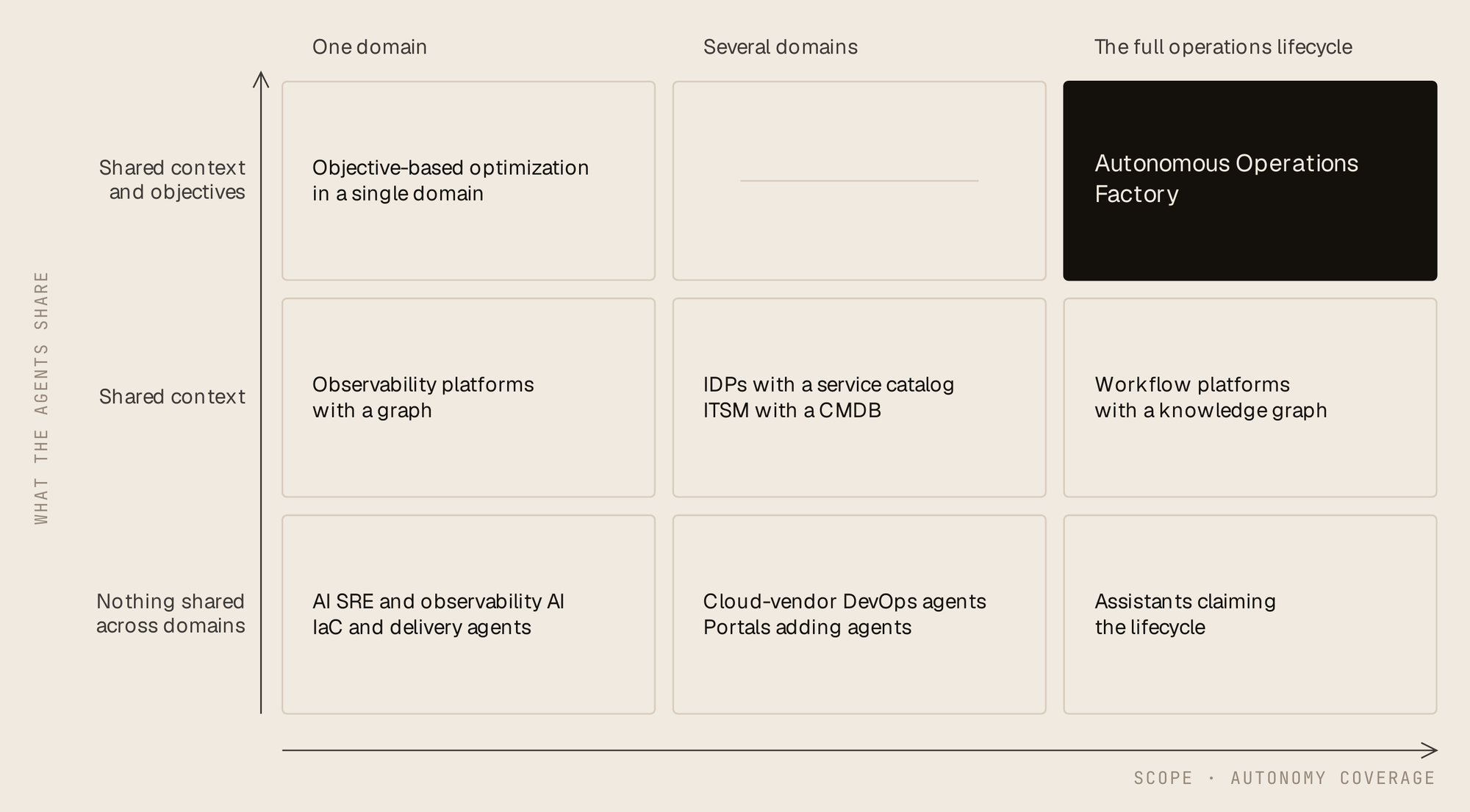
The market, by scope and by what the agents share. The categories cluster low and left because operations tooling is bought by domain and teams are staffed by domain.
The four components of an operations factory
This is the inclusion test: a candidate is only an operations factory if it has all four. The stages can grow, with FinOps and security the obvious additions, but the four components do not change.
- A production line with defined stages. Work enters at a stage and produces a defined output: a provisioned environment, a verified deployment, a resolved incident.
- A shared context that every stage works from. Not integrations between stages. One picture of the system that each stage reads before it acts and writes to after it finishes. This is the component almost every current architecture is missing.
- Guardrails and inspection at each step. Policy evaluated at every action boundary, before the action executes. Human approval where you require it, and an audit record of every input, decision and action.
- Instrumentation that reports cost and performance. In operations, that means how much of the work is being done autonomously, and at what cost.
Components three and four matter more than they first appear. Gartner predicts more than 40% of agentic AI projects will be canceled by the end of 2027, due to escalating costs, unclear business value or inadequate risk controls [1]. Governance and instrumentation are what stop an agentic program being canceled.
The stages of the production line
These are the stages the line runs, the domain each one maps to, and what an agent does inside it.
| Stage | Domain | What its agents do |
|---|---|---|
| Build | InfraOps | Discover, codify, provision and reconcile infrastructure; detect and remediate drift |
| Operate | DevOps | Gate, verify, promote and roll back deployments against live system state |
| Observe | Observability | Correlate signal, suppress noise, rank by impact and error-budget burn |
| Remediate | SRE | Triage, investigate, root-cause and resolve incidents |
| Learning step | Across all four | Prevention rules and calibrated gates from every outcome |
The value is not in any one stage but in what the shared context makes possible between them. A deployment can gate on infrastructure drift, because the drift is in the shared context.
What is an operations factory worth?
This is what the model should be judged on. Each benefit moves for the same underlying reason: the context an agent needs is already there when it acts.
- Velocity. Agents read the shared context immediately rather than waiting for a person to assemble it, so the wait between stages collapses. Lead time from merge to production falls, and the queue in front of each stage stops growing.
- Reliability. Operational context reaches the change while it is still being made, so a class of incident is prevented rather than resolved. When one does happen, the same context is already loaded, and investigation starts from what changed rather than from what is alerting.
- Productivity and cost. Routine decisions resolve without escalation, so the same team absorbs a higher arrival rate without hiring. StackGen runs its own multi-cloud Kubernetes estate across AWS, GCP and Azure with a four-person SRE team. The factory reports what each action costs to run, so autonomy never becomes an unbounded invoice. The estate itself gets cheaper too, because an agent that can see release commitments and compliance constraints can right-size the resource nobody dared touch.
For a shorter primer on the model, see Raj Nagarajan's What Is the Autonomous Operations Factory? Part 4 of this series goes inside the mechanism: the loop, the world model and the agent operating system.
Download the Autonomous Operations Factory white paper
This post is part 3 of 5 drawn from our white paper. The full paper brings the series together in one place, with the figures, the market map and every source. Download the white paper.
The series
- Part 1: AI Coding Gains Have Moved the Bottleneck to Operations
- Part 2: Why More AI Agents Won't Shorten Your Operations Loop
- Part 3: The Four Components Every Operations Factory Needs (you are here)
- Part 4: How AI Agents Coordinate Across the Operations Lifecycle
- Part 5: How to Start Building Autonomous Operations, Stage by Stage
Sources
- Gartner, Gartner Predicts Over 40% of Agentic AI Projects Will Be Canceled by End of 2027, press release, 25 June 2025.
GARTNER is a registered trademark and service mark of Gartner, Inc. and/or its affiliates in the U.S. and internationally and is used herein with permission. All rights reserved.