
Why More AI Agents Won't Shorten Your Operations Loop

This is part 2 of 5 in a series adapted from our white paper, The Autonomous Operations Factory: the operating model that completes the AI software factory. Download the full white paper for the complete argument, figures and sources.
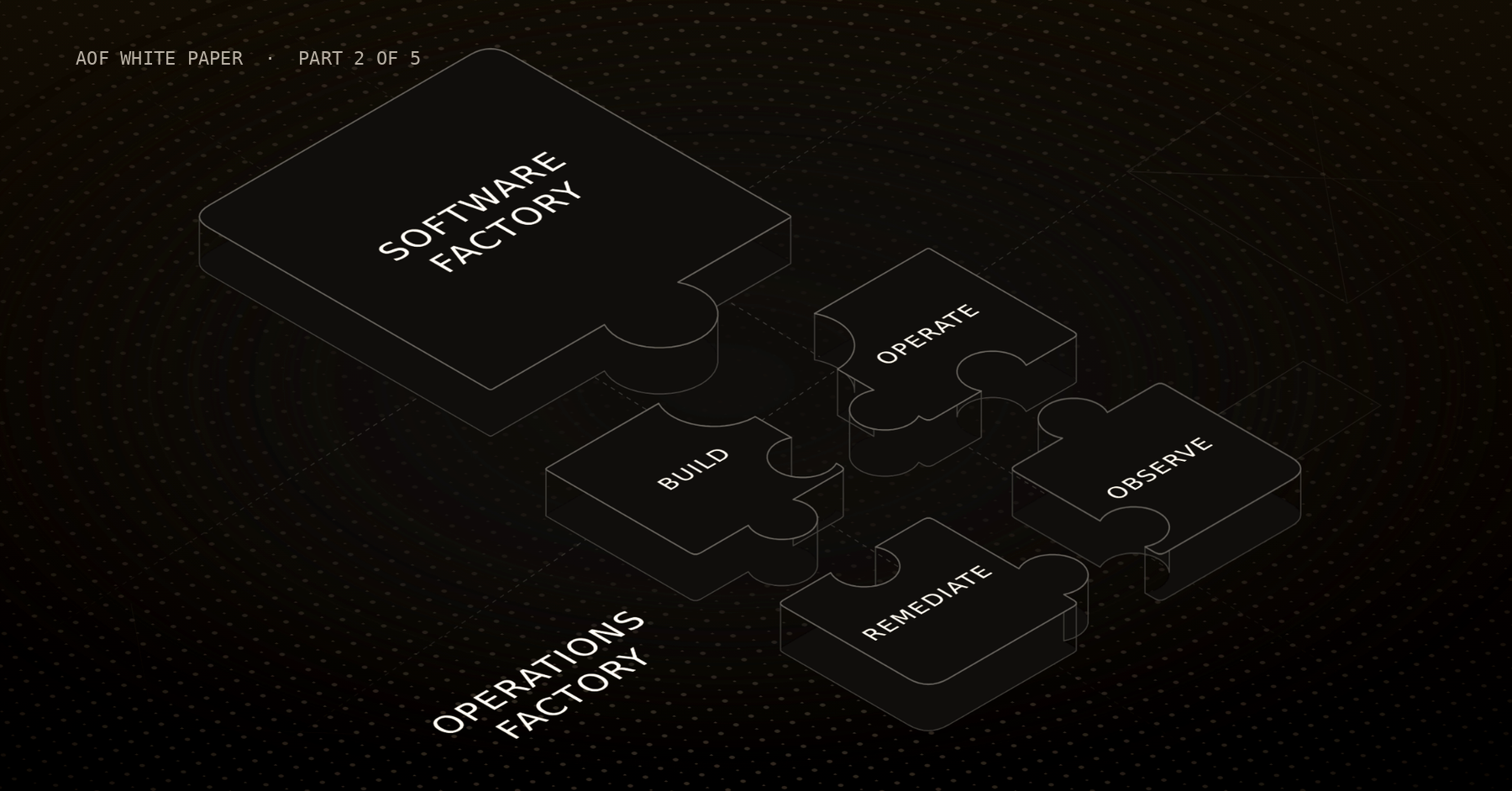
Every one of the four operations stages (build, operate, observe and remediate) now has AI agents available for it. They are useful, and adopting them is the right first move for most teams.
They do not shorten the operations loop, though, because they inherit the boundary they were built inside. Part 1 showed that operations cycle time lives in the handoffs between stages. A point agent works inside one stage, so the handoffs stay where they were.
There are five reasons the point-agent model stalls. Each one is answered by a specific element of the Autonomous Operations Factory, which Part 4 describes in full.
1. Context is rebuilt for every agent, on every task
Every point agent assembles its own view of the estate and discards it when the task ends. That cost is paid again each time and never compounds.
An agent reviewing a pull request does not know the current infrastructure state, or what incidents the last similar change caused. It starts from zero, every time.
What answers it: the world model, one shared picture of the system that every stage reads before it acts and writes to after it finishes.
2. A single-domain agent cannot reach its full potential
A point agent can improve the work inside its own stage, and often does. What it cannot see is the handoffs, the waits and the rework on either side of it, so end-to-end cycle time barely moves.
What answers it: the runtime, where orchestration moves the whole line rather than individual stations.
3. Nothing holds the objective between runs
A point agent takes an instruction, completes it and stops. No objective survives a sequence, so a person restates it at every handoff. That person has become the integration layer.
What answers it: intent, an operational outcome stated once, in plain language, that the factory holds until it is met.
4. Approvals and audit become fragmented
Each agent arrives with its own guardrail model. Ten agents means ten approval surfaces, ten audit trails and nowhere to state policy once. Governance gets harder with every agent added.
What answers it: the factory specification, a version-controlled document where policy is stated once for the whole factory instead of once per agent.
5. The toil moves rather than disappearing
Integration, context plumbing and agent supervision land on the platform team. Headcount was the constraint the exercise started with, so the saving is spent before it arrives.
What answers it: the learning step, which feeds every outcome back so the next similar situation starts from richer context and needs less supervision.
Why single-domain agents hit a ceiling
We describe operations autonomy on five levels, from L1 (manual) to L5 (full autonomy). L3 is the natural ceiling for a single-domain tool. An agent can be excellent inside its own cell and still leave a person carrying context to the next one, which is why adding more of them does not shorten the loop.
L4 is the first level at which a learning in one domain reaches another without a person relaying it. That is a property of the system the agents run inside, not of any single agent. Getting there takes a shared context, a shared objective and one governance layer across every stage.
That system is what we call an Autonomous Operations Factory. Part 3 defines it and sets out the four components it needs.
Download the Autonomous Operations Factory white paper
This post is part 2 of 5 drawn from our white paper. The full paper brings the series together in one place, with the figures, the market map and every source. Download the white paper.
The series
- Part 1: AI Coding Gains Have Moved the Bottleneck to Operations
- Part 2: Why More AI Agents Won't Shorten Your Operations Loop (you are here)
- Part 3: The Four Components Every Operations Factory Needs
- Part 4: How AI Agents Coordinate Across the Operations Lifecycle
- Part 5: How to Start Building Autonomous Operations, Stage by Stage