

Share This:
Your coding agents are writing more code than ever. Your validation process has to keep pace.
Introduction
AI coding agents have changed how much code one developer can produce. A developer working with Cursor, Claude Code, Kiro or Codex opens far more pull requests than a year ago, and AI-generated pull requests now arrive faster than most teams can validate them. The path that proves a change works before it can be deployed has barely moved. It is still one shared staging environment, a QA queue, and a reviewer reading a diff.
That gap is starting to show up in the data. DORA's 2024 research found that every 25% increase in AI adoption was associated with an estimated 7.2% drop in delivery stability. Faros AI's analysis of more than 10,000 developers found that teams with high AI adoption merged 98% more pull requests, while PR review time rose 91%.
Shipyard by StackGen gives every pull request its own full-stack, near-production environment. Developers, QA, CI pipelines and coding agents can all prove a change works before it merges. Here are three ways it helps a development team keep up.
1. Prove every AI-generated pull request before it merges
Reading a diff won't tell you whether a change works. AI-generated code tends to look plausible on the page, and the problems surface only when services start talking to each other. A missing environment variable, a changed API contract, a schema change, or a migration that runs in the wrong order will pass a careful read and still break the application.
The diagram below shows the difference. Without Shipyard, a reviewed diff is merged and the break shows up days later in staging, so the change goes round again. With Shipyard, the change is built and tested in its own environment before review, and it reaches production the first time.
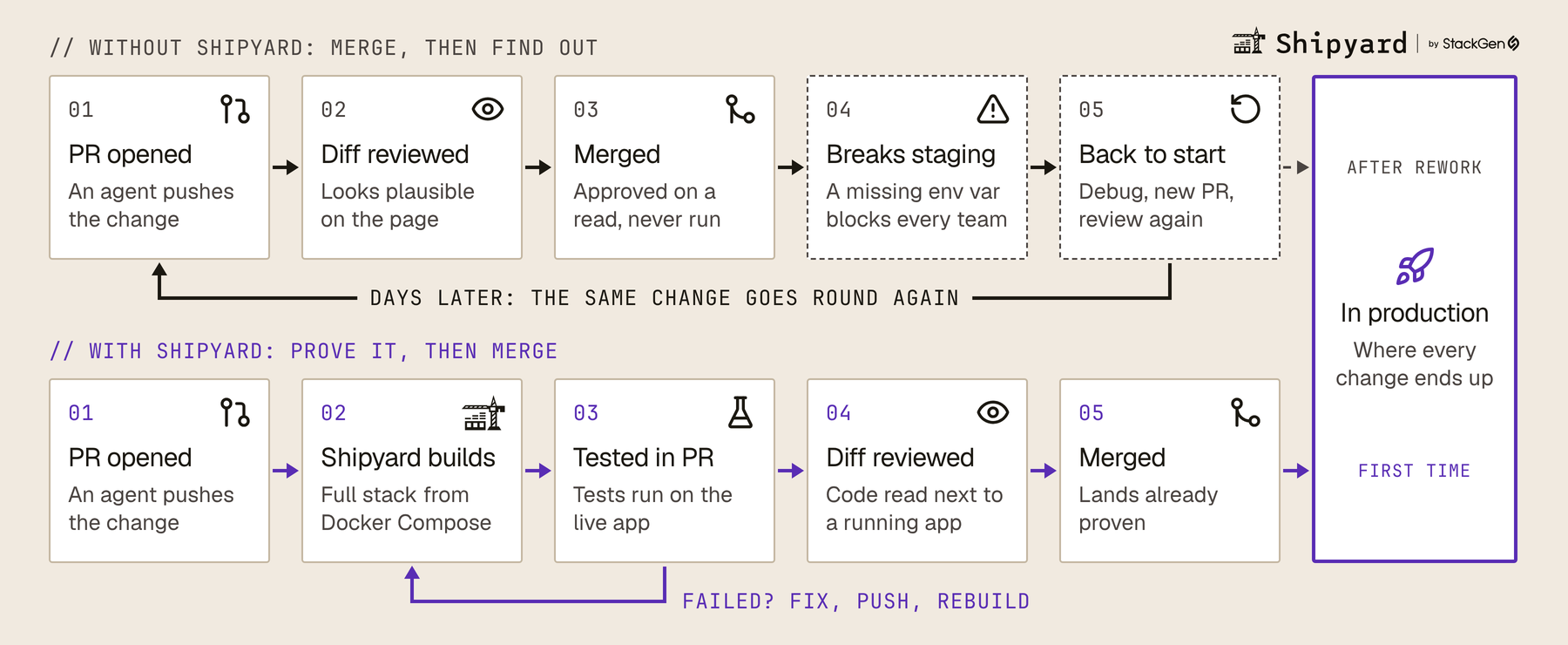
Shipyard closes that gap by actually running the change. When a pull request opens, Shipyard builds a full-stack environment from your application's own Docker Compose definition. It detects the services, builds them, and gives the environment a unique URL. You can watch the Docker build logs and then the live container logs once services are up.
The environment stays in step with the code. Every push to the tracked branch triggers an automatic rebuild through a Git webhook, so nobody has to run a separate staging deploy to see the latest version. On GitHub, Shipyard posts commit checks and PR comments with the status of each environment.
That changes what your tests can cover. Defects show up in the pull request that caused them, where the author still has context, rather than days later in shared staging.
"We've been Shipyard customers for years and we've been very happy with it. Every pull request gets a high-fidelity environment where our browser tests run before anything merges. With more and more PRs coming in from agents, that step matters more than ever."
— Harrison Hunter, CTO, Rippit
What your team gets: a running, near-production copy of every change, linked from the PR, for your tests and reviewers to use before anyone clicks merge.
2. Validate changes in parallel instead of queueing for staging
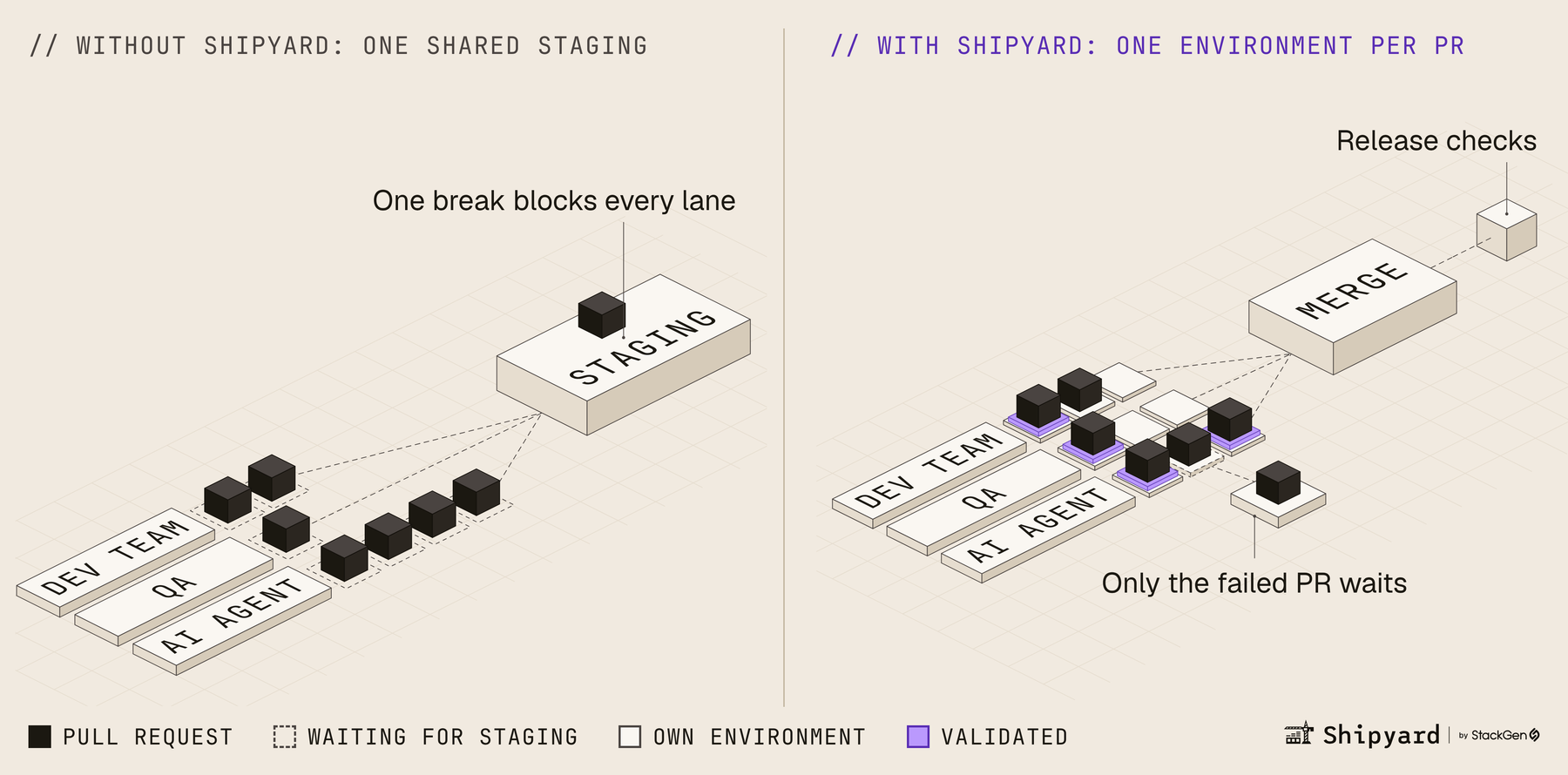
Shared staging forces parallel development into a serial validation process. That was tolerable when a team opened a handful of pull requests a day. When coding agents multiply the number of changes in flight, the queue for staging grows with them. One broken change can then block every team that depends on the same environment.
Shipyard gives each pull request an isolated environment of its own. Five changes can be tested at the same time without waiting on each other, and a regression in one branch never touches the other four. Developers stop asking who is using staging, and QA stops switching between partially deployed features.
The benefit reaches past engineering. Every environment has a unique, SSO-enabled link you can share with QA, product managers, designers and UAT reviewers. They can click through the running feature while it is still being built, instead of waiting for it to land in a staging release.
| Shared staging | Shipyard per-PR environments | |
|---|---|---|
| Where a change runs before merge | One environment shared by every team | Its own full-stack environment |
| Testing several PRs at once | Serialized, one change at a time | In parallel, one environment per change |
| Blast radius of a bad change | Every team using staging | That pull request only |
| When QA and product can review | After the staging deploy | As soon as the PR environment builds |
| Who provisions and cleans up | Platform or DevOps, often by hand | Automatic, tied to the PR lifecycle |
| Cost when no one is using it | Runs around the clock | Removed on merge; scales down when idle |
Your platform team gets time back too. Environments are created from Git events and torn down when the pull request merges, so nobody files a ticket to get one, repair one or clean one up. Teams that maintain their own preview-environment scripts can retire them, along with the work of keeping them in step with every service change, and put that time back into the platform.
With branch-level testing moved to per-PR environments, staging is left for release-level validation, performance testing and organizational controls.
At Healthie, moving to per-PR environments let the team retire eight staging servers, and Director of Engineering John Bachir says Shipyard gives him back “20-30% of my work week, easily.”
What your team gets: validation capacity that scales with the number of pull requests your developers and agents produce.
3. Give coding agents a running application to test against
Most coding agents stop at the commit. They generate the change, maybe run unit tests locally, and hand a pull request to a human. Getting that change into a real environment, reading the logs and working out why it failed is still a person's job. As agent output grows, that hand-off becomes the bottleneck.
Shipyard extends the agent's loop past the commit. After an agent pushes code, Shipyard creates or rebuilds the environment for that pull request. The agent can then use the Shipyard MCP server or CLI to work with the running application: read service logs, rebuild or restart the environment, and run tests against it. Our quickstart walks through the setup with Claude Code.
The practical difference looks like this:
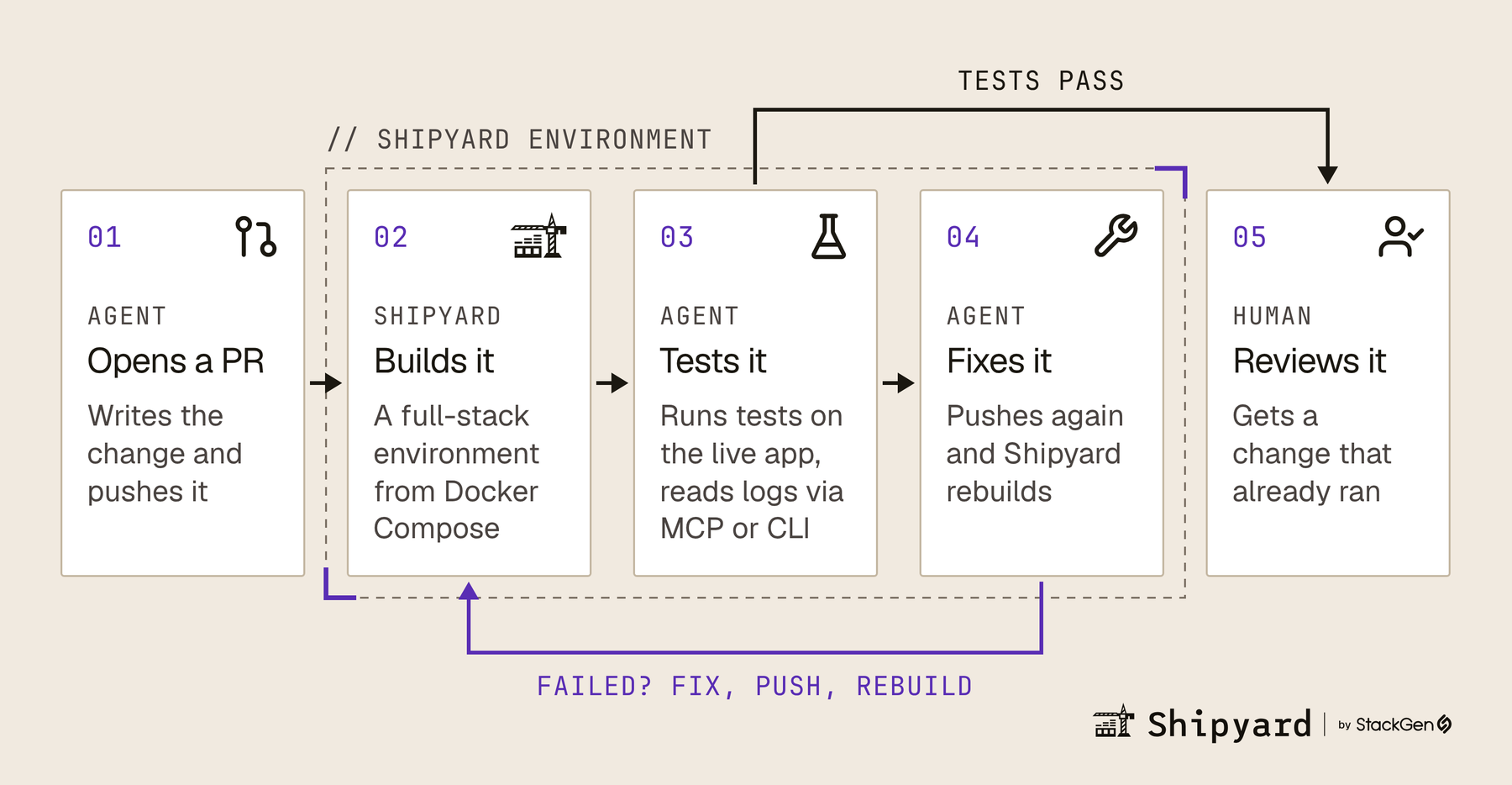
This scales with parallel work. If five agents are working at once, each gets its own place to test rather than lining up behind a single staging environment. That isolation is also what makes it safe and secure to let agents work this way. Each pull request runs in its own environment, so an agent can rebuild, restart and test its change without touching staging, production or anyone else's work.
Human review stays in place. What changes is the quality of what arrives for review. Instead of a diff and a hopeful description, reviewers get a change that has run, a link to the live environment, and the results of the tests your CI ran against it.
What your team gets: coding agents that produce validated changes, not just more code to review.
What per-PR environments do to your DORA metrics
Two DORA measures move first. Change failure rate drops because defects are caught in the pull request, before they ship. Lead time for changes shortens because changes no longer wait their turn on staging. Deployment frequency follows, because several changes can be validated at once.
Keeping validation in step with AI-generated code
AI has raised your team's capacity to write code. Unless validation capacity rises with it, the extra pull requests simply pile up in front of staging and reviewers. Shipyard lets validation scale the same way: every change is proven in an environment before merge, changes are validated in parallel, and coding agents get a running application to test their own work against.
The quickest way to see it is with one of your own repositories. If your application already boots from Docker Compose, you already have the starting point Shipyard needs to build a pull request environment. Start with the Shipyard quickstart, explore the Shipyard product page, or book a demo and we will walk through the lifecycle of a real change with you.
Frequently asked questions
What is a per-PR (ephemeral) environment?
A per-PR environment is a short-lived, isolated copy of your application created for a single pull request. Shipyard builds it from your Docker Compose definition, rebuilds it on every push, and tears it down when the work is done.
How does Shipyard help with AI-generated pull requests?
Shipyard gives every pull request, including those written by coding agents, its own full-stack environment. The change can be tested and reviewed in a running application before merge, and agents can use the Shipyard MCP server or CLI to inspect logs, run tests and iterate.
How do I try Shipyard with my coding agent?
Add the Shipyard MCP server to your agent, then ask it to create, inspect or rebuild the environment for a pull request. The docs include setup for Claude Code, Codex CLI, Cursor and Kiro, and any other MCP-compatible coding agent connects the same way. Shipyard is free to try for 30 days. MCP and CLI access are included from the Business plan.
Does Shipyard replace staging?
No. Shipyard takes branch-level testing and review off shared staging. Many teams keep staging for release-level validation, performance testing and organizational controls.
What do I need to get started?
You need a Docker Compose file for your application and a repository on GitHub, GitLab or Bitbucket. Multi-repo applications are supported.
Is Shipyard an AI agent sandbox?
No. Shipyard is not a general-purpose sandbox or disposable VM for running arbitrary code. It gives developers and agents access to the running application environment associated with a specific code change.
How many environments can run at once?
Shipyard measures running capacity in Drydocks. A Drydock is one slot for a running environment, so five Drydocks let five environments run at once. You can define as many environments as you need and start or stop them to stay within your allotment.
About StackGen
Shipyard is now part of StackGen, which is bringing per-PR environments into its Autonomous Operations Factory as a place where agents prove changes before they reach production.
