

Share This:
If you've spent the last year watching AI assistants hallucinate API calls, generate stale Terraform configs, or confidently suggest kubectl commands that break in staging — you're not alone. The gap between "AI that can write code" and "AI that can actually operate your systems" has been the defining frustration of this tooling era.
MCP servers — built on the Model Context Protocol open standard — are the infrastructure layer that closes that gap. And for platform engineering, DevOps, and SRE teams who've started wiring MCP servers into their workflows, the results go well beyond smarter autocomplete. This is about connecting AI to the live state of your environment. Hence, it reasons over what's actually deployed, what's actually breaking, and what it will actually cost — not what it guesses might be true.
In this post, we walk through what MCP servers are, why they matter for modern developer workflows in 2026, and exactly how teams are using them to move from AI-assisted coding to AI-powered operations.
What Is MCP, and Why Does It Matter Now?
The Model Context Protocol is an open standard, introduced by Anthropic, that lets AI models connect to external systems through a common interface. Instead of pasting infrastructure config into a chat window or hoping your AI assistant's training data reflects the shape of your Kubernetes API, MCP servers act as live bridges — giving AI agents real-time, bidirectional access to your tools, data, and services.
Think of it as a universal plugin layer for AI. Just as REST standardized how web services communicate, MCP standardizes how AI agents interact with the world around them.
The timing matters. Teams that have deployed GitHub Copilot at scale are running into a hard ceiling: AI helps developers write code faster, but infrastructure provisioning, deployment pipelines, and operational workflows are still entirely manual. MCP servers are what break that ceiling — they're the bridge between "AI that generates code" and "AI that can actually ship and operate that code."
Benefit 1: Real-Time Context Instead of Stale Assumptions
The most immediate benefit developers notice is accuracy. When your AI agent is connected to live systems via MCP, it stops making assumptions about your environment and starts working with verified facts.
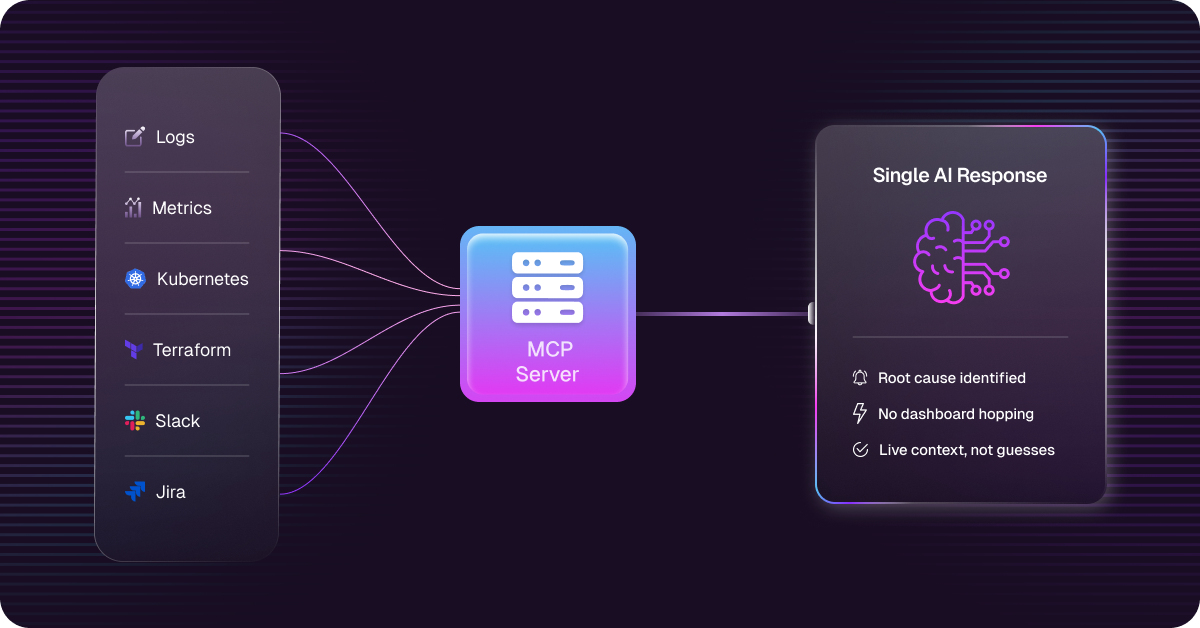
Consider a scenario every on-call engineer knows: debugging a deployment failure at 11 PM. Without MCP, you paste logs into a chat window, describe your setup, and hope the AI's training data is close enough to your actual environment to be useful. With an MCP server connected to your observability stack, your AI agent pulls the relevant logs, correlates them with the last three deployment events, checks current pod resource utilization, identifies the service with elevated error rates, and surfaces a prioritized root cause hypothesis in a single response, without you touching four different dashboards.
At StackGen, we built our MCP Server precisely to provide this grounded, production-accurate context. When Aiden operates against your infrastructure through our MCP Server, it's reading your actual Terraform state, your real resource configurations, and your live deployment history — not a simulation of what your environment probably looks like.
This matters especially for platform engineers managing complex, multi-account cloud environments where the gap between what's in code and what's actually deployed can quietly become a compliance time bomb.
Benefit 2: Eliminating the Context-Switching Tax
One of the least-discussed costs in modern DevOps is the context-switching tax. An engineer investigating an incident might jump between an observability dashboard, the Kubernetes CLI, a Terraform plan output, Slack threads, and a Jira ticket — all within a ten-minute window, never building full situational awareness across any of them.
MCP servers collapse this into a single AI interaction. Instead of manually gathering signals across six different surfaces, you ask a question and the AI agent queries the relevant systems on your behalf, synthesizing the results into a coherent answer.
A GitLab study found that developers spend less than a third of their time actually writing code. The rest goes to meetings, reviews, debugging, and exactly this kind of multi-tool context gathering. MCP-enabled workflows directly attack that overhead.
Put a number on it: a senior engineer fully loaded at $200K who spends 40% of their time on manual context gathering and tool-switching represents roughly $80K per year in automatable toil. For a platform team of ten, that's $800K annually in cost that doesn't appear as a line item anywhere. It shows up as infrastructure tickets with three-day turnarounds, P1 incidents that take four hours to root-cause, and engineers who eventually leave because the work feels like firefighting, not engineering.
Junior engineers benefit especially — they can navigate complex systems through natural language queries backed by live context, rather than memorizing tool-specific CLI syntax or the undocumented logic of the six wrapper scripts around Terraform that nobody remembers writing.
Benefit 3: Slashing MTTR with AI-Assisted Incident Response
Industry-wide, teams are spending more engineering time on incident response than ever — but not because incidents are more complex. It's because the context required to diagnose them is fragmented across too many tools.
"Our average P1 takes 4 hours to resolve. The first 90 minutes are just getting the right people in a room and agreeing on what's broken." That's not an unusual situation — it's the default. RCA becomes a week-long archaeology project: dig through logs, metrics, traces, and Slack threads from 3 AM, reconstruct a coherent timeline, write a post-mortem nobody reads before the next incident.
MCP changes this by giving your AI agent live access to the full incident context at the moment it's needed. The agent queries your observability data, cross-references recent deployments, checks for infrastructure drift, scans alert correlation across services, and generates a prioritized hypothesis list — in under two minutes.
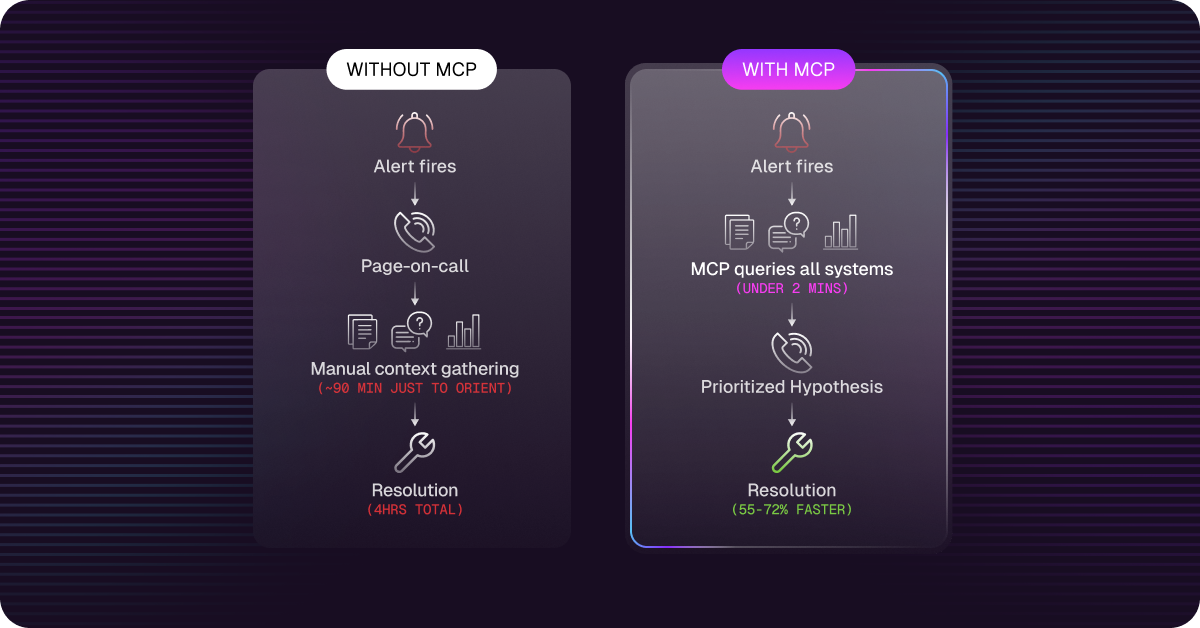
The results teams are seeing align with broader industry proof points: Coinbase's work with AI-assisted RCA delivered 72% faster root cause analysis. Snap's deployment of AI-powered incident management reduced MTTR by 55%. These aren't outliers — they're what happens when AI has the contextual access that MCP servers provide.
For SRE teams where on-call burnout is the leading driver of attrition, this is the benefit that hits differently. It's not the hours — it's the chaos. "We get 400 alerts per day. Maybe 10 are actionable. The rest are training the team to ignore alerts." MCP-connected agents running alert correlation and triage don't just speed up resolution — they give engineers their cognitive bandwidth back.
StackGen's Solutions for SRE teams cover how Aiden for SRE handles this workflow end-to-end, from alert triage and runbook execution to proactive anomaly detection.
Benefit 4: Breaking the Copilot Ceiling — From Code to Operations
If you've already deployed GitHub Copilot or Cursor, you've seen the productivity gains — and you've also hit the wall. AI helps developers write code faster. But the moment that code needs to be deployed, monitored, and operated, the AI falls silent. Infrastructure provisioning still goes through a platform team ticket queue. Deployments still require a human to babysit a pipeline for 45 minutes. Runbook execution is still manual.
This is the Copilot Paradox: AI makes your developers faster at writing code, which makes infrastructure provisioning and deployment the dominant bottleneck. The faster your developers can code, the more visible and painful that gap becomes.
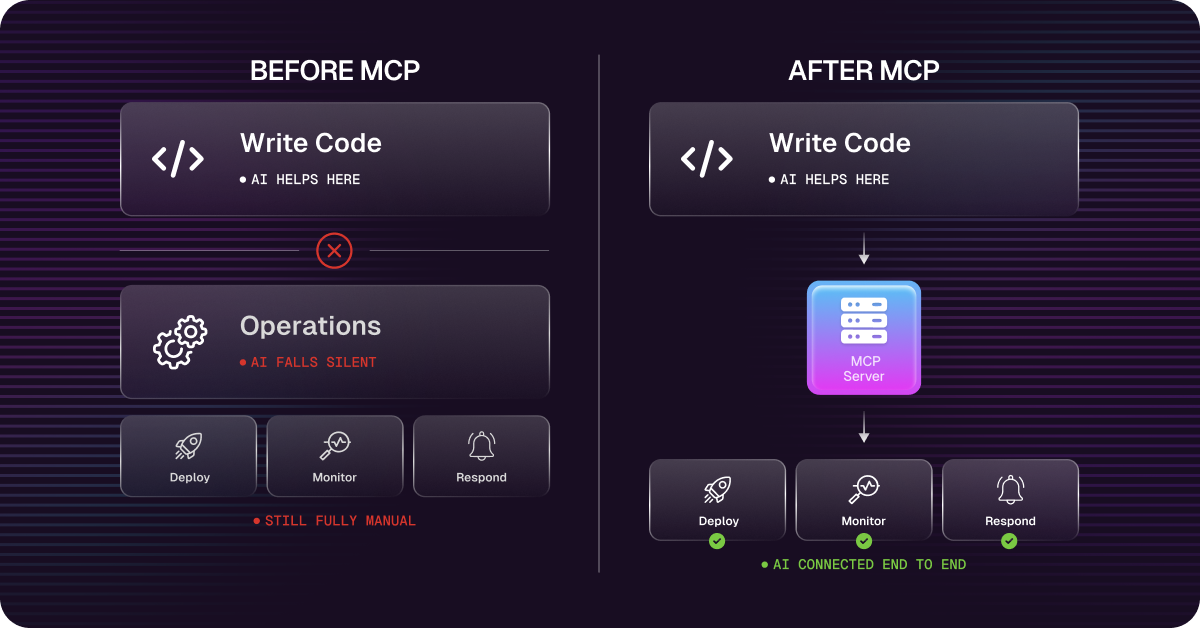
MCP servers break through that ceiling. By giving AI agents live access to your IaC tooling, CI/CD pipeline, and deployment infrastructure, you extend AI productivity from the editor into the full software delivery lifecycle. The agent that helped a developer write a service can now provision the infrastructure for it, review the deployment plan, monitor the rollout, and triage the first alert — all with live context, not guesswork.
For teams that have already invested in AI-assisted development, MCP-connected operations are the natural next step. It's how you turn "AI that writes code" into "AI that ships and operates code."
Benefit 5: Eliminating Cloud Cost Waste with AI Visibility
Cloud infrastructure costs are growing faster than teams can track. "Our cloud bill grows 30% year-over-year, but our traffic only grew 10%. Nobody can explain the gap." This is a common engineering reality — not a finance failure, a visibility failure. The data exists across cost explorer dashboards, utilization reports, and resource configs. No single engineer has time to synthesize it.
With an MCP server connected to your cloud cost and resource data, your AI agent does that synthesis continuously. It identifies staging environments running at full capacity over the weekend when nobody is using them. It flags services provisioned for 10x peak load with no auto-scaling. It surfaces the FinOps recommendation that's been sitting in a spreadsheet for six months because nobody had the bandwidth to action it.
"We know we're over-provisioned. We just don't have the confidence to right-size without risking an outage." MCP-connected AI solves both sides: it gives you environment-grounded analysis to know exactly what to change, and the context to assess the actual blast radius.
StackGen's Platform Integrations connect Aiden to your cloud provider cost APIs and resource configurations — so cost optimization becomes something AI reasons about proactively, not after the CFO asks.
Benefit 6: Scaling Platform Teams Without Scaling Headcount
Platform teams face a structural scaling problem. As engineering orgs grow, infrastructure request volume grows linearly — but platform headcount never keeps pace. The result: the platform team becomes the bottleneck, developer velocity suffers, and platform engineers spend their day processing requests instead of building platform capabilities.
MCP-enabled workflows attack this directly.
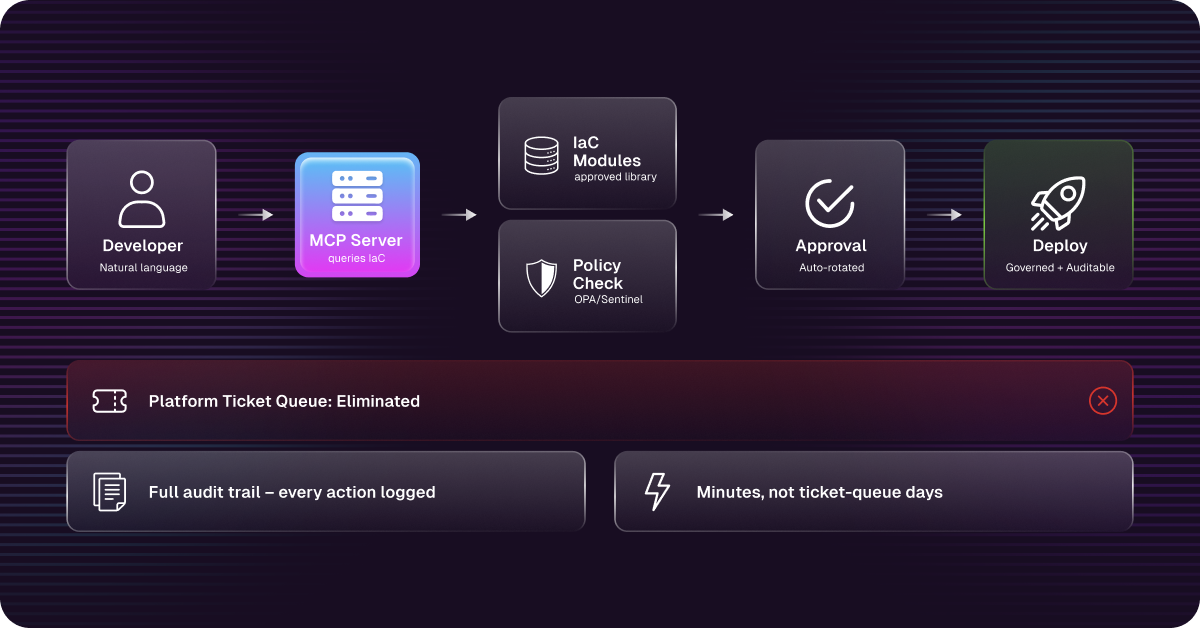
With an MCP server connected to your IaC tooling, a developer describes what they need in natural language ("same PostgreSQL spec the payments team uses, eu-west-1, GDPR-compliant tagging"), the AI agent queries existing infrastructure for reference configurations, generates a Terraform plan against your approved module library, validates it against policy-as-code rules, and routes it to the appropriate approval workflow — all in minutes, without a platform team ticket.
We've detailed how this works in our post on deploying and governing Cloud IaC with StackGen MCP and Cursor. Developers go from natural language intent to a governed, policy-compliant Terraform deployment without leaving their IDE.
For platform teams processing 50+ infrastructure requests a week, this is the difference between a team that's always behind and a team that's actually building. Engineers who used to review routine Terraform plans all day are now designing internal developer platforms and building the infrastructure capabilities that actually move the business.
StackGen's Solutions for Platform Engineering covers how we approach this workflow at scale.
Benefit 7: Auditability and Governance That Scales with AI
If an AI agent takes an action, who's responsible? How do you prove what happened, and why, when your auditor asks six months later?
MCP architectures answer this by making the full interaction chain explicit and immutable. Every action is traceable to a specific tool invocation with specific parameters, a timestamp, the data the agent queried, and the reasoning it applied. That creates an audit trail that's typically far more complete than what you'd get from engineers making ad-hoc changes through direct CLI access — where the change itself might be logged, but the why behind it rarely is.
"Every SOC 2 audit, the infrastructure section is the part that keeps me up at night." For teams under SOC 2, ISO 27001, GDPR, or internal governance mandates, MCP-connected operations with policy-as-code enforcement directly address this. Drift between what's in code and what's actually deployed gets detected automatically. Changes that would violate policy are blocked before they execute. Approval workflows are enforced programmatically, not by hoping the right person was in the right Slack thread.
"We failed an audit because we couldn't prove who approved an infrastructure change six months ago." With MCP, that question has a complete, queryable answer — because every change went through a documented, agent-mediated workflow.
StackGen's Solutions for Platform Engineering covers how we approach governance within agentic workflows at scale.
Benefit 8: The AI-in-Production Proof Point Boards Are Asking For
Engineering leaders are under specific pressure in 2026. Boards and executives want to see AI delivering operational outcomes they can point to in a quarterly review — not just faster syntax completion for individual engineers. "We've rolled out Copilot for code generation" no longer satisfies the question.
MCP-connected agentic operations are the proof point it demands. When your AI agent is querying live infrastructure, proposing and executing Terraform plans, triaging production alerts, correlating cost anomalies with deployment events, and routing compliance-relevant changes through documented approval workflows — that's AI in production with outcomes you can measure: MTTR reduction, provisioning cycle time, toil cost per engineer, compliance audit pass rate.
It also forces a useful discipline: giving an AI agent a coherent operational context requires consolidating your tooling and standardizing interfaces. Teams adopting MCP for agentic operations frequently report solving a years-old problem as a byproduct — the ten siloed tools that didn't talk to each other are now connected through a common operational fabric.
Uber's internal AI SRE system (Genie) saves 13,000 engineer hours per year. Microsoft's Azure SRE Agent initiative saves 20,000 hours. Nine hyperscalers — Meta, Uber, Google, Microsoft, eBay, AWS, Slack, Instacart, Mercari — have built internal GenAI operations systems. The market has validated this category. The question for engineering leaders isn't whether AI-powered operations deliver ROI — it's whether you want to build it yourself or adopt a platform built specifically for it.
For engineering leaders preparing the internal business case, StackGen's Platform Overview and Solutions for Engineering Leaders are the right starting points.
Getting Started: A Practical Sequencing Guide
If you're evaluating MCP servers for your team, the right starting point is a bounded, high-value read-only use case that delivers visible results without requiring change authorization. Three patterns that consistently work:
For SRE teams: Connect your observability stack through MCP for initial alert triage. The agent correlates firing alerts, cross-references recent deployments, checks for infrastructure drift, and generates a prioritized hypothesis list — so the engineer who gets paged at 2 AM starts with context, not 400 uncorrelated alerts.
For platform engineering teams: Connect your IaC tooling for Terraform plan review. The agent summarizes what a plan will actually change in plain language — so reviewers don't have to parse 200 lines of Terraform plan output to spot the one line that quietly removes a security group rule.
For DevOps teams: Connect your CI/CD pipeline for deployment pattern analysis. The agent surfaces correlations between test failure rates, deployment frequency, and incident volume — the kind of cross-cutting analysis that normally lives in a senior engineer's head rather than any dashboard.
In all cases: start with read access, demonstrate value, then expand action scope incrementally as trust is established. The teams that get the most out of MCP treat it as a progressive confidence-building exercise — not a single "flip the switch to AI" moment.
StackGen's MCP Server is available now. Explore how teams are using it on our Solutions for DevOps page, or schedule a demo with our team.
The Bigger Picture: From AI Copilot to AI Operations Platform
The copilot model — AI that helps engineers write code faster — is genuinely valuable. But it leaves 70% of the engineering workflow untouched. Deployment, operations, incident response, cost management, compliance — everything that happens after the code is written — is still largely manual.
MCP-connected AI is what changes that equation. When your AI agent has real-time access to your cloud environment, your observability data, your IaC state, your deployment history, your cost data, and your incident log, it can reason about your systems with the kind of operational awareness that used to require years of institutional knowledge to develop — and that walks out the door every time a senior engineer leaves.
That's what we're building at StackGen. Not AI tools that make individual engineers incrementally faster, but AI agents that make your entire operations platform systematically smarter by connecting intelligence to the live state of everything that matters.
Ready to see what MCP-connected AI can do for your team? Explore StackGen's MCP Server or schedule a demo with our team.