

Share This:
How AI Coding Tools Exposed Infrastructure as the Primary Bottleneck
There's a profound imbalance emerging in software development, and it's hiding in plain sight.
Walk into any modern software company and you'll witness a strange contradiction.
Developers are writing code faster than ever—10x faster in many cases—powered by AI assistants like GitHub Copilot, Cursor, and Claude. They're shipping features, refactoring systems, and solving complex problems at a velocity that would have seemed impossible just two years ago.
Yet these same developers are still waiting days or weeks for infrastructure. They're still filling out tickets. They're still blocked on environments. They're still waiting for DevOps to provision a database or configure a network policy.
The equilibrium that once existed between developers and platform teams has been completely shattered. And most organizations haven't even noticed.
The Old Equilibrium
For decades, software development operated under an implicit social contract. Developers wrote code at a certain velocity. Platform and DevOps teams provisioned infrastructure at a roughly matching pace. Sure, there were bottlenecks and complaints, but the system was basically in balance.
When a developer spent two weeks writing a new microservice, it was reasonable for infrastructure provisioning to take a few days. When refactoring a monolith took a quarter, a week or two to set up new environments felt acceptable. The ratio between coding velocity and infrastructure velocity was roughly stable.
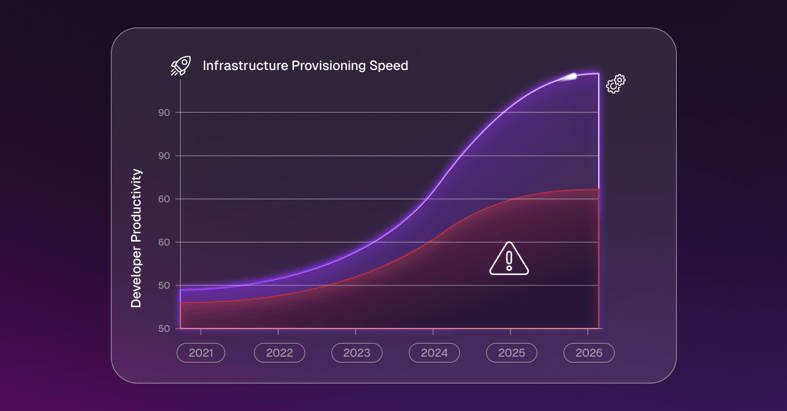 This equilibrium shaped how organizations thought about team sizing, processes, and tooling. Platform teams could operate with traditional ticket-based workflows because the volume of requests was manageable. Developers accepted some friction because infrastructure was inherently complex and required specialized expertise.
Everyone understood their role. Developers built features. Platform engineers built infrastructure. DevOps managed deployments. It wasn't perfect, but it worked well enough.
DevOps managed deployments. It wasn't perfect, but it worked well enough.
The Copilot Revolution
Then, almost overnight, everything changed.
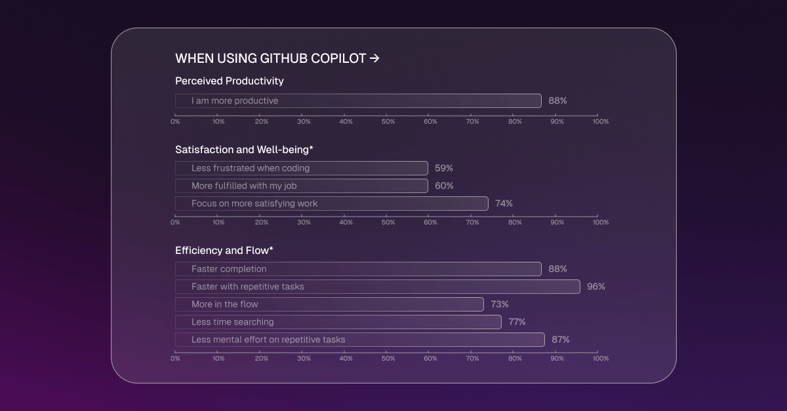
GitHub Copilot launched in 2021. Within two years, 95% of developers reported using AI coding assistants. Tools like Cursor, Claude Code, and others emerged, each pushing the boundaries of what AI could do for software development.
The impact was immediate and measurable. Studies showed developers completing tasks 55% faster. Some organizations reported 2-3x productivity gains. Developers who once spent hours debugging obscure errors were now solving them in minutes. Junior developers were writing code at senior-level quality. Complex refactoring projects that would have taken weeks were done in days.
But here's what nobody anticipated: infrastructure didn't speed up.
 The same developer who could now prototype an entire microservice in an afternoon still had to wait three days for a database to be provisioned. The team that could refactor their authentication system in a week still spent two weeks waiting for the platform team to configure proper network isolation. The product manager celebrating a 10x increase in development velocity was still seeing the same 2-5 day lead time for infrastructure changes.
AI didn't just make developers faster—it exposed infrastructure as the primary bottleneck in modern software delivery.
The Speed Mismatch Problem
This speed mismatch isn't just annoying. It's economically devastating.
Consider a typical enterprise scenario. You invest in AI coding tools for your 200 developers, spending perhaps $500,000 annually on licenses. Your developers become dramatically more productive—let's say 3x faster at writing code. On paper, you've just gained the equivalent of 400 additional developers. That's $40-80 million in theoretical value creation.
But your platform team—let's say 10 DevOps engineers—is still processing infrastructure tickets at the same rate as before. They're still manually reviewing Terraform configurations. They're still scheduling change windows. They're still operating with the same tools and processes they had when developers were 3x slower.
What actually happens? Your developers write code 3x faster, then sit idle waiting for infrastructure. Or worse, they find workarounds. They spin up unmanaged resources. They bypass governance policies. They create the exact kind of infrastructure chaos that your platform team was designed to prevent.
You've accelerated one half of the value chain while leaving the other half untouched. It's like upgrading to a fiber optic internet connection but keeping a dial-up modem at the last mile.
The result is predictable: your ROI on those AI coding tools is a fraction of what it should be. Your developers are frustrated. Your platform team is overwhelmed. Your infrastructure is becoming increasingly fragmented and ungoverned.
Why Infrastructure Can't Keep Up
The obvious question is: why can't platform teams just move faster?
The answer reveals a deeper problem. Infrastructure provisioning isn't just slower than coding—it's fundamentally different in nature.
When a developer writes code, they're working primarily with abstractions that exist in their IDE. They can iterate quickly, test locally, and use AI to help with every step. The feedback loop is tight. The tools are modern. The process is optimized for velocity.
When a platform engineer provisions infrastructure, they're dealing with real, stateful resources in production environments. They need to consider security, compliance, cost, networking, disaster recovery, and a dozen other concerns. They can't just "iterate quickly" because mistakes have real consequences. A bad code commit can be reverted; a misconfigured network policy can expose customer data.
Moreover, infrastructure provisioning typically happens through manual workflows designed for a different era. A developer wants a new environment? That's a ticket in JIRA. The ticket gets triaged, prioritized, assigned. The engineer manually writes Terraform. The Terraform goes through review. The review identifies issues. Back and forth. Eventually, days or weeks later, the infrastructure exists.
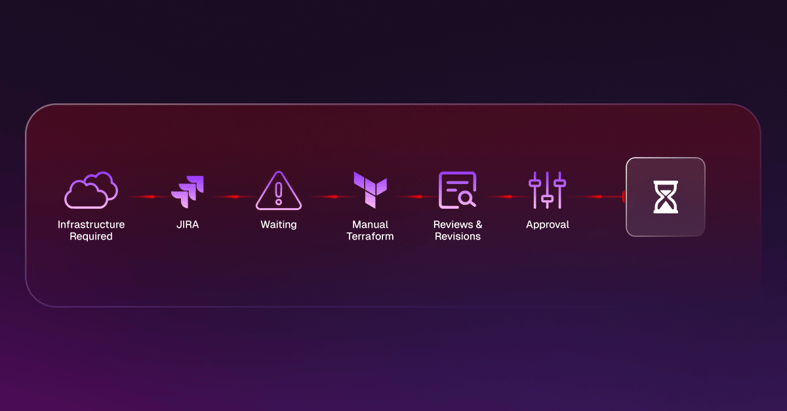 These workflows weren't designed for speed—they were designed for control, visibility, and safety. And in a world where developers wrote code at a measured pace, that trade-off made sense.
But in a world where developers write code 10x faster, these workflows have become the primary constraint on value delivery.
The Hidden Cost
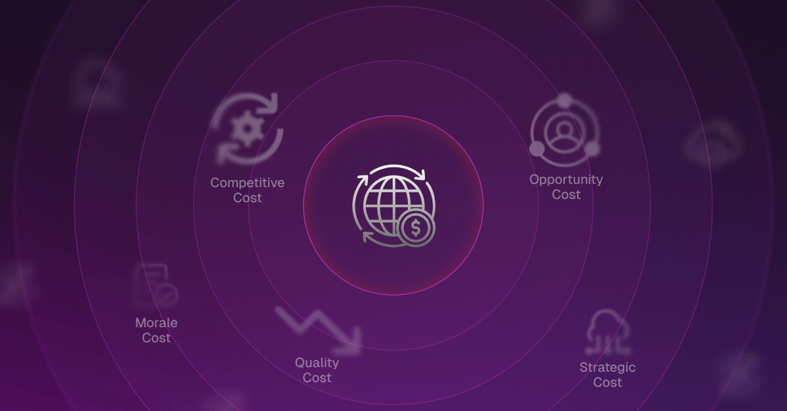
The speed mismatch creates costs that don't appear on any balance sheet.
Opportunity cost of delayed features. When your developers finish code but wait for infrastructure, you're not just delaying one feature—you're delaying every feature that depends on that infrastructure. The compound effect is enormous.
Quality cost of workarounds. Developers under pressure will find ways around slow processes. They'll create unmanaged resources, skip proper governance, or build on top of inappropriate infrastructure. You're trading short-term velocity for long-term technical debt.
Morale cost of chronic frustration. Your best developers—the ones who've learned to work at AI-accelerated speeds—are the ones most frustrated by infrastructure delays. They're also the ones most likely to leave for organizations that have solved this problem.
Strategic cost of reduced experimentation. When infrastructure takes days to provision, you can't afford to experiment. You can't test multiple approaches. You can't fail fast. You're forced back into waterfall-style planning, even though your development process has become radically more agile.
And perhaps most critically, the competitive cost. While you're waiting for infrastructure, your competitors—the ones who've solved the speed mismatch—are shipping, learning, and iterating. They're occupying market positions that you'll never recover.
The False Solutions
Organizations are trying to solve this problem, but most solutions miss the mark.
Some companies respond by hiring more DevOps engineers. This helps at the margins, but it doesn't scale. Adding people to a fundamentally manual process doesn't make it fast—it just makes it expensive. And you still can't hire DevOps engineers as quickly as AI is accelerating your developers.
Others try to solve it with better tooling—adopting the latest Internal Developer Platform or Infrastructure-as-Code framework. These help, but they're still asking developers to work in the old paradigm: forms, YAML files, configuration management. They've digitized the ticket queue, but they haven't eliminated it.
Some organizations attempt to solve it by giving developers direct access to infrastructure. This often ends badly. Developers optimized for velocity start provisioning resources without proper governance, security, or cost controls. The platform team spends all their time cleaning up after disasters instead of preventing them.
The problem isn't that we lack tools. The problem is that we're trying to solve an AI-era problem with pre-AI-era thinking.