


Share This:
Introduction
Your developers submitted an infrastructure request three days ago. It's still waiting for approval. Meanwhile, your competitors shipped twice.
This isn't a failure of your platform team—it's a failure of the TicketOps model itself. The same workflows designed to bring order and auditability to infrastructure have become the primary bottleneck to developer velocity in enterprise organizations. As software delivery accelerates, the gap between ticket-based provisioning and modern development speed becomes untenable.
In this post, we explore why traditional approval queues are breaking down, how agentic AI workflows are replacing them, and what this paradigm shift means for platform engineering teams ready to unlock self-service at scale.
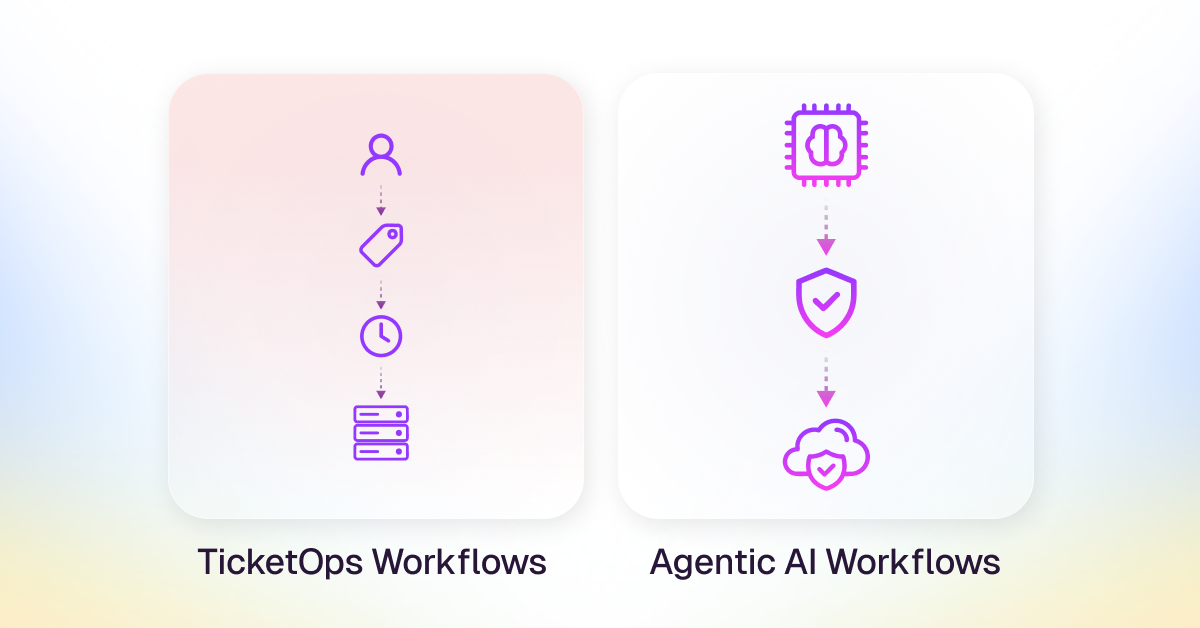
The TicketOps Model: Safety at the Expense of Flow
TicketOps evolved with good intentions. Developers submit tickets, platform teams review them, security teams approve them, and infrastructure is eventually provisioned. The model brought structure and audit trails to what was once chaotic, ad-hoc infrastructure management.
But "eventually" is doing a lot of heavy lifting in that sentence.
Human approval latency remains the most visible problem. Even routine, low-risk requests—spinning up a dev environment, adding a database replica—wait hours or days for human review. When a senior engineer's time is the gating factor for every provisioning request, queues grow faster than they shrink. According to Percona's analysis, a single manual database request costs an average of $1,140 in human capital—representing lost time for developers waiting, DBAs executing, and managers approving.
Context loss compounds the delay. Tickets rarely capture full developer intent. What does "I need a database" actually mean? What compliance requirements apply? What's the service boundary? The result is back-and-forth clarification that adds days to what should take minutes.
Linear scaling presents the structural challenge. As developer headcount grows and cloud footprints expand, approval queues scale linearly. Double your engineering team, double your ticket volume—while your platform team size stays flat. The math doesn't work. The 2024 State of DevOps Report from DORA (DevOps Research and Assessment) confirms that high-performing organizations achieve lead times 127 times faster than low performers—a gap that ticket-based workflows simply cannot close.
Shadow IT emerges as the inevitable consequence. When approved pathways take days, developers find workarounds. They spin up resources outside governed processes, putting security compliance and cost management at risk. The very controls meant to ensure safety create conditions that undermine it.
TicketOps optimizes for safety at the expense of flow, creating friction precisely where modern software teams need speed.
The Paradigm Shift: From Human Approvals to Policy-Driven Autonomy
Agentic AI workflows flip the model. Instead of human approvers evaluating each request, the system itself becomes intelligent—interpreting intent, enforcing policy, and provisioning infrastructure autonomously within pre-defined bounds. Deloitte predicts that by 2027, 50% of companies using generative AI will have launched agentic AI pilots—and infrastructure provisioning is a prime use case.
This shift centers on two core concepts: Golden Paths and Guardrails.
Golden Paths: Making the Right Choice the Easy Choice
Golden Paths are curated, pre-approved infrastructure blueprints—standardized IaC modules and reference designs that make the secure, compliant choice the easiest path for developers to follow. The term was popularized by Spotify, which uses Golden Paths to solve ecosystem fragmentation (Netflix calls the same concept a "Paved Road").
The concept isn't new. What's new is how agentic systems apply it. Instead of requiring developers to navigate documentation, select the right module, and configure parameters correctly, an AI agent can interpret natural-language requests and map them directly to the appropriate Golden Path.
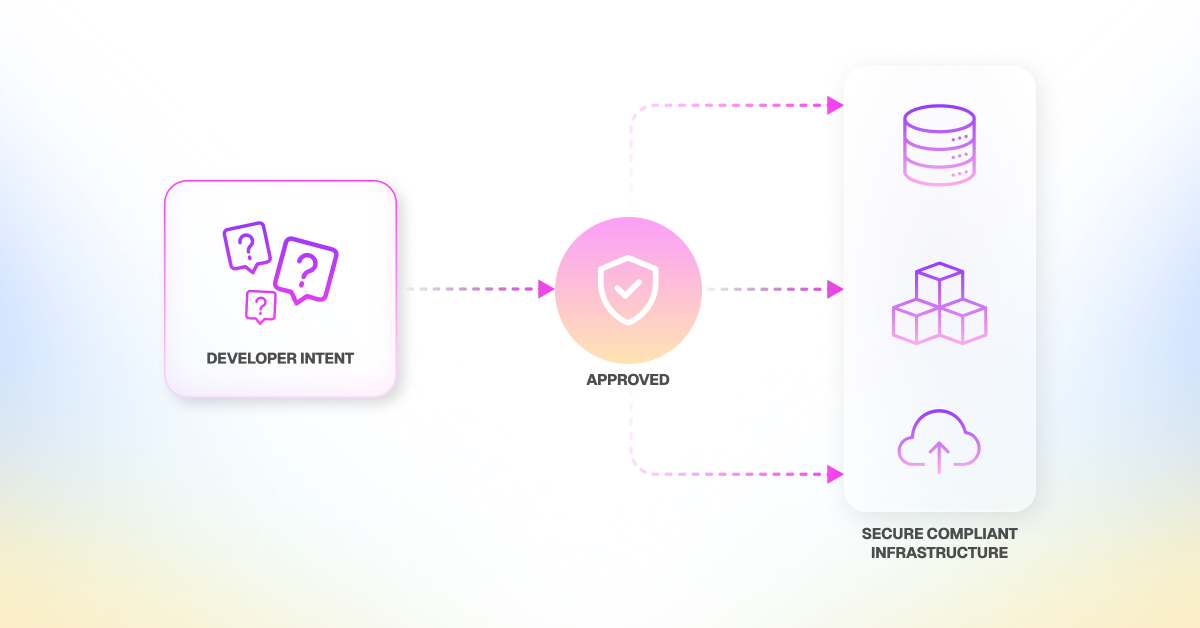
A developer says "I need a PCI-compliant Postgres database for my new service." The agent understands the compliance requirement, identifies the approved blueprint, and provisions it—without the developer needing to know which Terraform module implements PCI controls.
As Humanitec's CEO notes, platform teams should prioritize Golden Paths for "day 50, not day 1"—focusing on the ongoing operations that consume 99% of an application's lifecycle rather than just initial scaffolding.
Guardrails: Non-Negotiable Bounds at Machine Speed
Guardrails encode the security mandates and compliance standards that platform teams would otherwise enforce through manual review. They're the policies that define what operations are acceptable—and they execute at machine speed, not human speed.
When a request falls within guardrails, it proceeds automatically. When it doesn't, the system can either reject it with clear feedback or escalate to human review. The key difference: escalation becomes the exception, not the rule.
Guardrails maintain the integrity that TicketOps aimed to provide—but they apply it earlier, more consistently, and without queue latency.
What Agentic Infrastructure Workflows Look Like in Practice
In a modern platform engineering system with agentic self-service, the developer experience transforms fundamentally. Gartner predicts that by 2026, 75% of organizations with platform engineering teams will provide internal developer portals—up from 45% in 2023.
Consider the workflow: A developer needs infrastructure for a new service. Instead of navigating a ticketing system, selecting categories, filling out forms, and waiting, they describe what they need in natural language through an AI interface.
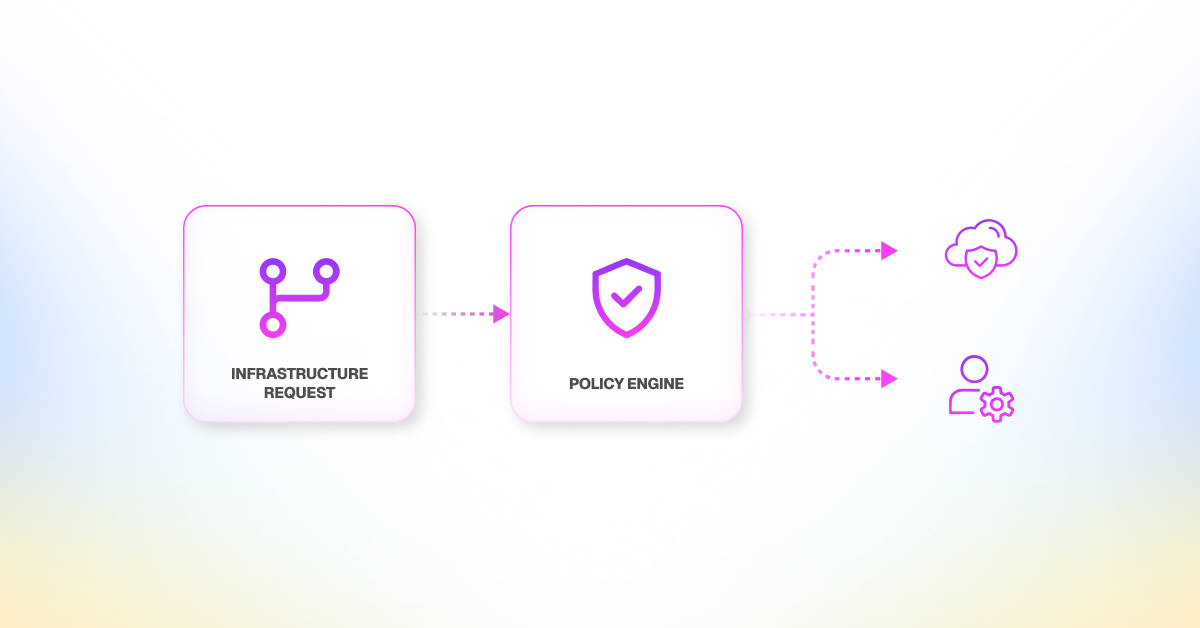
The agent interprets the request and its context—parsing not just what the developer asked for, but what compliance requirements apply based on the service, team, and data classification. It autonomously determines the appropriate Golden Path, provisions the cloud resources via infrastructure-as-code, and summarizes the actions taken for the developer.
The SIEM and Internal Developer Portal update automatically. No ticket. No queue. No waiting for a platform engineer to context-switch from their own work. As Atlassian's IDP guide explains, Internal Developer Platforms "offer a self-service platform that abstracts the complexities of infrastructure, deployment, and environment management."
Critically, requests that fall outside approved bounds still get human attention. But those requests represent perhaps 10% of total volume—the genuinely novel, high-risk, or ambiguous cases that warrant expert review. The other 90% of ticket-related toil simply disappears.
The Compounding Impact on Developer Velocity
This paradigm shift delivers benefits that compound over time. McKinsey's research shows that companies using agentic AI are moving from experimentation to transforming core processes—automating complex business workflows to shift AI from reactive to genuinely autonomous.
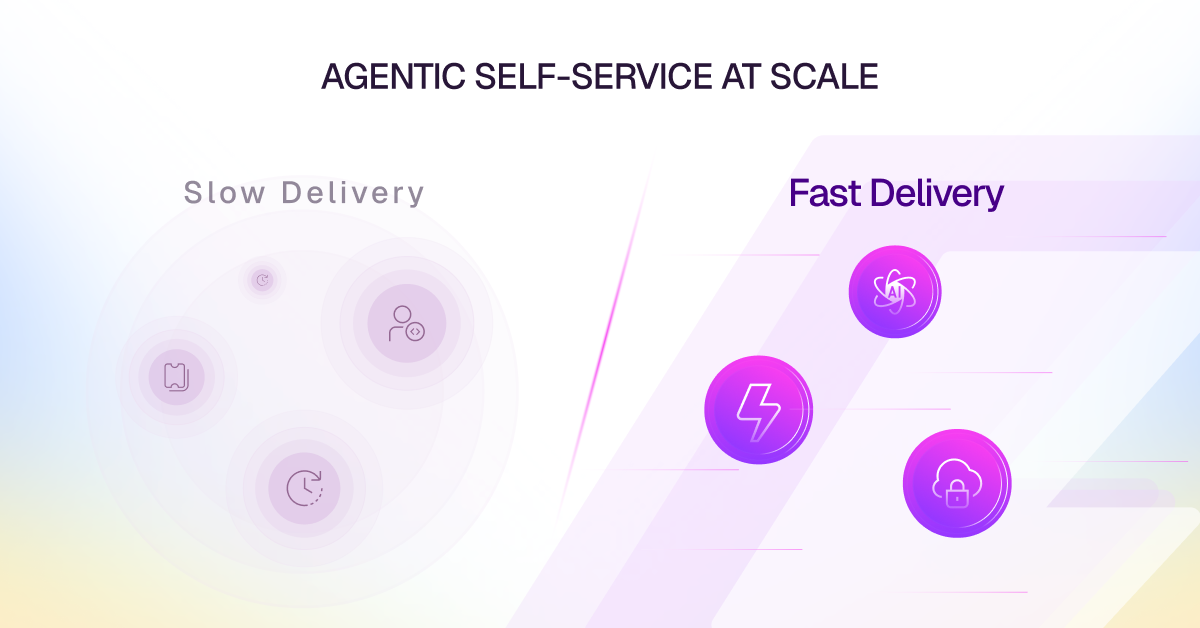
Provisioning time drops from days to minutes. When compliant infrastructure is available on-demand, developers stop planning around approval queue latency. Feature work that previously required scheduling infrastructure requests a week in advance can happen same-day.
Platform teams escape interrupt-driven work. The cognitive cost of context-switching to review routine tickets disappears. Platform engineers can focus on improving the platform itself—building better Golden Paths, refining guardrails, and solving genuinely complex problems.
Consistency and security actually improve. When policies are enforced computationally rather than through individual reviewer judgment, enforcement becomes uniform. No more variance based on which platform engineer reviews the request or how tired they are at 4 PM on Friday. The DORA metrics framework confirms that high-performing teams achieve both higher deployment frequency and lower change failure rates—velocity and stability aren't a tradeoff when automation enforces consistency.
Developer experience transforms. Clear, immediate feedback replaces opaque queues. Developers know instantly whether their request succeeded or what they need to change. The platform becomes a product that serves them, not a bureaucracy that blocks them.
The counterintuitive result: velocity increases without weakening controls. In many cases, security posture improves because enforcement is automated, deterministic, and comprehensive.
What This Means for Platform Engineering Teams
The transition from TicketOps to agentic workflows represents a fundamental change in how platform teams deliver value. The Platform Engineering community emphasizes treating Internal Developer Platforms as products—with clear MVPs, user research, and iteration cycles.
The work shifts from processing requests to defining policy. Instead of reviewing individual tickets, platform engineers encode their expertise into Golden Paths and guardrails that scale infinitely. A well-designed Golden Path handles its thousandth request as easily as its first.
The relationship with developers transforms from gatekeeper to enabler. When the platform delivers self-service that actually works—fast, secure, low-friction—developers stop viewing it as an obstacle to work around. As Red Hat's Golden Path guide notes, these patterns allow "development teams to build more efficiently in ways that meet organizational standards."
The metrics that matter change. Ticket queue depth and approval latency become irrelevant when most requests don't generate tickets. Teams can focus on platform adoption, developer satisfaction, and the sophistication of available Golden Paths.
Moving Forward
The transition from TicketOps to agentic AI workflows isn't about removing control—it's about applying control earlier, more precisely, and at machine speed. By front-loading decision-making into guardrails and approved Golden Paths, organizations replace slow, human-centric approval chains with fast, autonomous systems that scale.
For platform engineering teams evaluating this shift, the question isn't whether to make it, but how quickly. As software delivery continues to accelerate, agentic infrastructure workflows will become a prerequisite for competitive developer velocity.
The approval queue era is ending. What replaces it delivers both the speed developers need and the governance enterprises require.
Ready to eliminate infrastructure approval bottlenecks? Learn how StackGen's agentic platform engineering capabilities deliver self-service infrastructure at enterprise scale.