


Share This:
It's 3 a.m. when the alert fires the fourth one this week for the same flaky dependency. Whoever's on call takes 12 minutes just to acknowledge it, because they're not sure yet if it's real. That delay, repeated across thousands of incidents, is why StackGen's analysis of 80,743 real incidents across 360 companies and 22 industries in the State of Enterprise Reliability 2026 dataset found a median MTTR of 101 minutes, with only 34.9% of incidents resolved inside the first hour.
Most of that 101 minutes isn't spent fixing anything. It's spent figuring out what's happening, who owns it, and whether it's the same problem as last Tuesday. Alert fatigue and toil, not lack of engineering talent, are the biggest drivers of slow MTTR, and they're also the #1 reason SRE teams cite for evaluating new tooling in the first place, ahead of incident response itself.
This blog covers 10 SRE best practices for reducing MTTR, ranked by leverage, and backed by real incident-level patterns rather than generic advice.
Quick-reference stats (State of Enterprise Reliability 2026, StackGen):
- Median MTTR across 80,743 incidents: 101 minutes
- Mean MTTR: 265.4 minutes a long tail of major incidents pulls this far above the median
- P90 MTTR: 491.8 minutes
- Incidents resolved under 1 hour: 34.9%
- Average repeat-incident rate across 342 companies: 21%
- Top root-cause categories: Network/DNS (12.4%), Application Errors (10.2%), Performance Degradation (8.6%)
Get the detailed report of State of Reliability 2026
What Is MTTR and Why Does It Matter for SRE Teams?
MTTR (mean time to resolution) measures the average time between an incident starting and service being fully restored. It's the clearest proxy SRE teams have for reliability, on-call burden, and customer trust. A team with a 4-hour MTTR spends 4x longer in a degraded state than a team with a 1-hour MTTR, for the same incident volume.
The gap between median and mean MTTR in the benchmark data tells the real story: most incidents get handled reasonably fast, but a long tail of slow, ambiguous incidents drags the average up. Reducing MTTR isn't one problem; it's a toil problem (alert noise, manual triage, repeat incidents) stacked on top of a small number of genuinely hard incidents. The 10 practices below target both.
The 10 Best Practices for Reducing MTTR
1. Cut Alert Noise Before You Chase MTTR
Teams that report the worst MTTR almost always report the same root complaint first: too many alerts, not enough signal. Operational toil, alert fatigue, manual triage, and repetitive firefighting are the single largest drivers of SRE tool evaluations, well ahead of incident response itself, because it's the thing burning out senior engineers and slowing down every incident before anyone starts real debugging. Audit alert volume per on-call rotation and cut anything with a false-positive rate above 80% before optimizing anything downstream.
2. Fix Alert Routing Before You Fix Alerts
In the benchmark dataset, Network/DNS issues (12.4% of incidents) and Application Errors (10.2%) are the two largest root-cause categories after the catch-all "Other" bucket. Both are notorious for landing on the wrong team's pager first. Every minute an incident sits with the wrong on-call engineer is a minute added to MTTR before anyone has started debugging. Map root-cause categories to owning teams explicitly, and route on signal pattern, not on which service happened to alert first.
3. Standardize Root Cause Analysis with Runbooks
Ad hoc RCA is slow because every engineer re-derives the same diagnostic steps under pressure and because the context is scattered across logs, metrics, traces, and last week's Slack thread. Runbooks that encode "if you see X symptom, check Y first" cut the diagnostic phase dramatically for known failure modes. This matters most for Performance Degradation incidents (8.6% of the dataset), which have several plausible causes and reward structured elimination over guesswork.
4. Track Repeat Incidents as a Leading Indicator
Across the dataset, the average repeat-incident rate is 21%; roughly one in five incidents is a recurrence of a previously seen problem. A repeat rate above 15–20% signals that RCA is identifying symptoms, not root causes. Reducing MTTR sustainably means closing the loop: every postmortem should produce a fix or a monitoring change that prevents recurrence, not just a summary nobody reopens.
5. Separate "Detect," "Triage," and "Remediate" as Distinct Clocks
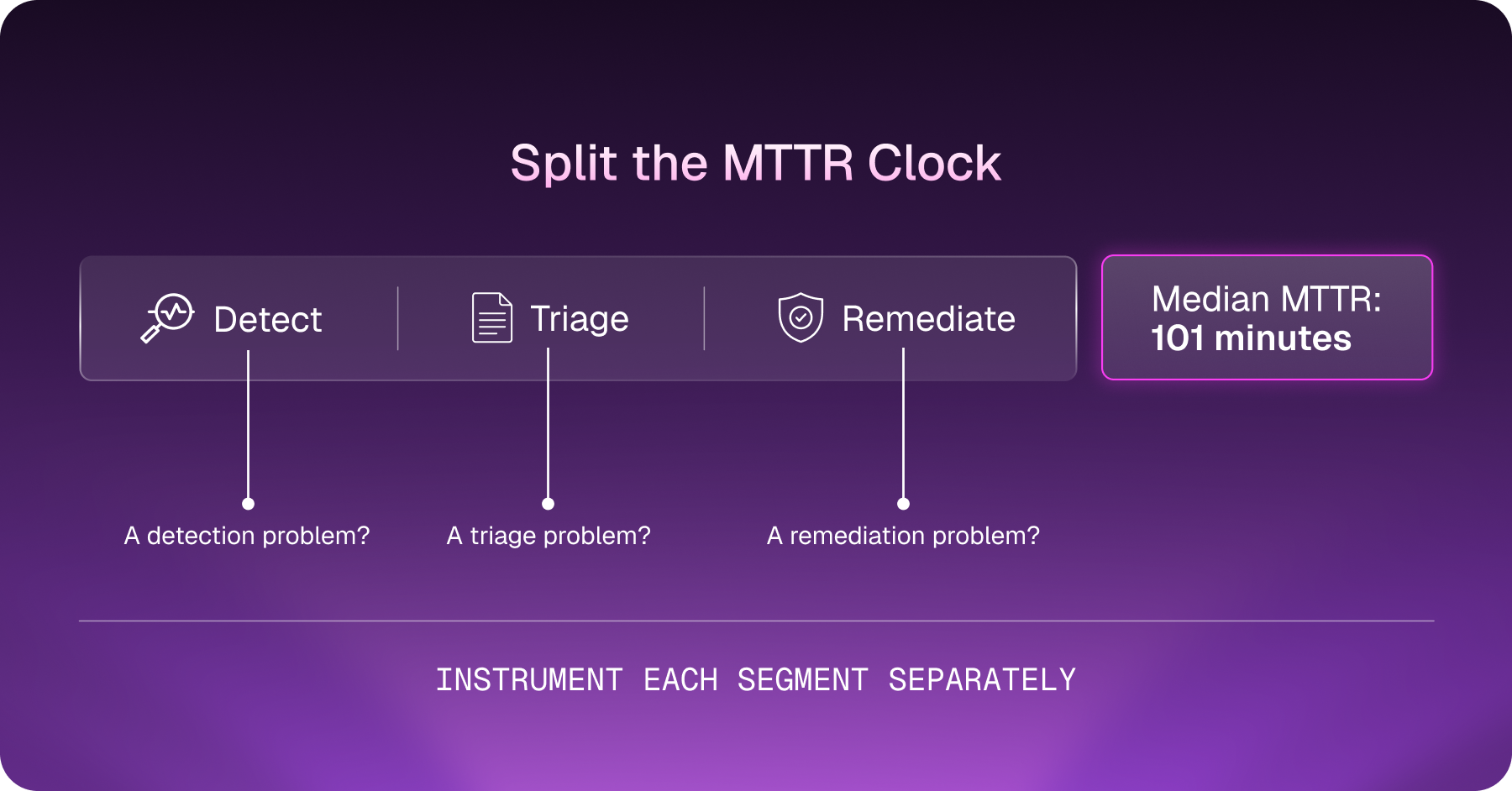
Teams that only measure total MTTR can't tell whether they have a detection problem, a triage problem, or a remediation problem and they end up investing in the wrong fix. Split the clock into three segments and instrument each separately. This is also the fastest way to prove ROI when introducing AI-assisted detection or automated triage, since you can show exactly which segment shrank.
6. Automate the Toil, Not the Judgment
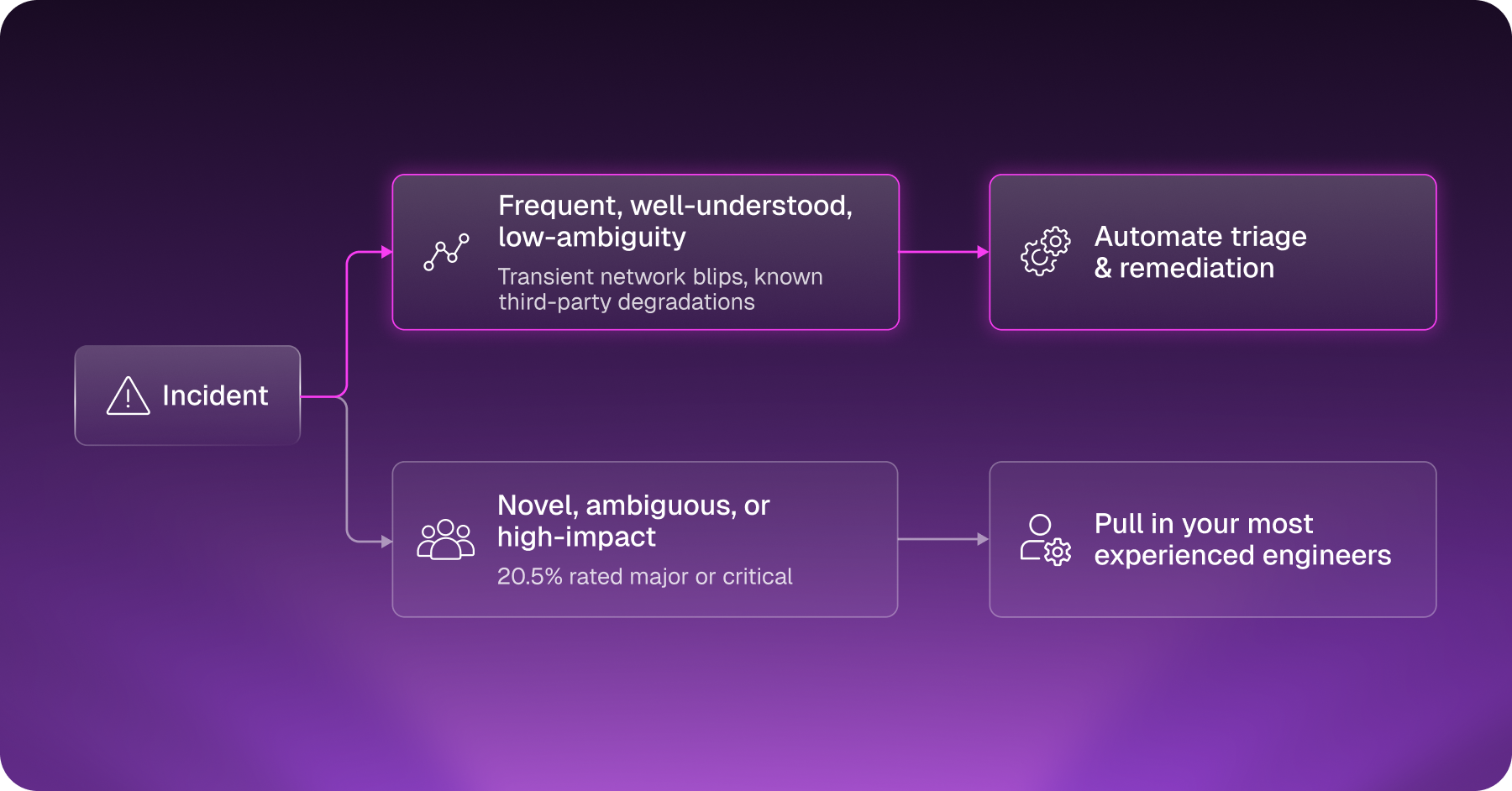
Not every incident needs a human making a judgment call. Frequent, well-understood, low-ambiguity incidents transient network blips, known third-party degradations — are the best candidates for automated triage and remediation. This is where AI-powered SRE tooling delivers the fastest, best-evidenced payoff: pattern-matching known incident types, not replacing engineering judgment on novel ones.
7. Reserve Human Judgment for the Long Tail
The dataset's P90 MTTR (491.8 minutes) versus its median (101 minutes) shows exactly where expertise still matters most: the small share of incidents that are genuinely novel, ambiguous, or high-impact a combined 20.5% of incidents rated "major" or "critical." Don't try to automate these away. Make sure your most experienced engineers are pulled in the moment an incident trends toward major impact, not 40 minutes in after automated triage has already exhausted its playbook.
8. Reduce Blast Radius with Progressive Rollouts
A meaningful share of incidents originate from deployments and configuration changes. Feature flags, canary releases, and progressive rollout patterns don't just prevent incidents they cap how bad the ones that do happen can get, directly compressing the long tail that drives mean MTTR up. This is an infrastructure investment that pays off precisely in the incidents that hurt the most.
9. Build a Real Postmortem Culture, Not a Compliance Ritual
Postmortems that exist to satisfy a process requirement don't move MTTR. Postmortems that produce specific, owned, dated action items do because they're the mechanism that turns "we had an incident" into "we now detect this 20 minutes faster." Track postmortem action-item completion rate as seriously as MTTR itself; it's a leading indicator for next quarter's number.
10. Benchmark Against Your Actual Sector, Not the Industry Average
"Good MTTR" varies by sector. In the State of Enterprise Reliability 2026 dataset, the Observability & Monitoring sector posts a median MTTR of 92 minutes across 23 companies and 1,815 incidents faster than the 101-minute cross-industry median, consistent with that sector's tooling maturity. Comparing your team to a generic industry number can make a genuinely strong team look mediocre, or a weak one look fine. Benchmark against your actual peer segment.
Who's Already Winning This: Real-World MTTR Reduction Numbers
Reducing MTTR through automation isn't theoretical it's already been proven publicly by teams operating at scale:
- Uber's internal "Genie" GenAI SRE system is reported to save engineering teams roughly 13,000 hours per year by automating incident triage and diagnosis.
- Snap's internal BACCA system is reported to have driven a 55% reduction in MTTR.
- At least nine hyperscalers, including Meta, Uber, Google, Microsoft, eBay, AWS, Slack, Instacart, and Mercari, have built internal GenAI-powered SRE systems, validating AI-driven incident response as a proven category rather than an emerging bet.
These are large, well-resourced engineering organizations but the underlying mechanism (faster detection, automated triage, accelerated RCA) is exactly what practices #1, #5, and #6 above describe, and it's available without building it in-house.
What Should SRE Teams Do First to Reduce MTTR?
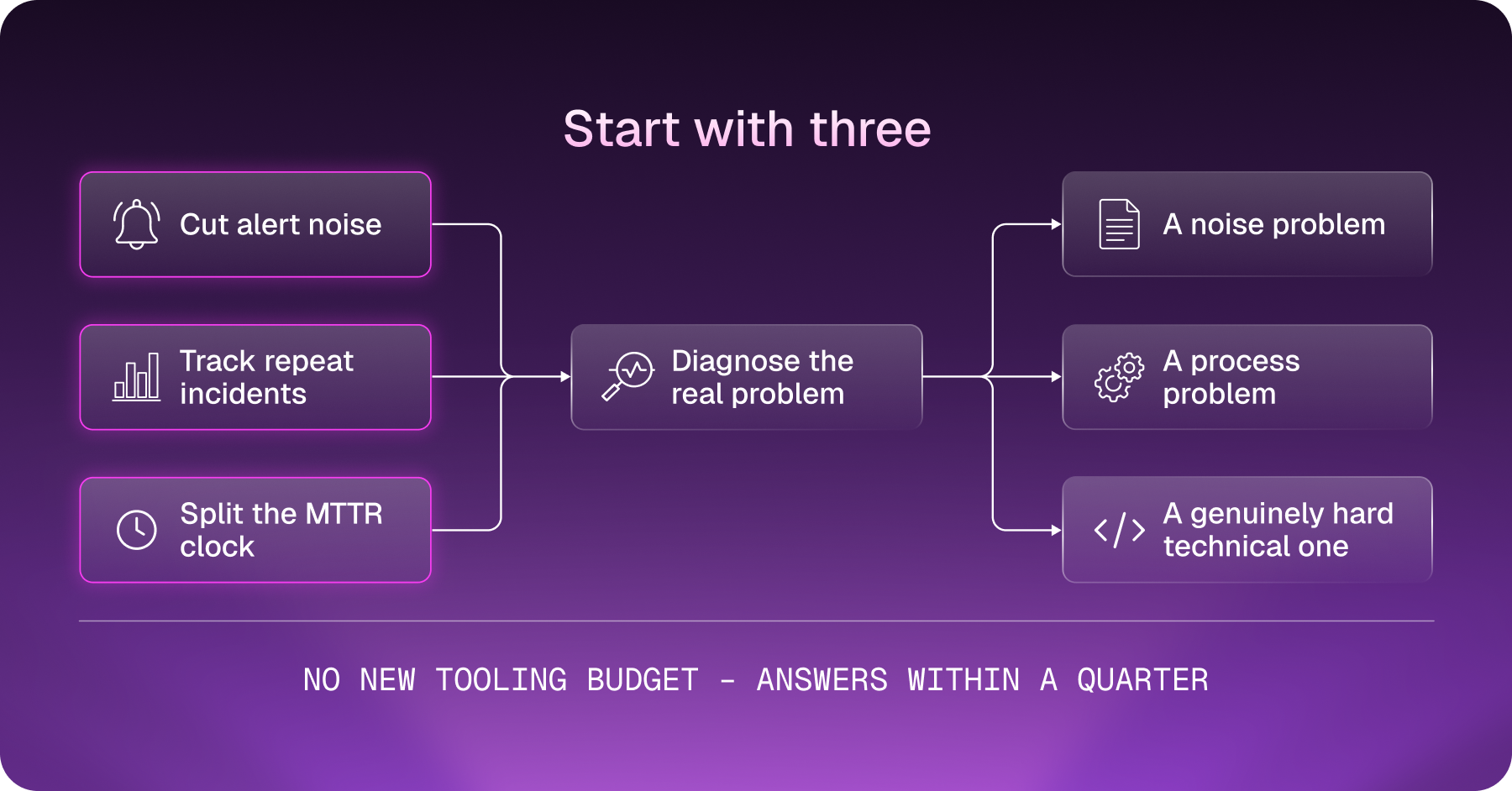
If you only act on three of these, act on alert noise, repeat incidents, and split the clock first. None require new tooling budget, and together they tell you within a quarter whether your MTTR problem is a noise problem, a process problem, or a genuinely hard technical one which determines what to invest in next.
How Does AI-Powered SRE Tooling Reduce MTTR?
Aiden for SRE, StackGen's AI-powered incident detection and remediation copilot, is built around the split-clock model in practice #5: it targets faster anomaly detection, automated triage and routing, and accelerated root cause analysis by correlating signals across logs, metrics, and traces in the exact segments where automation has the clearest payoff, before human judgment is needed on the long tail. It directly attacks the alert-noise and toil problem in practice #1 rather than adding another dashboard to check. Paired with ObserveNow's unified observability across metrics, logs, and traces, teams get a single pane of glass instead of context-switching between five tools mid-incident its own quiet MTTR tax.
FAQ: MTTR and SRE Best Practices
What is a good MTTR benchmark? There's no single good number; it depends on sector. Across StackGen's 2026 dataset of 80,743 incidents, the cross-industry median MTTR is 101 minutes, but sector medians vary meaningfully, so compare against your specific industry segment rather than an overall average.
What's the difference between MTTR, MTTD, and MTTA? MTTD (mean time to detect) measures how long until an issue is noticed. MTTA (mean time to acknowledge) measures how long until someone starts working it. MTTR (mean time to resolution) measures the full cycle from incident start to resolution, and includes both of the others.
What is "toil" in SRE, and why does it matter for MTTR? Toil is manual, repetitive operational work: triaging duplicate alerts, re-running the same diagnostic steps, chasing false positives that doesn't scale with system growth. High toil directly inflates MTTR because engineers spend time on noise instead of the incident, which is why alert-fatigue reduction (practice #1) is the highest-leverage starting point for most teams.
Can AI actually reduce MTTR, or is that just vendor claims? Publicly reported results suggest yes, specifically in the detection and triage segments. The long tail of novel, high-impact incidents still benefits most from experienced human judgment, which is why splitting the MTTR clock (practice #5) matters before deciding where to apply automation.
How often should teams re-benchmark their MTTR? Quarterly at minimum, alongside a postmortem action-item review. MTTR without the context of what changed since the last quarter is a number, not an insight.
Key Takeaways
MTTR isn't one number to chase it's alert noise, triage accuracy, and RCA discipline stacked on top of each other, with a long tail of hard incidents that need different tactics than the routine ones. Cut the noise, close the loop on repeat incidents, split the clock, and benchmark against your actual peers rather than an industry folklore number.
Want to see where your team actually sits? Schedule a demo to benchmark your MTTR against StackGen's State of Enterprise Reliability dataset, or try Aiden to see AI-powered detection and triage cut alert noise in practice.