

Share This:
If that sounds familiar, this guide is for you. The AIOps market has crossed $18 billion. Autonomous AI agents are rewriting how incidents get triaged, investigated, and resolved. Here's how to cut through the noise and choose the platform that fits your stack.
1. Why AI SRE, Why Now
Every new microservice adds 15 to 20 new alert rules. Nobody is removing the old ones. You know the result: dashboards that nobody trusts, on-call rotations that burn people out, and root cause analysis that turns into a days-long archaeology project across six disconnected tools.
This is not a staffing problem. It is an engineering problem that the industry has been too slow to address — until now.
 The math finally forces the issue. A single hour of production downtime costs enterprises an average of $2 million in lost transactions, SLA penalties, and recovery labour. The 2024 DORA State of DevOps Report found that elite-performing teams recover from incidents 7,200 times faster than low performers. That gap does not close with more headcount. It closes with intelligence applied at the point of failure.
The AIOps market reached $18.95 billion in 2026, growing at a 14.8% CAGR toward a projected $37.79 billion by 2031. SRE practices are now formalised at 48% of enterprises — up from 34% in 2023. AI-powered monitoring adoption moved from 42% to 54% between 2024 and 2025 alone.
2. What an AI SRE Tool Actually Does
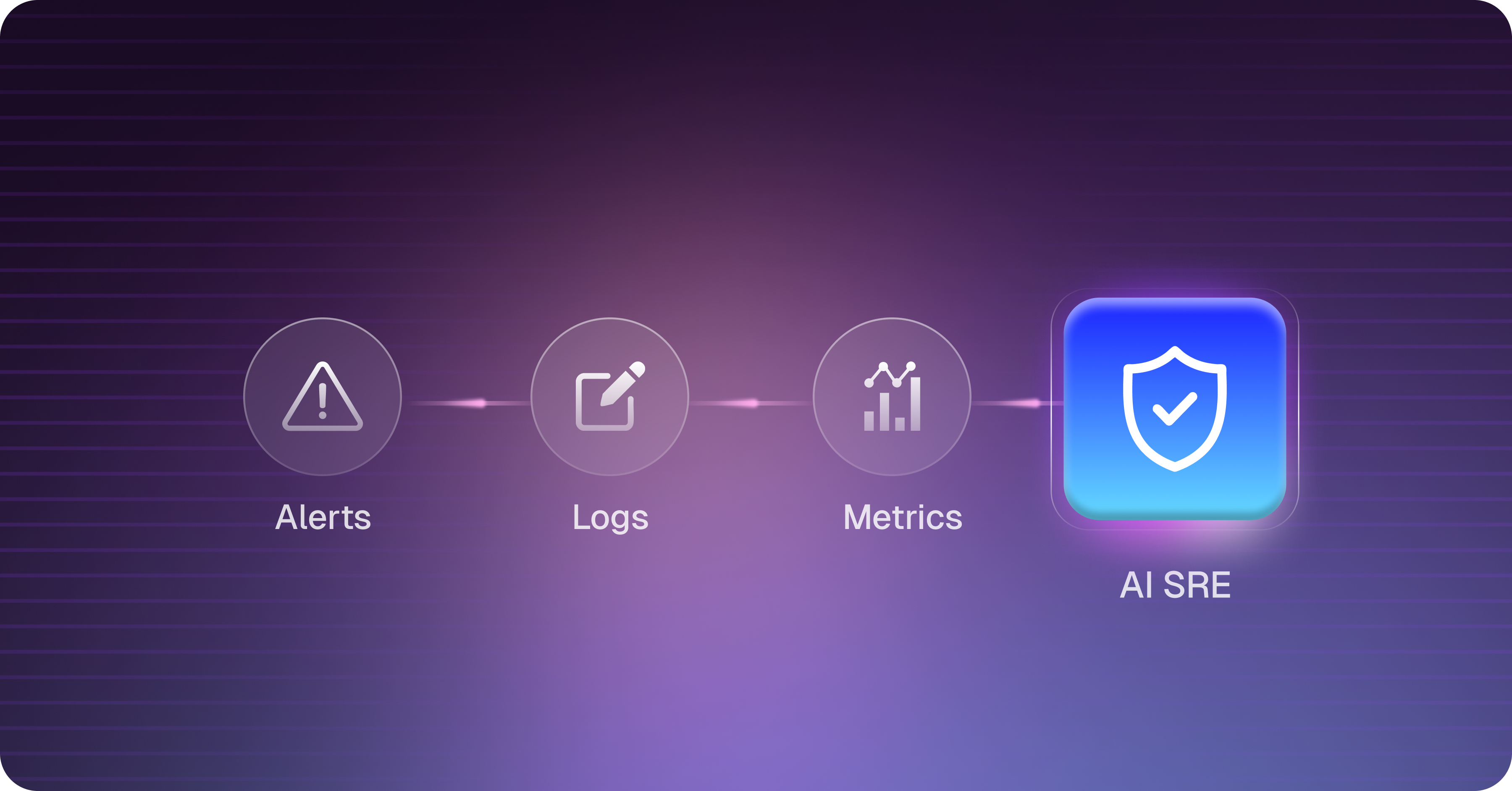
An AI SRE tool is software that uses artificial intelligence to automate site reliability engineering tasks — detecting issues, performing root cause analysis, triaging alerts, and in some cases suggesting or executing fixes autonomously. When an incident fires, a mature platform will:
- Correlate signals — suppressing duplicate alerts from Alertmanager, checking deployment history, classifying severity by blast radius and downstream impact
- Investigate across the full stack — querying logs, metrics, and traces; correlating timing with recent deploys, config changes, and Kubernetes rollout events
- Reason toward root cause — matching patterns against historical incidents, generating timeline reconstructions, 5-whys analysis, and evidence-backed RCA
- Recommend or execute remediation — rolling back deployments, scaling resources, toggling feature flags, restarting services — with full audit trails
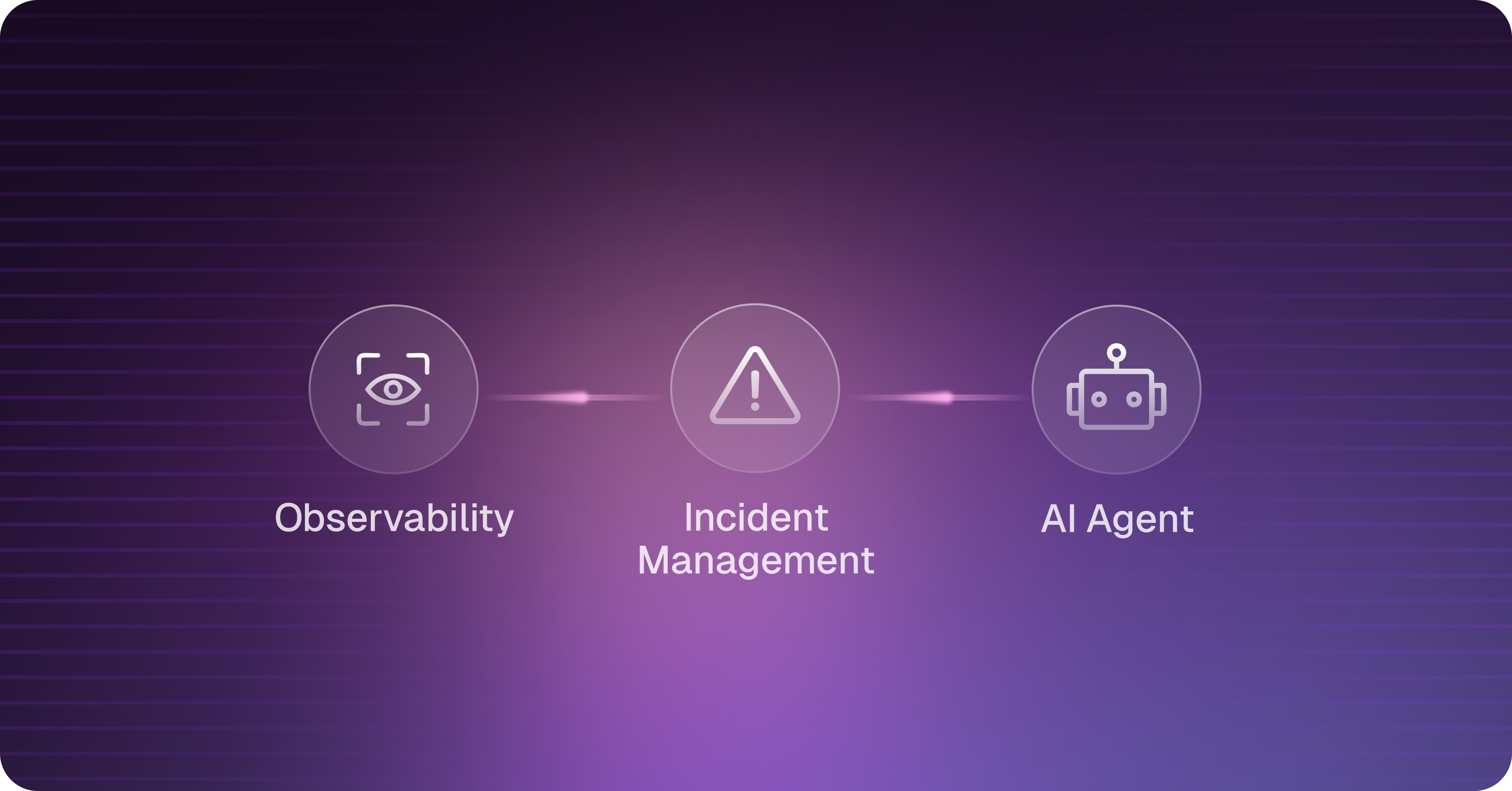
3. Three Categories of AI SRE Tooling
1. Observability Platforms with an AI SRE Layer
Tools like Datadog, Dynatrace, and New Relic built their moats on telemetry collection. Their AI SRE capabilities sit on top of native telemetry, giving rich signal breadth. Per-investigation pricing models of some platforms create cost exposure at scale. Ideal for teams already heavily invested in that observability ecosystem.
2. Incident Management Platforms with AI SRE
Rootly and PagerDuty own the incident and resolution history layer. Their AI draws on deep institutional knowledge about how your team has resolved past incidents. Best for teams where the bottleneck is coordination and knowledge retention, not investigation depth.
3. Standalone AI SRE Agents
Tools like StackGen's Aiden AI Copilot, Komodor's Klaudia, and Lightrun take an integration-first approach, working across your existing observability stack without requiring full data ingestion into a proprietary lake. Broader stack portability, with integration complexity compressed to under 30 minutes for modern platforms.
4. Top Platforms Compared
StackGen — Aiden AI Copilot [Recommended for Cloud-Native]
We built Aiden specifically to solve the problems keeping SREs up at night in cloud-native environments. When a Kubernetes pod starts crash-looping at 2 AM, Aiden does not wait for you to open a dashboard. It detects the cascading degradation, correlates it with the deploy event that triggered it, checks the GitOps history, and initiates a rollback — all before your on-call engineer has found their laptop. Our ObserveNow unified observability dashboard gives complete visibility from Kubernetes cluster health to application-layer latency — without rebuilding your existing Prometheus and Grafana investments.
💰 14-day free trial · No credit card required · Integrates in <30 min · 45% cost reduction vs. APM
Komodor — Klaudia AI [Kubernetes Specialist]
Klaudia is trained exclusively on telemetry from thousands of production Kubernetes environments, achieving 95% accuracy across real-world K8s incident resolution scenarios. It covers the full catalogue of cloud-native failure modes: pod crashes, failed rollouts, autoscaler friction, misconfigurations, and cascading failures. Uniquely, it folds cost optimisation into the SRE loop — treating cloud spend efficiency as a reliability outcome alongside uptime. Named a Representative Vendor in the 2026 Gartner Market Guide for AI SRE Tooling.
💰 Contact for pricing · Gartner 2026 AI SRE Market Guide
Dynatrace — Davis AI [Observability Platform]
Dynatrace's Davis AI is one of the most proven AI engines in the category, with documented customer results showing 60% MTTR reduction through distributed-trace analytics that map anomalies directly to affected user sessions. Alert compression rates of up to 95% have been documented via event deduplication and causality detection — practically eliminating the Alertmanager storm problem most SRE teams deal with daily.
💰 Usage-based pricing · Enterprise tier available
Datadog — Bits AI [Observability Platform]
Datadog's Bits AI is an AI SRE layer on top of the industry's largest observability ecosystem. It offers natural-language querying across logs, metrics, and APM data, plus automated investigation summaries and suggested runbook actions. In 2025, Datadog added LLM Observability — tracking token consumption, latency, and error rates in generative AI workloads. The per-investigation pricing (~$30/investigation) can produce bill shock when incident volume grows alongside your stack.
💰 ~$30/investigation + platform subscription
Rootly [Incident Management]
Rootly approaches AI SRE from the incident management angle. Its AI agents automate the full incident lifecycle — from initial Slack triage through post-mortem generation — and its institutional memory layer learns from every past resolution to improve future escalation routing and runbook suggestions. If your on-call rotation is the main driver of engineer attrition, Rootly's coordination layer will deliver visible returns faster than any observability-native tool.
💰 Team and Enterprise tiers · 14-day trial
Lightrun [Runtime Intelligence]
Lightrun's Runtime Context engine generates missing evidence on demand by interacting directly with live running services — without requiring redeployments. This directly addresses the gap where 44% of AI SRE failures stem from missing execution-level data: Thanos query latency, Elasticsearch JVM pressure, specific memory allocation paths — signals not in any pre-captured telemetry. Used by AT&T, Citi, and Salesforce. Launched February 2026, so track record at scale is still accumulating.
💰 Contact for pricing · Enterprise-focused · No public trial
5. Feature Comparison Table
6. Key Buying Criteria
1. Investigation Depth
Does the tool correlate signals from pre-captured telemetry, or can it validate actual execution behaviour in running services? For teams where Thanos query latency, Elasticsearch JVM pressure, or Kubernetes scheduler behaviour are common unknowns, this distinction determines whether the tool solves your actual problem.
2. Automation Maturity
There is a wide spectrum from 'suggests runbook actions' to 'executes bounded remediations with audit trails.' The trust-gradient model — start with AI-assisted investigation, expand to human-approved remediation, then bounded autonomous execution — is the safe and effective adoption path.
3. Integration Breadth and Setup Reality
Does the platform work with your existing observability stack without a rip-and-replace? Always ask vendors: what does a realistic integration look like for a team running Prometheus, Grafana, and PagerDuty? How long did the last comparable customer take to get value?
4. Governance and Auditability
For regulated industries under DORA or HIPAA, every AI action must be inspectable, attributable, and reversible. The EU's Digital Operational Resilience Act obliges banks to restore critical services within two hours, making audit trail completeness a compliance requirement.
5. Total Cost of Ownership
Per-investigation pricing models can produce bill shock when incident volume grows. Model your incident volume across a 12-month growth horizon before committing — not just current volume.
7. The Hidden Cost: On-Call Burnout and Knowledge Silos
When your two most experienced SREs leave — and they will, because the market for senior reliability talent never cools — they take with them years of institutional knowledge about your specific failure modes, your undocumented runbooks, your Slack threads from the outages nobody wrote post-mortems for.
AI SRE tools address this in two structural ways. First, they build institutional memory automatically — every incident investigation, every hypothesis tested, every remediation executed becomes training data that improves future responses. Second, they compress the knowledge required to handle a novel incident: a junior on-call engineer gets a fully-contextualised investigation summary with recommended next steps — not a blank dashboard and a phone tree.
8. Decision Framework: Which Tool for Which Team
9. Your AI SRE Evaluation Checklist
Use this during vendor trials. Any tool that cannot answer these questions concretely during a POC should not advance to procurement.
- Can the tool investigate a real incident from our own production data — not a synthetic demo environment?
- How does it handle incidents where the triggering signal was never captured in pre-existing telemetry?
- What is the model for human oversight — at what specific point does AI action require approval?
- What does the complete audit trail look like for an AI-executed remediation in production?
- How does pricing scale with incident volume over 12 months, modelled against our current growth rate?
- What integrations are required for our stack, and what was the actual setup time for the last comparable customer?
- How does the platform capture and resurface institutional knowledge for novel incident types?
- What happens when the AI service itself goes down — what is the vendor's SLA for the AI layer?
- Can a junior on-call engineer use this tool effectively for an incident type they have never seen before?
10. Conclusion
AI SRE has crossed the tipping point in 2026. The evidence base for MTTR reduction, alert noise compression, and cost efficiency is no longer theoretical — it is documented at scale, across enterprise environments, with named customers and published metrics. The tools are ready.
What still varies enormously is fit. A Kubernetes-native team and a hybrid-infrastructure enterprise are not buying the same product. A team whose primary constraint is on-call burnout and knowledge silos needs different tooling than a team whose constraint is investigation depth into Thanos query latency and Elasticsearch JVM behaviour.
The teams getting the most out of AI SRE tooling in 2026 share a common pattern: they started with a real incident, measured what the tool actually changed, and expanded automation gradually along the trust gradient. They solved one specific problem — alert noise, or MTTR, or on-call coordination — and let the results build the case for the next layer.
Start there. The rest follows.
See Aiden AI in a Real Incident
Don't take our word for it. Connect your existing observability stack, run a 14-day trial against your actual production data, and measure what changes in MTTR, alert volume, and on-call load. No credit card required.