

Share This:
You know the drill.
PagerDuty fires at 2:47 AM. You acknowledge, shake the sleep off, and pull up Datadog. The dashboard for the EU-west API gateway is a sea of red 5xx rate spiking, p99 latency through the floor. You flip to Grafana. Then, to your Kubernetes namespace. Then to the Confluence runbook that was last updated eleven months ago, by someone who left in Q3.
By the time you've assembled a working hypothesis — DB connection pool exhaustion, probably related to the deploy at 6 PM — it's been 90 minutes. Your incident channel has 140 unread messages. Someone from customer success has already pinged you.
This is not a skills problem. It's a context problem.
SREs aren't slow. The context they need to triage and resolve incidents is fragmented across a dozen systems Prometheus alerts, Kubernetes pod logs, deployment history in GitHub Actions, traces in Jaeger, change tickets in Jira, past incidents in PagerDuty and none of it talks to each other in real time. Every investigation starts from scratch. Every context switch costs minutes you don't have.
The Model Context Protocol (MCP) is the emerging standard that changes this. And with StackGen's MCP Server giving AI assistants direct access to your infrastructure lifecycle, from IaC generation to drift detection to incident remediation, teams are cutting MTTR by up to 30% and getting their SREs back to the work that actually requires them.
Here's what that looks like in practice.
What MCP Actually Is (and Why SREs Should Care)
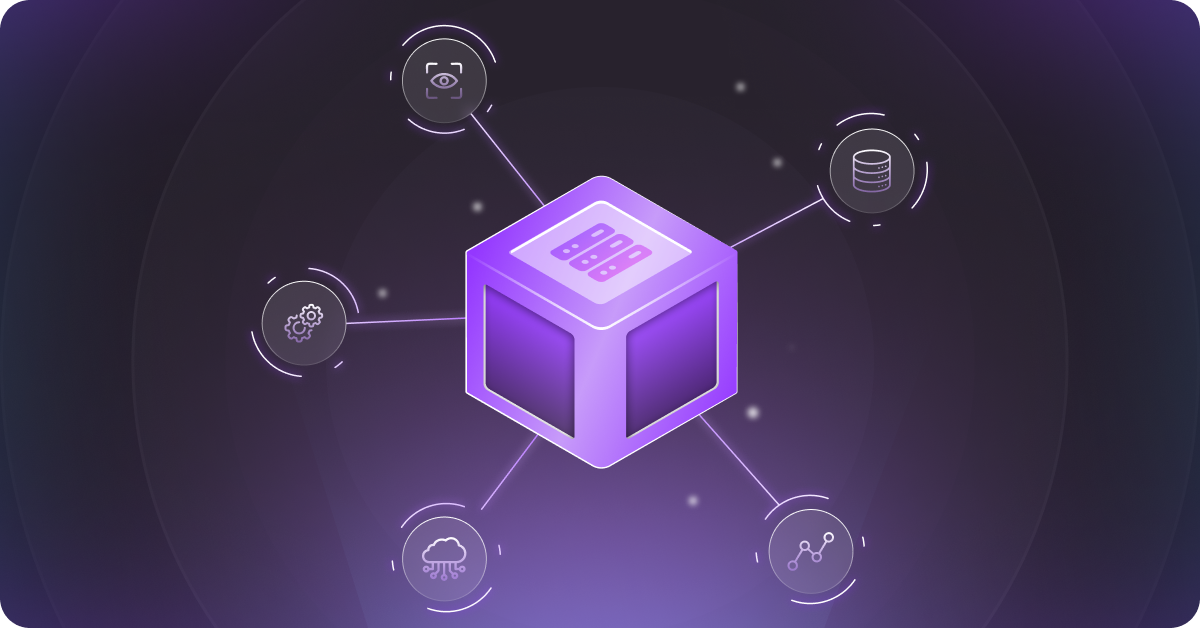
MCP is an open protocol developed by Anthropic and now adopted across the industry that lets AI agents communicate with external systems in a consistent, structured way. Think of it as a universal adapter: instead of every AI tool requiring a custom plugin for every service you run, MCP provides a single interface through which agents can discover capabilities, negotiate permissions, and take actions.
For SRE specifically, this matters because your operational surface is enormous. You're running Kubernetes clusters across AWS, GCP, or Azure. You have Prometheus and Alertmanager for metrics, Elasticsearch or Loki for logs, and Jaeger or Tempo for traces. You have PagerDuty for escalation, Jira for incident tracking, and GitHub Actions for CI/CD. When a P1 fires, context is scattered across every one of these systems.
.png?width=1200&height=628&name=1.%20What%20MCP%20Actually%20Is%20(and%20Why%20SREs%20Should%20Care).png)
MCP collapses that into a single semantic layer. An AI agent with MCP access can query "what's the SLO status for the payments service right now," fetch correlated traces from the past 30 minutes, check the last three deployments, and cross-reference similar past incidents in seconds, not minutes.
Critically, MCP doesn't mean unsupervised AI running loose in production. Servers control exactly what tools are exposed, permissions are scoped (read-only metrics vs. write access for scaling actions), and every interaction is logged for audit. You get the speed of agentic assistance with the governance your on-call process actually requires.
The Real Cost of Fragmented Context
Before getting into what MCP enables, it's worth being honest about what fragmented tooling costs.
Alert noise is the tax no one talks about. Teams commonly report 300-500 alerts per day. Fewer than 5% are actionable. The rest train your SREs to tune out until the one real incident gets missed because Alertmanager's deduplication rules weren't updated when you added that new microservice family in November.
Triage is archaeology. Root cause analysis for complex incidents averages 4-6 hours. The first 90 minutes of a P1 is typically spent agreeing on what's actually broken, not fixing it. RCA that follows is a week-long archaeology project: Slack threads from 3 AM, log exports, timeline reconstruction across tools that don't share a data model.
Knowledge dies in incidents. Even when your team resolves something fast, the context, the hypothesis that worked, the metric that was the real signal, and the exact sequence of steps evaporate into a Confluence page that nobody will read. The next SRE to hit the same failure mode starts from zero.
On-call burnout is the downstream symptom. It's not the hours, it's the chaos. It's waking up to a screen of uncontextualized alerts and having to manually reconstruct what matters. Teams report that on-call rotation is the #1 reason engineers leave. Not the pager volume. The feeling of fighting blind.
MCP addresses the root cause of all four: context fragmentation.
How StackGen MCP Server Changes the Incident Workflow
StackGen's MCP Server connects AI assistants Claude, VS Code, Cursor directly to StackGen's agentic infrastructure platform. It exposes 25+ tools spanning IaC generation, drift detection, policy enforcement, and incident remediation. Setup takes 5-10 minutes.
Here's what a real incident workflow looks like with it connected.
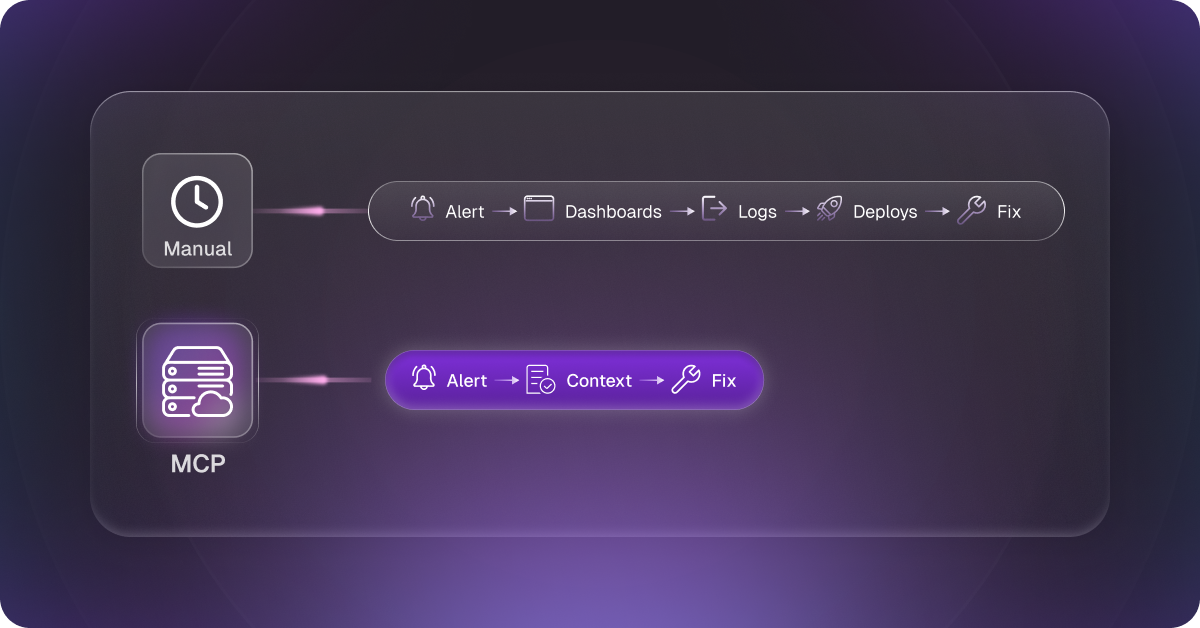
Before: The 2:47 AM Gauntlet
Time to first hypothesis: 60-90 minutes. Context assembled manually. Runbook possibly stale.
After: MCP-Connected Investigation
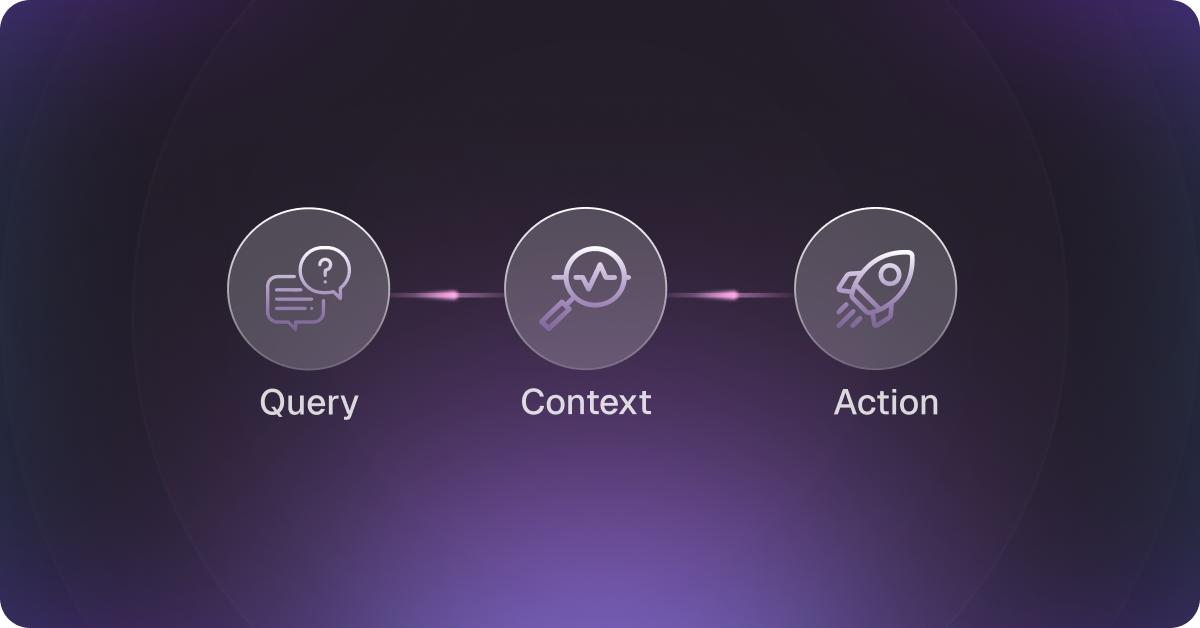
An SRE types into their AI assistant: "5xx spike on payments-api EU-west, started 23 minutes ago, help me triage."
The MCP client calls StackGen tools in sequence:
- get_incident_context → correlates current Prometheus alerts with service topology
- fetch_recent_deployments → surfaces deploy #612 at 18:03, touching the payments-service DB config
- query_similar_incidents → finds two prior incidents with matching fingerprint, both resolved via connection pool scaling
- run_diagnostics → confirms pool exhaustion, quantifies user impact (1.8% of EU sessions affected)
The agent returns: "High confidence: DB connection pool exhaustion triggered by deploy #612. Similar to INC-204 (March) and INC-187 (January). Recommended action: scale the connection pool to 150, monitor for 10 minutes. Estimated time to resolution: 8-12 minutes. Proceed?"
SRE reviews, approves, and executes remediation. Audit log captures every step.
Time to first hypothesis: under 5 minutes. Context assembled automatically. Every action traceable.
Five Areas Where MCP Delivers Measurable SRE Impact
1. Alert Triage — From Noise to Signal
Effective triage depends on correlation: connecting the raw alert to the service, the recent change, and the blast radius. Without MCP, that correlation is manual and slow. With MCP, an agent can cross-reference alert patterns with deployment history, topology data, and past incidents simultaneously.
Teams report:
- 30-50% reduction in triage time — hypothesis formed in 10-20 minutes vs. 30-60
- 25% de-duplication of alert volume — agents identify grouped failure modes that Alertmanager's static rules miss
- False positive rate cut roughly in half — better context means fewer "is this real" escalations
The specific signal SREs describe: instead of waking up to 40 unrelated alerts, you wake up to one enriched incident summary with a working hypothesis already formed.
2. Intelligent Runbook Execution
Runbooks are supposed to encode institutional knowledge. In practice, they're out of date within six months of being written, and the knowledge of which runbook applies to this incident lives in the head of the SRE who's been on the team longest.
MCP makes runbooks dynamic. Instead of a static document with steps to follow manually, an agent can:
- Identify the matching runbook or past resolution pattern from your incident history
- Execute the safe, read-only diagnostic steps automatically
- Propose (with your approval) the remediation steps, with policy guards applied
StackGen's Aiden for SRE surfaces this via the MCP server's heal_drift and run_diagnostics tools. Self-healing for known failure patterns completes in under 5 minutes. For novel incidents, the agentic flow provides structure and context rather than leaving an on-call engineer to reconstruct everything alone.
3. Governance That Doesn't Slow You Down
The fear with "AI taking actions in production" is legitimate. Scope creep, unvetted changes, insufficient audit trails — all real risks.
MCP's architecture is specifically designed to contain this. The server side controls exactly what tools are exposed. StackGen's MCP Server uses token-based authentication (STACKGEN_TOKEN), and every action logs a full JSON record: what was called, what was returned, what was applied. You configure which tool classes require human approval before execution. The AI proposes; humans approve.
This matters for compliance, too. SOC 2 and HIPAA audit trails are built into the interaction log rather than reconstructed after the fact. The change record isn't "SRE did something around 3 AM" — it's a timestamped, structured record of every query and action with full inputs and outputs.
What teams report: 25% reduction in infrastructure misconfigurations, and more importantly, a shift from ad-hoc production changes to governed, auditable workflows.
4. Postmortems That Actually Prevent the Next Incident
Here's an underappreciated benefit: MCP doesn't just improve incident response. It improves everything that happens after.
Because every tool call, diagnostic query, and remediation step is captured in the MCP interaction log, postmortem timelines are generated automatically. You don't reconstruct from memory and Slack. You have a structured, accurate record of exactly what happened, in what order, and what worked.
More importantly: those structured records become reusable context. Future incidents can query, "find similar incidents to this signature and surface the resolution steps that worked." The knowledge doesn't die in a doc — it becomes findable by the agent handling the next 2:47 AM page.
The result SREs describe: postmortems that used to take a full day now take an hour. Follow-up action items are generated from the structured log rather than argued about in a review meeting.
5. Continuous Cost and Capacity Optimization
SRE's scope has expanded. Teams now own reliability and FinOps-adjacent work: ensuring infrastructure is right-sized, that scaling policies match actual traffic patterns, that you're not running five over-provisioned nodes because someone set a floor in 2022 and nobody revisited it.
MCP gives agents continuous access to the joined context needed for this: runtime utilisation metrics, billing data, scaling history, and SLO baselines all at once. Instead of waiting for a capacity incident to force a conversation, agents can surface optimisation opportunities continuously: right-sizing recommendations, scheduling proposals, and architecture concerns with cost implications.
StackGen teams report 15% average infrastructure cost reduction when MCP-connected agents have continuous visibility across both reliability and cost signals. The insight isn't new — your monitoring tools have the data. The bottleneck has always been someone having time to correlate it.
Setting Up StackGen MCP Server
Setup is intentionally minimal.
For VS Code:
Restart VS Code. Type "fix drift in prod cluster" or "triage the current 5xx spike." The tools are available immediately.
For Claude CLI:
From there, natural language queries in your IDE map directly to StackGen's 25+ infrastructure tools. IaC generation, drift detection, policy enforcement, and incident remediation — all accessible without switching context out of the environment you're already working in.
Getting Started: A Four-Week Adoption Path
Week 1 — Identify your highest-pain incident patterns. Look at your last 30 days of PagerDuty data. Where did the investigation take the longest? Which runbooks are most out of date? Which failure modes have recurred? These are your pilot candidates. Connect the StackGen MCP Server to one AI assistant and start with read-only diagnostic queries.
Week 2 — Prototype on 1-2 incident patterns. Pick the recurring failure modes from week 1. Build the MCP-connected investigation flow for each: what context does the agent need, what diagnostic steps should it run, and where does human approval sit in the flow?
Week 3 — Add governance and integrations. Define your approval policies: which actions are auto-approved for read-only, which require human confirmation before write operations. Integrate PagerDuty and Jira so incident context flows in both directions. Test your audit log completeness.
Week 4 — Measure and scale. Instrument MTTR for MCP-assisted vs. manual incidents. Measure alert-to-hypothesis time. Run a postmortem comparison: structured log reconstruction vs. traditional memory-and-Slack approach. Use the data to make the case for broader rollout.
What SREs Get Back
The real value of MCP isn't the 30% MTTR reduction, though that's real and measurable. It's what your SREs get to do with the time they recover.
When investigation is agentic and context assembly is automated, experienced engineers stop spending 60% of their time on work a well-written runbook could handle. They start spending that time on the things that actually require judgment: SLO refinement, capacity architecture, reliability strategy, mentoring junior engineers, and preventing the next incident instead of just surviving the current one.
That's the shift from reactive reliability to proactive reliability. MCP is the infrastructure that makes it tractable.
Start Here
Explore Aiden for SRE to see the full set of incident and infrastructure tools available through StackGen's MCP Server. The free tier includes MCP access — setup takes 10 minutes, and you can run your first agentic triage against a real incident pattern the same day.
Your next 2:47 AM page doesn't have to start from scratch.