

Share This:
Agentic AI is crossing a threshold. For the past two years, most enterprise AI projects were bounded: a model answered questions, a human reviewed the output, and nothing happened autonomously. That boundary is dissolving. Agents now plan multi-step workflows, invoke tools, write to systems of record, trigger approvals, and take real-world actions with or without a human in the loop for each step.
This shift is creating a new category of security problem, and the industry is beginning to respond. In early 2026, NIST's Center for AI Standards and Innovation issued a Request for Information asking developers, deployers, and security researchers how autonomous AI systems should be secured. The responses, including detailed submissions from major cloud providers, are shaping what will become the first generation of industry standards for agentic AI security.
Those responses are important and worth reading. But they are largely written from the perspective of cloud infrastructure providers: how to secure the model execution environment, the underlying compute, the network boundary, and the authentication layer. That framing is correct as far as it goes. AWS's published principles, for instance, provide sound architectural guidance for organizations building agentic services on cloud infrastructure.
The enterprise operator, however, faces a different version of the problem.
When agents move from sandboxed environments into production enterprise workflows, touching CRM records, triggering provisioning requests, coordinating across teams, handling sensitive data, the security challenge shifts from “how do we secure the infrastructure running the agent” to “how do we ensure the agent behaves correctly, consistently, and within policy across thousands of actions we can’t individually review.” That is an operations problem as much as an infrastructure problem. It requires what we call an agentic harness: the structured layer of governance, policy enforcement, and workflow formalization that constrains agent behavior without removing its capability, the way a harness enables work while preventing falls.
What follows is our attempt to articulate those principles: five foundations for securing agentic AI in the enterprise, grounded in the realities of production deployment rather than infrastructure design.
The failure modes enterprises actually encounter
Before the principles, the context. Most discussions of agentic AI security focus on adversarial attacks (e.g., prompt injection, model manipulation, supply chain compromise, etc). These are real risks. But in enterprise deployments, the failures we see most often aren't adversarial. They are structural:
- Policy gaps. An agent executes a workflow that is technically correct but violates a policy that exists only informally. No one encoded it. The agent had no way to know. Approval gates that existed in human judgment simply aren't present.
- Brittle execution. Retries, error handling, and fallback behavior are ad hoc. An agent that fails halfway through a multi-step workflow can leave systems in inconsistent states with no reliable recovery path.
- Improvised behavior. The safest, most compliant way to run a given workflow lives in the head of one engineer or in an informal Slack thread. The agent fills the gaps with inference. Inference at machine speed, across thousands of executions, is unpredictable—and unpredictability is a security property.
The bottleneck is not model capability. It is enterprise-grade execution: the governance structures, workflow formalization, and deterministic controls that make autonomous action trustworthy at scale. In other words, it is the absence of a well-designed agentic harness.
These are not hypothetical scenarios. Researchers at Palo Alto Networks have shown how a deployed AI agent could potentially be weaponized by an attacker. and manipulated to perform privilege escalation and data exfiltration of projects running on a major cloud provider's AI engine through the attack surface created by excessive permissions at deployment time.
Principle 1: Apply secure development lifecycle practices to all components, including workflow definitions
A sound, secure development lifecycle for agentic systems must cover three categories of components, not two.
The first two are well-understood. Traditional software components (APIs, databases, orchestration logic) require the established practices: code review, static analysis, dependency scanning, and threat modeling. AI components (foundation models, prompt templates, retrieval pipelines) require additional rigor: behavioral testing, adversarial evaluation, and continuous monitoring, because probabilistic systems cannot be validated by regression testing alone.
The third category receives less attention: workflow definitions, the runbooks, playbooks, and skill templates that encode how an agent is supposed to behave in a specific context.
These are not static artifacts. They evolve as teams refine agent capabilities. They are typically informal. And they carry security implications that are invisible until something goes wrong. When workflow logic lives in informal documents, Slack threads, or institutional memory, agents fill the gaps with inference. An agent told to "handle incident escalations" without a versioned, audited playbook will improvise, and the improvisation may satisfy the model's criteria for correct behavior while violating a compliance requirement the security team cares about.
The SDL extension for agentic systems, therefore, includes version control and review processes for workflow definitions, behavioral testing against known-good workflow traces, and drift detection when agent behavior deviates from versioned baselines.
Tribal knowledge is a security vulnerability. Formalizing organizational know-how into versioned, testable, auditable workflow definitions is security work.
Principle 2: Traditional security controls apply, and their blast radius is larger
Agents inherit the full attack surface of traditional software. Privilege escalation, confused deputy issues, code injection at tool boundaries, session hijacking, and supply chain compromise all extend directly into agentic systems. This is not a new insight, but it bears emphasis because agentic architectures can make these risks feel secondary to "AI-specific" concerns.
What genuinely changes in agentic contexts is blast radius.
Human operators naturally pause. They escalate when something seems unusual. They have intuition for "this doesn't feel right." Agents do not hesitate. An agent operating with excessive privileges will exercise those privileges completely, consistently, and at machine speed. The same excessive permission that a human might never use in practice becomes a reliable attack surface when an agent is operating autonomously.
Three traditional controls deserve particular emphasis:
- Least privilege is non-negotiable. Agents should be granted access to the specific tools, APIs, and data required for a defined set of workflows, nothing more. Broad-scoped permissions that would be acceptable for a human operator are a significant risk for an agent that does not self-limit.
- Tenant and session isolation is a first-class requirement. Multi-tenant agentic systems must prevent cross-tenant data leakage, not just at the data layer but at the execution layer. Each agent session should run in an isolated environment where it cannot observe the state from concurrent sessions.
- The supply chain surface is broader. Agentic systems consume foundation models, plugins, tool servers, and external data retrieval sources in addition to third-party code. Each is a supply chain surface. Agents that generate code or interact with external APIs create injection surfaces at tool boundaries that require explicit validation.
Principle 3: Security enforcement belongs outside the agent's reasoning loop
This is the most important architectural principle for enterprise agentic AI, and it requires being stated plainly.
LLMs cannot enforce security boundaries. They can be instructed to refuse certain requests, but prompt injection and adversarial inputs can override those instructions. They can be told to respect access controls, but they have no reliable mechanism to enforce them. Security policies expressed as prompts like "never take action on production systems without approval," "always confirm with the user before deleting records" are aspirations, not controls.
The failure mode here is subtle. A well-aligned model will follow these instructions in the vast majority of cases. This creates confidence. But the long tail of cases, such as edge cases, adversarial inputs, and novel situations the designer didn't anticipate, is precisely where security controls matter most, and it is where prompt-based constraints are least reliable.
The security enforcement mechanism must be external to the agent, deterministic in its operation, and comprehensive in its coverage. Every interaction between the agent and the outside world should pass through it. Model manipulation cannot bypass it.
In practice, this means:
- Access control is enforced at the infrastructure level, not by agent judgment. If an agent shouldn't write to a production database in a given workflow, that permission doesn't exist it isn't merely instructed not to use it.
- Policy gates intercept tool calls before execution. An agent attempting to send an external communication, provision a resource, or modify a high-value record hits a policy gate that evaluates the action against explicit, deterministic rules down to individual parameters, not just API-level access. Policy languages such as Cedar and OPA are well-suited to this role being formally specified, auditable, and capable of expressing fine-grained constraints down to individual tool parameters without relying on model reasoning.
- Approval workflows are enforced, not suggested. For actions above a defined risk threshold, a human-in-the-loop approval requirement is imposed by the system architecture, not deferred to the agent's courtesy.
The governance layer that wraps agent execution is itself a security control, and it is the core of what we mean by an agentic harness. Its integrity is as important as the model’s alignment. These are separate concerns and must be treated as such.
Principle 4: Formalize what agents know before you deploy them
Most agentic security discussions focus on what agents can do. The harder problem, in practice, is what agents know—whether the procedures they follow accurately reflect how your organization wants work to be done.
An agent executing an incident triage workflow needs accurate, complete knowledge of: which logs to gather, how to classify severity, which team to route to based on affected system and time of day, when to escalate versus handle autonomously, what the documentation requirements are for compliance, and which exceptions to the standard procedure are recognized. If any of that knowledge is missing or wrong, the agent will fill the gap; and the fill may be technically coherent while being operationally, legally, or policy-incorrectly wrong, consistently, across thousands of executions.
The security implications of poorly-specified workflow knowledge include incorrect escalation routing, missing approval steps for exception conditions, mishandled data due to absent privacy guidance, and inconsistent behavior across runs because procedures weren't deterministic.
The control here is workflow formalization before deployment:
- Capturing expert behavior, including rules, exceptions, and edge cases, not just happy paths
- Making workflow knowledge versioned, reviewable, and auditable
- Distributing approved workflow definitions with access controls and rollback capability
- Treating a workflow definition update as a change that requires review, not an informal edit
Agents should be taught. Teaching should be a controlled process. The organizational know-how that makes a workflow safe to automate is an asset that requires the same governance discipline as the code that runs it.
Principle 5: Earn expanded autonomy through evidence, and scope oversight correctly
Every agentic deployment faces the same calibration question: where should the agent act autonomously, and where should a human make the final call?
The right answer begins conservative and expands based on demonstrated performance. High-consequence actions such as writes to production data above a defined scope, financial transactions above a threshold, external communications containing sensitive information, and access provisioning for privileged roles start with human approval. The agent recommends; a human decides. Over time, as the evidence base shows sustained alignment between agent recommendations and human decisions, autonomy expands for those specific operation types.
But this progression creates a well-understood failure mode if not designed carefully. If every consequential action requires human approval, the volume of decisions overwhelms reviewers. Review becomes reflexive. Humans approve without genuine evaluation. You have not added security; you have added liability and security theater.
The design principle is: scope human oversight to decisions where human judgment genuinely adds value. This means:
- Defining consequence thresholds explicitly at design time. What constitutes a high-consequence action is a policy decision, not an agent decision.
- Building the evidence base systematically. Record what the agent recommended, what the human decided, and what actually happened. The path from oversight to autonomy runs through data, not time.
- Making autonomy expansion specific. An agent that has earned autonomy for incident severity classification has not earned it for financial reconciliation. Expansion happens at the operation type level.
- Treating regression as normal. Reintroducing human oversight when behavioral drift or unexpected outcomes are detected is the system working correctly, not a failure.
- Maintaining permanent boundaries. Some action categories remain gated regardless of demonstrated performance, because the consequence of an error is unacceptable under any reasonable risk analysis. These boundaries are enforced at the infrastructure level.
From principles to architecture
These five principles translate into a specific set of architectural components for enterprise agentic AI. Together, they compose the agent harness:
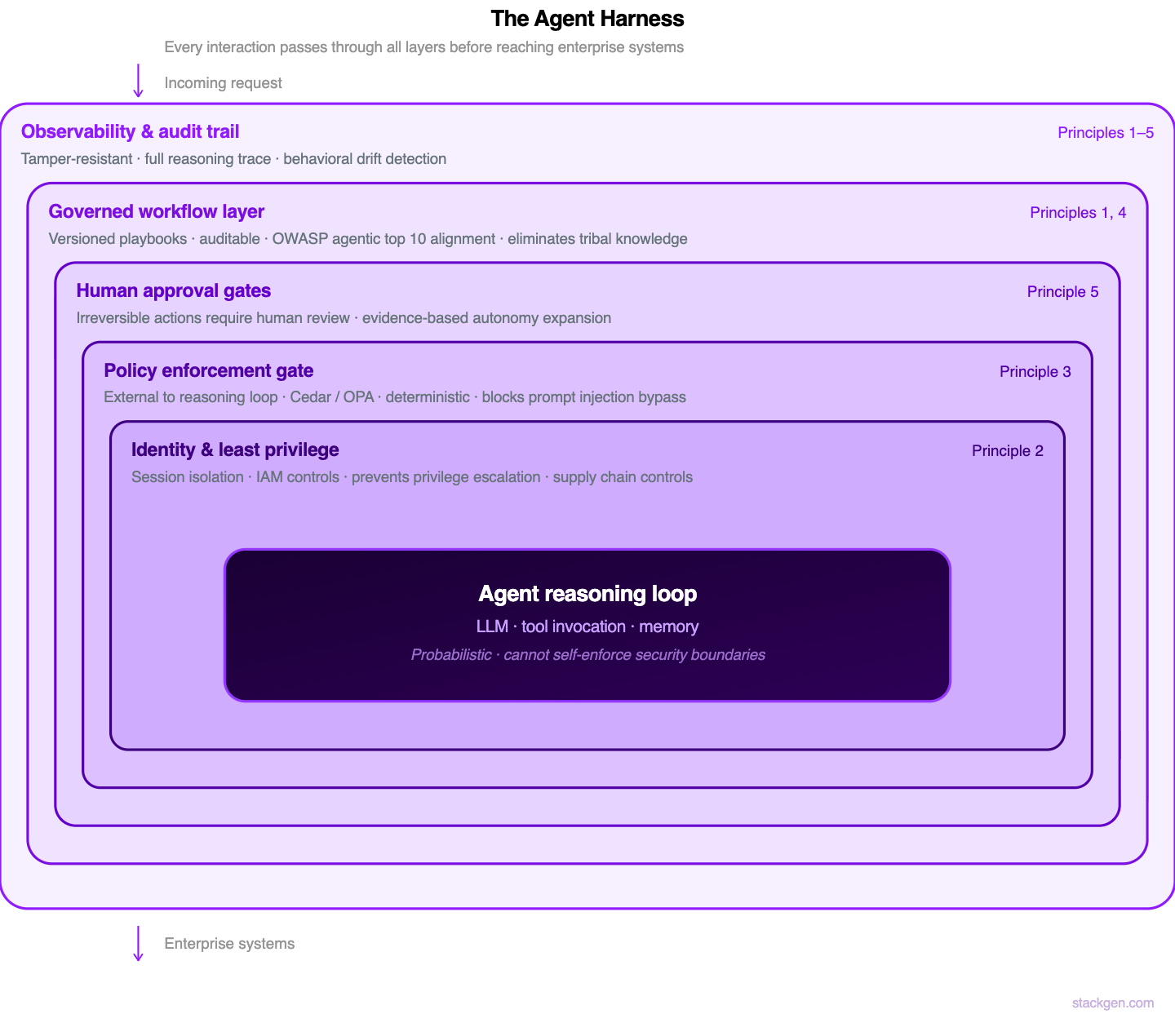
The following five components map to the diagram layers above, reading from the innermost layer outward:
- An isolated execution runtime (Identity & least privilege) provides session-level isolation, deterministic policy enforcement, and tool-access controls that are external to the agent's reasoning loop. Every agent action is policy-bound and observable. Agents cannot observe the state from other sessions.
- A guardrail plane (Policy enforcement gate + Human approval gates) intercepts tool calls before execution and enforces approval requirements for high-consequence actions. This layer is architecturally separate from the agent; it cannot be bypassed by model behavior.
- A governed knowledge layer (Governed workflow layer) stores versioned, auditable workflow definitions, the formalized organizational know-how that agents execute against. This layer is maintained like software: with review, versioning, access controls, and rollback. An update to a playbook is a change event, not an informal edit.
- Comprehensive observability (Observability & audit trail) captures the full trace of agent reasoning and action: not just logs, but the context that makes those logs interpretable and auditable. This infrastructure is protected from the agents it monitors, for the same reason employees cannot edit their own audit logs.
- Behavioral testing and drift detection (also Observability & audit trail) , model updates, workflow changes, and new tool additions as events requiring re-evaluation. Behavioral drift is a security property. The evaluation is ongoing, not a one-time gate.
None of this is conceptually new. Isolation, least privilege, immutable audit trails, policy-as-code, change management—these are established practices. What is new is applying them to a system where the actor is an AI reasoning engine operating at machine speed, and where the workflow definitions governing behavior require their own security controls alongside the code.
The operating layer is the security layer
The infrastructure layer matters. Model alignment matters. The cloud security primitives that providers have documented matter.
But for the enterprise operator deploying agents across real workflows, workflows that touch customer data, financial systems, access controls, and production infrastructure, the security challenge is ultimately an operations challenge.
Agents that act autonomously on enterprise systems must be taught correctly, governed consistently, and constrained deterministically. The agentic harness that makes this possible, the versioned workflow definitions, the policy enforcement layer, the approval gates, and the behavioral monitoring are not features layered on top of security. It is the security.
The organizations that get agentic AI right in the near term will not be those that find the best model. They will be those who build the agentic harness with the same rigor they apply to the software it runs alongside.