

Share This:
The AWS Kiro developer's problem
For an AWS team standardizing on Kiro, the pattern is familiar: developers want to spin up infra on demand, but platform and security teams need control over what gets deployed, where, and under which guardrails. Without the right abstraction, this becomes ticket-driven "DevOps as a service," with long back-and-forth cycles every time someone wants a new SNS topic, ECS service, or Bedrock-backed microservice. AI-assisted IDEs like Kiro help developers author code faster, but they don't by themselves encode your AWS guardrails, environment conventions, or cost constraints.
StackGen is designed to close that gap: it lets platform engineers define reusable Terraform-based building blocks and governance policies once, then makes them safely consumable through Kiro as a Power. If you're already familiar with how StackGen's MCP server connects AI tools to your infrastructure lifecycle, the Kiro Power builds directly on that foundation.
The result is a Kiro experience where a developer can ask "deploy this as a notification service on AWS" and get a compliant, production-grade app stack, without needing to know VPC layouts, subnet IDs, or internal platform rules.
What StackGen actually is
What StackGen enables: prompt to new cloud infrastructure resources in under 5 minutes.
From an AWS and Kiro user's perspective, StackGen is an infrastructure lifecycle management platform, with cutting-edge agentic workflows and configurable governance. In StackGen, platform teams model reusable infrastructure, policies, and environments that application developers can provision easily.
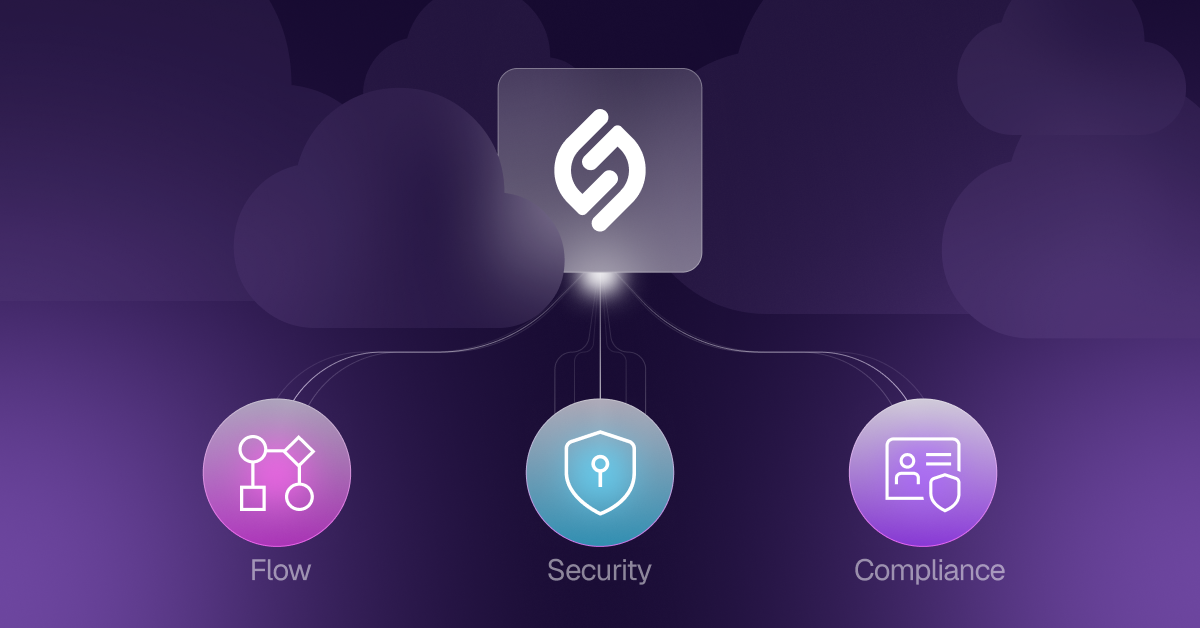
Key elements include:
- A visual flow builder to model AWS resources (for example S3 buckets, ECS services, networking primitives) and generate Terraform or OpenTofu code. You can also import your own custom Terraform modules — including Kiro-generated ones.
- A central policy engine where you encode security and compliance rules — such as "no public S3 buckets," "enable encryption on route tables," or FedRAMP/GDPR/HIPAA-driven constraints.
- A compliance dashboard that evaluates Terraform/IaC against those rules and surfaces violations per resource.
StackGen's policies are designed to be enforced and remediated automatically, including via agents within Kiro. That enforcement capability is what makes it a natural fit as a backend to a Kiro Power: the agent can ask "what did I violate?" and "fix this plan to comply," then regenerate the appStack accordingly. For a deeper look at why governance matters as much as the code generation itself, see Why AI-Generated Infrastructure Without Governance Is a Risk.
Governance-first infra for AWS
Platform engineers define policies once in StackGen or import them via integration with tools such as Wiz, and those policies automatically apply to every appStack created, regardless of whether it was drawn in the UI, pushed through CI, or generated from Kiro.
Examples include:
- Ensuring encryption is enabled on sensitive resources such as route tables and storage.
- Preventing S3 buckets from being exposed to the public internet.
- Encoding regulatory regimes — FedRAMP, GDPR, HIPAA — into concrete IaC checks.

When Kiro (via the StackGen Power) generates Terraform for a new AWS application, StackGen automatically runs those policies and returns any violations. The agent can then retrieve "current violations," adjust the appStack, and resubmit until there are no violations visible in the compliance dashboard as "no violations detected." This gives Kiro developers a "secure by default" experience: anything they deploy through StackGen already conforms to your AWS platform's rules. The same governance engine powers the StackGen + HCP Terraform integration for teams who want enterprise state management alongside it.
Reusable Terraform building blocks via resource packs
At the heart of StackGen's integration with Kiro is the concept of a resource pack — a hardened, reusable Terraform module encapsulating a particular infrastructure pattern. Platform engineers define and approve these resource packs in StackGen (for example, an "SNS fan-out notification service" or an "ECS Fargate microservice"), and then expose them to Kiro.
When prompted, the Kiro agent inspects the repository (reading Dockerfiles, server code, etc.), realizes it needs a notification service, and discovers a StackGen "SNS fan-out" resource pack it can reuse. Once the developer approves, the Power calls StackGen to:
- Instantiate the appropriate resource pack for the chosen environment (say, an AWS dev space).
- Fill in application-specific parameters such as cluster name, task definitions, and subnet IDs.
- Ensure the resulting Terraform respects all configured governance policies.
For AWS Kiro users, this shifts infrastructure from "write Terraform by hand" to "compose from curated resource packs," without leaving the IDE. It lets developers benefit from platform engineering work-hardened modules, security guardrails, guardrails on Bedrock access, cost limits, while staying in a conversational, code-centric workflow. This pattern is also documented in detail in the StackGen MCP + Cursor walkthrough for teams already using that workflow.
A day in the life: Kiro + StackGen for AWS
A typical flow illustrating how Kiro and StackGen work together for AWS deployments:
- A platform engineer uses StackGen's visual builder and policy system to define environments — say, a "dev" AWS account — and infrastructure resource packs. They configure AWS access for that environment inside StackGen so that app stacks can be deployed with one click.
- In Kiro, the team installs the StackGen Power, which wraps StackGen's MCP server and exposes a set of tools (API calls) to the Kiro agent.
- A developer, inside Kiro, writes or opens an application — e.g., a notification microservice and issues a natural-language prompt like "deploy this as a notification service on AWS using the StackGen Power."
- The Power orchestrates a series of steps: scans for an existing app stack, reads Dockerfiles and application code to infer infra needs, selects appropriate StackGen resource packs (e.g., SNS fan-out), uses the AWS CLI to pull details like subnet names in the right region, and creates an app stack in StackGen populated with those modules and parameters.
- StackGen immediately runs governance checks on the generated Terraform. If any policy violations appear, the agent can query them and regenerate a compliant version. The full Kiro integration page documents the supported tools and outcomes.
- From StackGen, the team can then deploy the AppStack into the configured dev environment on AWS, push the Terraform to Git for human review, or consume it via StackGen's CLI within an existing CI/CD pipeline.
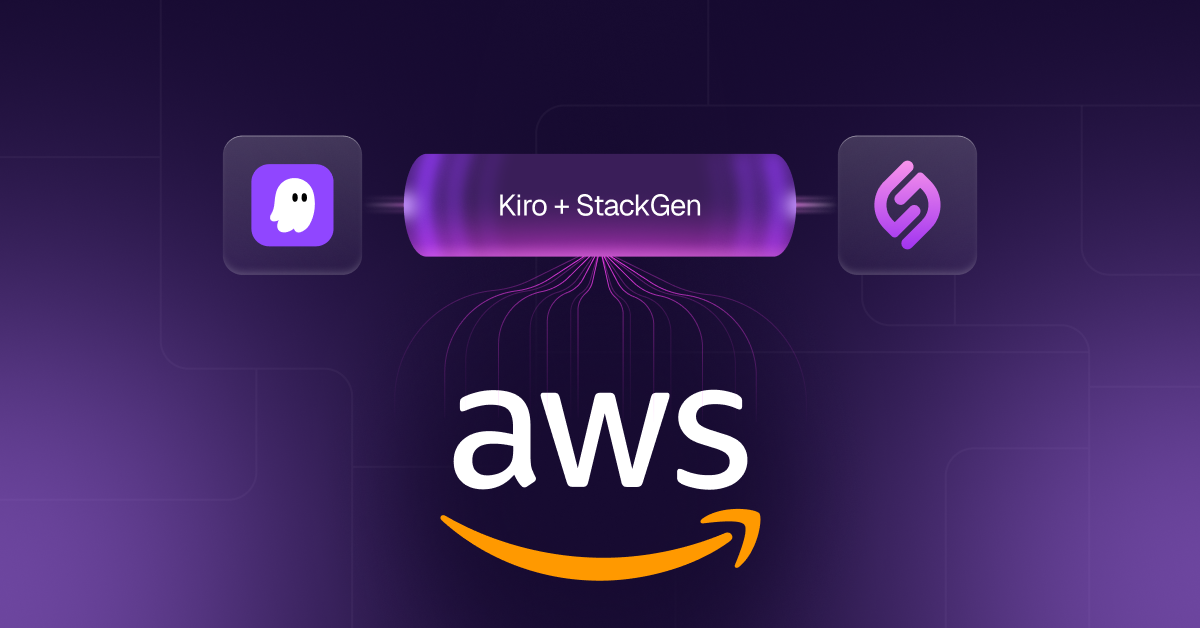
This workflow gives developers an end-to-end path from code in Kiro to running AWS infrastructure under platform-defined guardrails, with minimal friction. It's the same principle described in our broader look at MCP servers as the missing piece in every platform engineer's toolchain.
Personas and organizational fit
StackGen's Kiro Power explicitly targets key overlapping personas in platform engineering, DevOps, and SRE, with the primary focus being on enhancing the platform engineering and application developer relationship.
- Platform engineers use StackGen to define environments, resource packs, policies, and compliance baselines — effectively encoding how AWS "should" look for their organization.
- Developers, often not deeply versed in infrastructure, interact with those definitions indirectly through Kiro, gaining a streamlined "just deploy this" experience that still lands on approved patterns.
For a broader view of the AI-powered tools across this space, see Top AI-Powered Tools for Infrastructure Management in 2026.
Why this matters for AWS Kiro users
For existing or prospective Kiro customers, the StackGen Power provides three main advantages on AWS:
- Governed self-service: Developers get AI-powered, one-prompt provisioning of AWS infrastructure, but everything remains constrained by StackGen's policy engine and resource packs.
- Reduced ticket ops: Instead of back-and-forth between developers and DevOps/SecOps about VPCs, S3 policies, or Bedrock access eligibility, those decisions are codified once and reused programmatically by the Kiro agent.
- Flexible delivery paths: Whether your team prefers 1-click deploys from StackGen, Git-centric workflows with human review, or CLI-driven CI/CD pipelines, the same app stacks and policies apply.
This combination has already drawn interest from joint customers, who use StackGen in production and also have a significant Kiro user base.
Check out the Kiro Power by StackGen
StackGen has finalized the StackGen Power and published it in the Kiro Powers Registry, which will make it discoverable directly from the Kiro IDE and on Kiro.dev. Check it out today — or explore the StackGen MCP Server page to see the full range of infrastructure lifecycle tools available to your team.